
We may earn a commission when you buy through links on this page, at no extra cost to you. Learn more
Choosing the best filament 3d printer for beginners is less about chasing the highest speed and more about reducing setup frustration. Automatic leveling, enclosed designs, simple controls and dependable filament feeding can make the difference between an enjoyable first project and a failed print.
This list includes complete FDM printers as well as beginner-friendly PLA filament bundles. The printers suit different priorities, from family-safe creative projects to fast everyday printing, while the filament options provide small amounts of color for testing, crafts and learning.
Pay attention to whether you want a ready-to-use machine, multicolor capability or affordable material for practice. A printer with easy automation may be worth paying more for, while compact filament bundles can help newcomers experiment without committing to full-size spools.
| Product | Title | Key Features | Price |
|---|---|---|---|
 |
#1Best Overall FlashForge Adventurer 5M Brand: FLASHFORGE
|
|
Check Latest Price |
 |
#2Best for Kids AOSEED AI 3D Printer Brand: AOSEED
|
|
Check Latest Price |
 |
#3Best Color Variety Dynta PLA Filament Bundle Brand: Dynta
|
|
Check Latest Price |
 |
#4Best Enclosed Printer Bambu Lab P1S Printer Brand: BAMBULAB
|
|
Check Latest Price |
 |
#5Best Multicolor Bambu Lab P1S Combo Brand: BAMBULAB
|
|
Check Latest Price |
 |
#6Best Budget Filament SUNLU PLA Mini Spools Brand: YOOPAI
|
|
Check Latest Price |
What to Look for in Best Filament 3d Printer For Beginners
- Look for automatic bed leveling if you want to spend less time adjusting the build platform before each print.
- An enclosed printer is useful for family spaces and can improve performance with more advanced filament types.
- Check whether the machine supports the materials you plan to use, such as PLA, PETG, TPU or ASA.
- Choose small filament spools when you want to test colors and projects without accumulating unused material.
- For multicolor printing, confirm whether an additional color-management system such as an AMS is included or required.
#1 · Best Overall
FlashForge Adventurer 5M
The FLASHFORGE Adventurer 5M is a strong starting point for beginners who want automation without giving up speed. Its automatic bed leveling helps simplify first-layer setup, while the CoreXY structure offers travel speeds up to 600mm/s and acceleration up to 20,000mm/s². The 220 x 220 x 220mm print area is suitable for everyday models, prototypes and creative projects.
Its 280°C direct-drive extruder, dual-fan cooling and vibration compensation are aimed at consistent results during fast printing. A dual-sided PEI platform supports easier model removal, and the quick-change nozzle design makes maintenance less intimidating. Remote monitoring through Flash Studio also gives beginners a convenient way to check progress and receive status alerts.
Pros
- Automatic bed leveling
- Fast CoreXY motion system
- Quick three-second nozzle changes
- Remote app monitoring
- Dual-sided PEI platform
Cons
- Single printer rather than a multicolor bundle
- Optional nozzle sizes are sold separately
- The very high speed may require careful settings
In everyday use, the Adventurer 5M emphasizes a short path from setup to printing. It reportedly warms to 200°C in 35 seconds, and its high-flow nozzle is designed for rapid output. The standard 0.4mm nozzle handles general work, while optional 0.25mm to 0.8mm sizes let users trade detail for throughput as their confidence grows.
Compared with the enclosed AOSEED, this model is more focused on general-purpose printing and speed than child-oriented simplicity. It also costs less than either Bambu Lab P1S option in the supplied pricing, while offering a larger stated print volume than the small-family-toy positioning of the AOSEED. It is a practical choice for adults and hobbyists learning FDM fundamentals.
#2 · Best for Kids
AOSEED AI 3D Printer
The AOSEED AI 3D Printer is designed for children and families who want a guided introduction to 3D printing. Its app provides access to more than 12,000 human-reviewed and print-tested models, while AI Doodle, AI MiniMe and MINIMAKIE offer creative ways to turn prompts, images and photos into projects. One-tap printing keeps the process approachable for younger users.
Safety and convenience are central here. The enclosed, pinch-resistant design, quiet operation, leveling-free platform and tested PLA are intended for home use. Wi-Fi, voice control, smartphone monitoring and compatibility with iOS, Android and Windows add flexibility. The printer supports single-color printing only, although separate parts can be printed and assembled into multicolor designs.
Pros
- Enclosed, pinch-resistant design
- One-tap app printing
- 12,000-plus model library
- Built-in camera and time-lapse videos
- Filament runout detection
Cons
- Single-color printing only
- More family-focused than general-purpose
- The listed peak speed is not its normal range
The printer combines beginner-friendly automation with useful safeguards. Its stated printing range is 220–250mm/s, with peaks up to 400mm/s, and small toy projects may finish in about 20 minutes. Filament runout detection pauses a job when material runs out, while the quick-release nozzle is intended to simplify filament changes.
This is the most approachable option for a family that values guided creativity over traditional printer tinkering. The FlashForge offers a larger general-purpose build focus, while the AOSEED adds a more curated creative ecosystem and enclosed format. At the supplied price, it sits below the Bambu Lab P1S Combo but is specifically oriented toward easy, supervised home projects.
#3 · Best Color Variety
Dynta PLA Filament Bundle
Dynta’s bundle is useful for beginners who already have a compatible FDM printer and want to practice with several colors. It includes 10 colors in 250g mini spools, including black, white, gray, clear, red, blue, green, orange, yellow and purple. Those smaller amounts suit test prints, school STEM work, prototypes and small crafts without requiring a full kilogram of every color.
The 1.75mm PLA is specified with a tolerance of ±0.02mm and is designed for mainstream FDM printers, including Creality Ender, Prusa+, FlashForge and Bambu systems. Individual vacuum sealing with desiccant helps protect the material from humidity. The recommended nozzle range is 190°C–230°C and the suggested heated-bed range is 45°C–60°C.
Pros
- Ten assorted colors
- Compact 250g spools
- Individually vacuum sealed
- 1.75mm ±0.02mm diameter
- Suitable for many FDM printers
Cons
- Material only, not a printer
- Small spools provide less material per color
- Recommended use is within three months after opening
For a first-time user, the main advantage is experimentation. Ten mini spools let you test color combinations, adjust printing parameters and make multicolor parts without buying ten large rolls. The mechanically wound filament is intended to reduce knots, tangling, clogging and excessive stringing, while the vacuum packaging helps it arrive ready for use.
Dynta complements the printers in this roundup rather than competing with them. It can be a sensible add-on for the FlashForge, AOSEED or Bambu Lab machines when the goal is learning through small projects. Its supplied price is far below a complete printer, making it the most accessible way to expand color choices, provided your machine accepts 1.75mm FDM filament.
#4 · Best Enclosed Printer
Bambu Lab P1S Printer
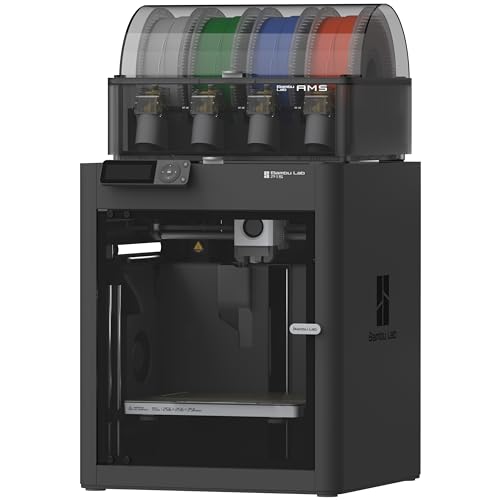
The Bambu Lab P1S is a ready-to-use FDM printer for beginners who want an enclosed machine with strong automation and room to grow. It includes automatic bed leveling and is designed to be set up in 15 minutes, reducing the initial assembly burden. Its enclosed body is intended to improve print performance when using advanced filament types.
Speed is another major attraction, with a stated maximum of 500mm/s and acceleration up to 20,000mm/s². The P1S is ideal for PLA, PETG, TPU, PVA, PET and ASA, and is capable of PA and PC according to the supplied information. It can support up to 16 colors, but connecting a Bambu Lab AMS is required.
Pros
- Enclosed body
- Automatic bed leveling
- 15-minute setup claim
- Supports several common materials
- Up to 500mm/s stated speed
Cons
- AMS required for multicolor printing
- Not recommended for carbon- or glass-fiber-reinforced polymer
- Costs more than the FlashForge
The P1S is positioned as a machine that beginners can start with quickly while retaining broader material options. Its enclosure is especially relevant for users who expect to move beyond basic PLA, and automatic leveling removes one common adjustment task. The supported-material list gives it more flexibility than a narrowly focused starter printer.
It is a step up from the FlashForge in the supplied price and offers an enclosed design, but it does not include the AMS in this listing. That makes the standard P1S a better fit for single-material printing or gradual upgrades. Shoppers wanting multicolor immediately should compare it with the P1S Combo instead of assuming the base printer includes that hardware.
#5 · Best Multicolor
Bambu Lab P1S Combo
The Bambu Lab P1S Combo combines the P1S printer with an AMS, making it the clearest choice here for beginners who specifically want multicolor or multimaterial printing. The system is described as supporting up to 16 colors, while automatic bed leveling and a 15-minute setup aim to keep the starting process straightforward. Its enclosed body also suits users considering more advanced materials.
Like the standard P1S, the Combo reaches a stated 500mm/s and 20,000mm/s² acceleration. It is ideal for PLA, PETG, TPU, PVA, PET, ASA and is capable of PA and PC. The supplied information does not recommend carbon- or glass-fiber-reinforced polymer, so material selection still matters even with the more complete package.
Pros
- Includes printer and AMS
- Up to 16-color capability
- Enclosed design
- Automatic bed leveling
- Fast setup and printing
Cons
- Higher cost than the standard P1S
- Not recommended for reinforced polymers
- Multicolor projects add material-management complexity
The included AMS changes the buying decision substantially: unlike the standard P1S listing, this package is presented with the hardware needed for its multicolor focus. That makes it attractive for decorative models, characters and projects where color changes are central rather than occasional. Automatic leveling and the enclosed format preserve the beginner-friendly character of the underlying printer.
This is the most capable complete package in the group for users who already know they want multicolor output. It costs more than the FlashForge, AOSEED and single P1S, so it is not the economical learning choice. However, compared with buying the standard P1S and adding an AMS later, the Combo directly addresses shoppers who want the expanded setup from the beginning.
#6 · Best Budget Filament
SUNLU PLA Mini Spools
This SUNLU-branded PLA listing, identified with YOOPAI in the supplied product data, offers compact 250g spools for beginners who want several colors without storing multiple full-size rolls. The bundle is aimed at small prints, accent parts, test pieces, toys, decorations, prototypes and utility items. Standard PLA profiles, low warping and dependable layer adhesion make it a practical everyday material.
The filament uses a stated 1.75mm ±0.02mm diameter and is designed for most 1.75mm FDM printers with external, top-mounted or open spool holders. Precision winding is intended to reduce snags, while the 140mm diameter, 36mm width and 53mm center hole provide useful holder information. Bambu Lab AMS or AMS lite users need a compatible 250g spool adapter.
Pros
- Compact 250g spool format
- Beginner-friendly PLA
- 1.75mm ±0.02mm diameter
- Designed for most 1.75mm FDM printers
- Useful for small projects and tests
Cons
- AMS users need an adapter
- Small spools run out sooner than full rolls
- Material only, not a printer
The practical appeal is variety without waste. Instead of committing shelf space and money to large quantities of colors used rarely, beginners can keep several small rolls for prototypes and decorative details. Consistent diameter and steady extrusion are intended to support even layers, while the winding guidance helps users avoid loose loops during loading and storage.
Among the filament choices, this is the lower-priced option in the supplied data and a straightforward companion for a first printer. Dynta offers 10 explicitly named colors and individual vacuum sealing, whereas this listing emphasizes standard PLA behavior, compact spool dimensions and broad holder compatibility. It is particularly suitable for casual projects, provided the printer’s spool setup matches the listed dimensions.
Frequently Asked Questions
What should beginners prioritize in a 3D printer?
Automatic bed leveling, simple setup and dependable material support are useful starting points. An enclosed design can also be helpful for home use and for printing with a wider range of materials.
Are these products all 3D printers?
No. The FlashForge, AOSEED and two Bambu Lab listings are printers, while the Dynta and SUNLU listings are PLA filament bundles. The filament products require a compatible 1.75mm FDM printer.
Which option is best for multicolor printing?
The Bambu Lab P1S Combo is the clearest choice because the listing includes the printer and AMS and states support for up to 16 colors. The standard P1S requires connecting a Bambu Lab AMS, while the AOSEED supports single-color printing only.
Is PLA suitable for beginners?
PLA is presented as beginner-friendly in both filament listings, with the SUNLU product emphasizing standard PLA profiles and low warping. Dynta lists recommended nozzle and bed temperature ranges to help users begin tuning settings.
Do small filament spools work with every printer?
They are designed for compatible 1.75mm FDM printers, but the holder arrangement still matters. The SUNLU listing specifically notes that Bambu Lab AMS or AMS lite users need a compatible 250g spool adapter.
Final Thoughts
For a first complete printer, the FLASHFORGE Adventurer 5M balances automatic leveling, fast printing, nozzle flexibility and remote monitoring at the lowest supplied printer price. Families may prefer the enclosed, guided AOSEED experience, while the Bambu Lab P1S offers a more enclosed, material-flexible platform.
Choose the P1S Combo if multicolor printing is the priority and you want the AMS included. If you already own a printer, Dynta is the stronger color-variety pick, while the SUNLU mini spools are a budget-conscious way to keep practical amounts of PLA available for tests and small projects.

Olivia
Writer at Helmet Today, covering helmet reviews, fit and riding safety.


