
We may earn a commission when you buy through links on this page, at no extra cost to you. Learn more
Choosing the Best Resin 3d Printer for Miniatures is mainly about fine detail, dependable layer curing and how much setup you are willing to handle. Tiny faces, armor textures and delicate accessories quickly expose weaknesses in resolution, exposure consistency and build-plate adhesion.
Resolution matters, but it is not the whole story. Automatic leveling, failure detection, stable lighting, resin handling and a practical build volume can save more time than headline specifications, especially when printing several miniatures in one job.
This roundup includes compact beginner-friendly machines, faster premium options and one FDM printer that is not a resin model. Compare the technologies carefully, then choose the printer that matches your miniature detail needs, workflow and tolerance for post-processing.
| Product | Title | Key Features | Price |
|---|---|---|---|
 |
#1Best Value ANYCUBIC Photon Mono 4 Brand: ANYCUBIC
|
|
Check Latest Price |
 |
#2Best Premium ELEGOO Saturn 4 Ultra 16K Brand: ELEGOO
|
|
Check Latest Price |
 |
#3Best Starter ANYCUBIC Photon Mono 4 10K Brand: ANYCUBIC
|
|
Check Latest Price |
 |
#4Best Budget ELEGOO Mars 5 Brand: ELEGOO
|
|
Check Latest Price |
 |
#5Best FDM Alternative Bambu Lab P2S Combo Brand: BAMBULAB
|
|
Check Latest Price |
 |
#6Best Pro Workflow Heygears Reflex RS Turbo Brand: Heygears
|
|
Check Latest Price |
 |
#7Best Monitored ELEGOO Mars 5 Ultra Brand: ELEGOO
|
|
Check Latest Price |
What to Look for in Best Resin 3d Printer For Miniatures
- Look for a high-resolution mono LCD and a uniform light source when small facial features and surface textures are priorities.
- Automatic or simple leveling is valuable if you want to spend less time calibrating the build plate.
- Check adhesion features, residue detection and power-failure recovery because failed resin prints waste both material and time.
- Choose a printer with monitoring or diagnostic features if you expect to run long, detailed miniature batches unattended.
- Remember that resin printers require washing and curing after printing, while the listed Bambu Lab model uses FDM filament instead.
#1 · Best Value
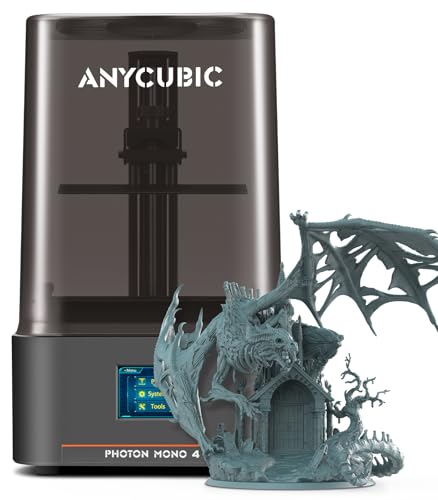
ANYCUBIC Photon Mono 4
The ANYCUBIC Photon Mono 4 is a strong fit for miniature makers who want high detail without moving into a premium price tier. Its 7-inch 10K screen uses 9024×5120 resolution and 17×17μm pixels, giving small models crisp definition. The LighTurbo matrix light source is designed to provide balanced, uniform exposure, helping reduce visible layer lines and preserve fine sculpted detail.
Its build volume measures 153.4mm by 87mm by 165mm, giving you room for multiple small figures or a larger model. The laser-engraved Print Platform 2.0 is intended to improve adhesion while keeping removal manageable. Four-point leveling is approachable for beginners, and power-failure recovery helps protect lengthy jobs from unexpected interruptions.
Pros
- 10K resolution with 17μm pixel size
- Uniform LighTurbo matrix lighting
- Useful miniature-sized build volume
- Power-failure print recovery
- Beginner-friendly four-point leveling
Cons
- No Anycubic app support
- Manual four-point leveling is still required
- The feature set is simpler than premium models
In practical use, the Mono 4 focuses on the fundamentals that matter for tabletop figures: sharp screen detail, consistent light distribution and a platform designed to reduce lifting or warping. The power-resume function is particularly useful for long miniature plates, where a failed restart could waste considerable resin. It does not include the automated monitoring or heating features found on some higher-priced alternatives.
At the listed $209.99 price, it sits alongside the other Photon Mono 4 entry and offers a compelling detail-oriented starting point. Choose it over the ELEGOO Mars 5 when 10K resolution is more important than one-click automation, but consider the Mars 5 Ultra if you specifically want AI monitoring and faster tilt-release printing.
#2 · Best Premium
ELEGOO Saturn 4 Ultra 16K
The ELEGOO Saturn 4 Ultra 16K is aimed at miniature enthusiasts who want exceptionally fine detail together with a more automated workflow. Its 16K resolution is designed to reproduce smooth surfaces, lifelike textures and intricate model features. Automatic leveling removes manual adjustment from the setup process, making this a sophisticated option for users who want to concentrate on preparing models rather than repeatedly tuning the printer.
This printer also adds smart tank heating that maintains resin at 30°C, supporting fluidity and layer adhesion. Tilt-release technology enables speeds up to 150mm/h, while the AI camera can monitor empty build plates and warped models. Built-in lighting and time-lapse support add convenience, although the product notes that AI results can vary with the environment, model and resin.
Pros
- Very high 16K resolution
- Automatic leveling
- 30°C intelligent resin heating
- Tilt-release printing up to 150mm/h
- AI camera and chamber light
Cons
- Higher listed price than the compact models
- AI detection is not guaranteed in every situation
- More features may be unnecessary for casual users
For batch miniature work, the Saturn 4 Ultra 16K combines several useful safeguards in one machine. Resin heating can be helpful when fluidity and adhesion are concerns, while residue detection, resin-shortage alarms and leveling-failure alerts are designed to limit avoidable problems. The tilt-release system also targets shorter peeling cycles without giving up the advertised emphasis on detailed output.
At $519.99, it is a substantial step above the Photon Mono 4 and Mars 5. That premium makes the most sense for serious hobbyists who value automation, monitoring and speed alongside resolution. It is more feature-rich than the Mars 5 Ultra, particularly with tank heating, but the smaller machines may offer better value if you mainly print occasional figures.
#3 · Best Starter
ANYCUBIC Photon Mono 4 10K
This second ANYCUBIC Photon Mono 4 listing offers the same core miniature-friendly formula: a 7-inch 10K mono LCD, 9024×5120 resolution and 17×17μm pixel precision. Those specifications are intended to bring out micro-details in faces, clothing and accessories while the stabilized LighTurbo matrix light source works toward smoother surfaces and less noticeable layer lines.
It is also designed to be quick to start. The printer arrives fully assembled, tested and factory-calibrated, with a four-point leveling check before printing. Its Laser Engraving Platform 2.0 improves adhesion and helps reduce shedding or warping, while power-failure recovery can resume a job after downtime. With a listed price of $209.99, it is positioned as an accessible high-detail resin printer.
Pros
- 7-inch 10K mono LCD
- 17×17μm XY pixel precision
- Factory-calibrated setup
- Improved platform adhesion
- 1.5-second exposure capability
Cons
- A four-point leveling check is still needed
- No listed app support in this product data
- Lacks premium camera and heating features
The practical appeal here is simplicity: unbox the machine, perform the quick leveling check and begin working with detailed resin models. The 1.5-second exposure claim adds speed potential, while the stabilized light source is intended to keep curing even across the screen. For miniature hobbyists, the combination should be more meaningful than chasing maximum build size.
Compared with the other Photon Mono 4 entry, this listing emphasizes the factory-calibrated experience and 1.5-second exposure capability. It shares the same listed $209.99 price and core 10K resolution, so the choice between the two may come down to which seller package or listing details you prefer. It is less automated than ELEGOO’s Mars 5 models, but offers higher stated screen resolution than the Mars 5.
#4 · Best Budget
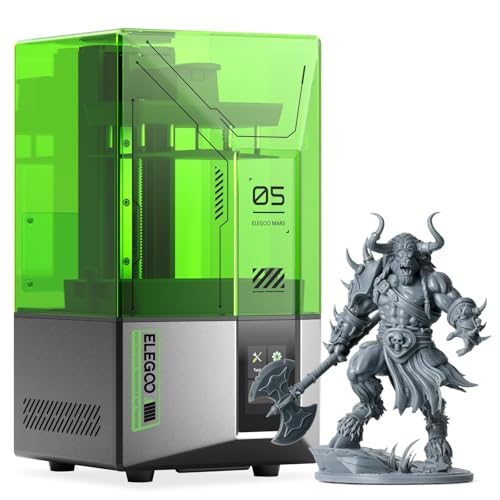
ELEGOO Mars 5
The ELEGOO Mars 5 is a sensible budget choice for miniature printing when easy setup and protective features matter more than having the highest screen resolution. Its 4K mono LCD and COB light source are designed to reproduce intricate details and textures with good fidelity. One-click automatic leveling removes a common beginner hurdle, making the printer approachable straight from unboxing.
ELEGOO also builds in several checks intended to reduce wasted prints. A one-click self-check verifies component operation before each job, while a mechanical sensor can detect residue and help protect the LCD. Resin-shortage and leveling-failure alarms add further reassurance, and overheat protection stops printing if the LED temperature exceeds 80°C.
Pros
- Lowest listed price in the roundup
- One-click automatic leveling
- 4K mono LCD with COB lighting
- Pre-print self-check
- Overheat protection
Cons
- Lower resolution than the 9K and 10K models
- No AI camera listed
- No tilt-release speed feature listed
The Mars 5 is best suited to someone entering resin printing who wants fewer calibration chores. Automatic leveling and the self-check routine address setup anxiety, while residue detection and temperature protection provide useful safeguards during everyday operation. Its 4K screen should still handle detailed miniatures, although the product data does not claim the same pixel-level precision as the higher-resolution alternatives.
At $199.99, it is the least expensive printer here and only slightly below the Photon Mono 4 listings. That makes it an appealing first machine if your priority is accessible operation rather than maximum miniature sharpness. Spend more on the Mars 5 Ultra for 9K detail, AI monitoring and tilt release, or choose the standard Mars 5 when those extras are not essential.
#5 · Best FDM Alternative
Bambu Lab P2S Combo
The Bambu Lab P2S Combo is fundamentally different from the other entries: it is an FDM 3D printer, not a resin printer for miniature work. It prints filament at speeds up to 600mm/s and uses active flowrate compensation, automatic calibration and AI failure detection. Those features make it attractive for general 3D printing and larger, sturdier parts, but this is not the conventional choice for highly detailed resin miniatures.
Its AMS 2 Pro supports multi-color and multi-material printing, with filament drying up to 65°C. The printer also offers adaptive airflow, a carbon filter and a workflow through Bambu Studio, Bambu Handy and MakerWorld. Note that the product data specifically says the P2S printer does not support multi-color printing by itself; the Combo version is required.
Pros
- Up to 600mm/s FDM printing
- Automatic calibration
- AI failure detection
- Multi-color capability with AMS 2 Pro
- Filament drying up to 65°C
Cons
- Not a resin printer
- FDM is less suited to tiny miniature detail
- The listed price is highest here
For the stated keyword, the P2S Combo should be viewed as an alternative rather than a direct competitor. FDM avoids liquid resin handling and can be useful for terrain, organizers or larger display pieces, while the automatic workflow and quick-swap nozzles support convenient general-purpose printing. However, the provided data does not claim resin-style miniature resolution, so it is a poor fit if tiny sculpted details are your main goal.
At $769.00, the Combo costs more than every resin option in this roundup, but it includes a broader filament workflow and multi-color capability through the AMS 2 Pro. Choose it if you want one fast FDM system for varied projects and accept the trade-off in miniature detail. For character figures and delicate textures, the resin printers are the more appropriate choices.
#6 · Best Pro Workflow
Heygears Reflex RS Turbo
The HeyGears Reflex RS Turbo is built for users who want a highly automated, professional-style resin workflow. Its high-contrast amber screen is designed to combine speed with sharp detail, while the stated 566:1 contrast ratio supports crisp model edges and dimensional accuracy. The system also offers one-click slicing that can detect and repair inverse normals, holes and intersecting shells before generating supports.
Its automation extends into leveling and print protection. Floating Screen Auto-Leveling corrects deviations up to 0.15°, and force monitoring can detect resin residue as fine as 0.2mm before pausing a job. The printer uses a precision C5 ball-screw Z-axis, calibrated COB lighting and adaptive motion control, while dedicated support promises 24-hour response assistance.
Pros
- High-contrast amber screen
- One-click model repair and support generation
- Automated leveling correction
- Force monitoring with auto-pause
- Professional support and diagnostics
Cons
- Highest listed price among resin models
- Advanced workflow may be excessive for beginners
- The data does not provide a build volume
This machine stands apart through process control rather than a simple resolution headline. Its force sensors read motion data 80 times per second, while the diagnostic report after each job is intended to make failures easier to understand. The stated Z-axis repeat accuracy of ≤2μm and print tolerances of ≤0.05mm also point toward users who care about repeatable results across demanding projects.
At $799.00, the Reflex RS Turbo is a specialist purchase rather than a casual entry printer. It is the strongest fit here for a production-minded user who values automated preparation, material-aware processing and support access. Hobbyists may get better value from the ELEGOO Saturn 4 Ultra 16K, while beginners will likely find the Photon Mono 4 or Mars 5 less intimidating.
#7 · Best Monitored
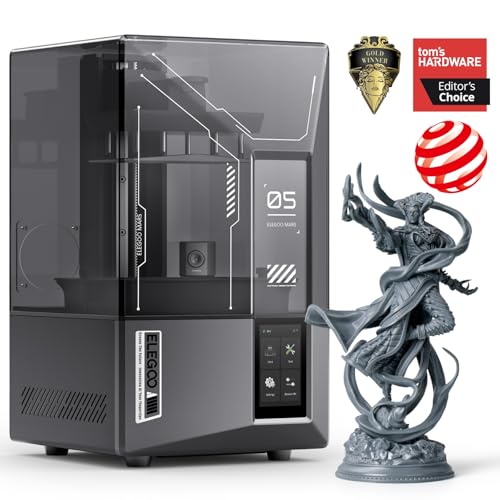
ELEGOO Mars 5 Ultra
The ELEGOO Mars 5 Ultra targets miniature makers who want detailed prints, faster release and more oversight than a basic entry machine provides. Its 7-inch 9K mono LCD offers 18μm XY resolution, designed to reproduce fine textures and small model features. Tilt-release technology supports speeds up to 150mm/h, with fast and slow modes available for different workflow priorities.
An AI camera watches for empty build plates and warped models, sending alerts when it detects potential issues. The printer also includes residue detection to protect the LCD, plus alarms for resin shortages and leveling failures. Wi-Fi cluster printing allows multiple Mars 5 Ultra machines to be controlled from one device, although AI detection can vary with the environment, model and resin.
Pros
- 9K resolution with 18μm XY detail
- Tilt-release printing up to 150mm/h
- AI camera monitoring
- Wi-Fi cluster printing
- Residue and resin-shortage detection
Cons
- AI alerts may vary by conditions
- Less resolution than the Saturn 4 Ultra 16K
- Advanced features may exceed occasional needs
The Mars 5 Ultra is particularly appealing when failed prints and production time are bigger concerns than absolute maximum resolution. Tilt release can speed up model peeling, while the camera and mechanical sensors provide several layers of oversight. Wi-Fi cluster control is also unusual at this size and could be useful for a hobbyist or small workspace running more than one compatible printer.
At $299.99, it costs more than the standard Mars 5 and Photon Mono 4 but remains far below the Saturn 4 Ultra 16K and HeyGears Reflex RS Turbo. It is the logical upgrade for users who want monitoring and speed without paying for the most elaborate premium systems. Choose the Saturn when 16K detail and heated resin matter more, or the Mars 5 when lowest cost is the priority.
Frequently Asked Questions
Which printer is best for highly detailed miniatures?
The ELEGOO Saturn 4 Ultra 16K has the highest stated screen resolution in this roundup and adds automatic leveling, heated resin and tilt release. The ANYCUBIC Photon Mono 4 models are more affordable alternatives with 10K resolution and 17×17μm pixels.
Is the Bambu Lab P2S Combo a resin printer?
No. The P2S Combo is an FDM filament printer with an AMS 2 Pro for multi-color and multi-material printing, so it is not a direct resin-miniature competitor.
Which option is easiest for a beginner?
The ELEGOO Mars 5 offers one-click automatic leveling, a pre-print self-check and protective alarms. The Photon Mono 4 is also beginner-friendly, but it uses a four-point leveling process rather than fully automatic leveling.
Do any of these printers monitor failed prints?
Yes. The Saturn 4 Ultra 16K and Mars 5 Ultra include AI cameras that can monitor issues such as empty build plates and warped models. Their product data cautions that detection results may vary with the environment, model and resin.
Which printer is best for repeated production?
The HeyGears Reflex RS Turbo is designed around automated preparation, force monitoring, adaptive processing and professional support. The Mars 5 Ultra may be a more affordable production-oriented choice if Wi-Fi cluster printing and camera monitoring are useful to you.
Final Thoughts
For most miniature hobbyists, the ANYCUBIC Photon Mono 4 is the strongest value-focused recommendation: it combines 10K detail, uniform lighting, useful adhesion features and a practical build volume at a relatively accessible listed price. Beginners who prioritize automatic leveling and safeguards should look closely at the ELEGOO Mars 5 instead.
Move up to the ELEGOO Mars 5 Ultra for faster, monitored printing, or the Saturn 4 Ultra 16K for a premium blend of resolution, heating and automation. The HeyGears is best reserved for professional workflows, while the Bambu Lab belongs on your shortlist only if you specifically want fast FDM filament printing rather than resin miniature detail.

Olivia
Writer at Helmet Today, covering helmet reviews, fit and riding safety.