We may earn a commission when you buy through links on this page, at no extra cost to you. Learn more
Choosing the best brush for Polycrylic is mainly about controlling the finish. Water-based clear coats reward smooth, consistent application, so the bristle material, brush width, and handle design all matter more than flashy extras.
A narrow brush can be easier to manage on trim, small furniture, and detailed areas, while a wider brush covers larger panels faster. Synthetic blends are especially relevant here because the listed options are designed for water-based finishes or broad paint and varnish use.
This roundup compares five brushes by intended finish compatibility, handling, cleanup, and value. The Minwax options are the most directly targeted, while the Wooster and Newkita brushes offer alternative shapes, widths, and multipurpose flexibility.
| Product | Title | Key Features | Price |
|---|---|---|---|
 |
#1Best for Small Minwax 1.5-Inch Finish Brush Brand: Minwax
|
|
Check Latest Price |
 |
#2Best Overall Size Minwax 2-Inch Finish Brush Brand: Minwax
|
|
Check Latest Price |
 |
#3Best for Tight Wooster Shortcut Angle Sash Brush Brand: Wooster
|
|
Check Latest Price |
 |
#4Best Budget Set Newkita Three-Brush Paint Set Brand: Newkita
|
|
Check Latest Price |
 |
#5Best for Large Wooster 3-Inch Chiseled Brush Brand: Wooster
|
|
Check Latest Price |
What to Look for in Best Brush For Polycrylic
- Choose a synthetic or synthetic-blend brush specifically listed for water-based finishes, varnishes, or stains.
- Match brush width to the project: narrower brushes suit small areas, while wider brushes cover larger surfaces more quickly.
- Look for a handle and ferrule that give you steady control, particularly when coating edges or tight spaces.
- Water-cleanup compatibility makes rinsing easier after using water-based Polycrylic.
- Check the product instructions for loose bristles and remove them before starting a visible finish.
#1 · Best for Small
Minwax 1.5-Inch Finish Brush
The Minwax 1.5-Inch Polycrylic Wood Stain Brush is the most directly focused option here for smaller water-based finishing jobs. Its nylon and polyester blend is designed for water-based stains and finishes, while the soft application design aims to support a smooth, even coat. The narrower width suits small furniture, trim, craft work, and areas where a larger brush could feel cumbersome.
A stainless steel ferrule connects the bristles to a natural hardwood handle, giving this brush a traditional finish-tool setup. It is intended for pint or half-pint cans of water-based stains and finishes, so it makes particular sense when you are working on a modest project rather than coating broad surfaces.
Pros
- Synthetic nylon-polyester blend
- Designed for water-based finishes
- Narrow 1.5-inch width
- Natural hardwood handle
- Cleans with soap and water
Cons
- Less efficient on large panels
- Sized for pint or half-pint cans
- Not the widest coverage option
In practical use, the 1.5-inch format should make it easier to control edges, corners, and smaller surfaces than the two- and three-inch alternatives. The soft synthetic bristles are intended to promote an even finish, and the stated soap-and-water cleanup is convenient for water-based products. Rinsing well after use remains part of the care routine.
At the listed $8.03 price, this is a focused choice rather than a general bulk brush set. It costs less than the two-inch Minwax model and offers a more compact working width, but the Newkita set supplies three sizes for less money. Choose the Minwax when finish-specific guidance and controlled application matter more than maximum quantity.
#2 · Best Overall Size
Minwax 2-Inch Finish Brush
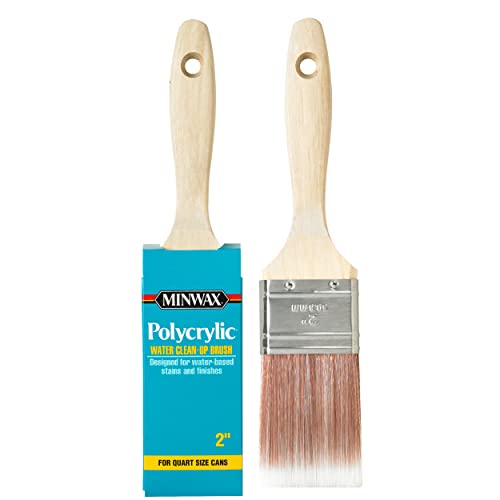
The Minwax 2-Inch Polycrylic Wood Stain Brush is built around the same water-based finishing purpose as the smaller Minwax brush, but its extra width favors broader coverage. Its fine-craft nylon and polyester blend is designed for water-based stains and finishes, and the soft application design is intended to help produce a smooth, even result on wood projects.
This brush is specified for quart-size cans of water-based stains and finishes, making it a practical match for larger jobs than the 1.5-inch version. The natural hardwood handle and stainless steel ferrule keep the design straightforward, while the synthetic bristles and soap-and-water cleanup fit the needs of a water-based Polycrylic workflow.
Pros
- Purpose-built for water-based finishes
- Useful 2-inch working width
- Nylon-polyester synthetic blend
- Natural hardwood handle
- Soap-and-water cleanup
Cons
- May feel large on fine detail work
- Specified for quart-size cans
- Costs more than the 1.5-inch model
The two-inch width offers a useful middle ground: it should cover more area per pass than the 1.5-inch brush without being as broad as the three-inch Wooster. That makes it a sensible everyday size for furniture panels, shelves, and other medium-scale surfaces. As with any finish brush, washing it promptly while the product is water-cleanup compatible is important.
At $9.99, this is the highest-priced option in the group, but it is also one of the two brushes explicitly designed for water-based stains and finishes. Compared with the smaller Minwax, it prioritizes coverage; compared with the multipurpose choices, it provides more specific product guidance. It is the strongest all-around fit when your project uses a quart-size can.
#3 · Best for Tight
Wooster Shortcut Angle Sash Brush
The Wooster Shortcut Angle Sash Paintbrush brings a different shape to Polycrylic work. Its two-inch angled sash profile is paired with a flexible purple Shergrip handle measuring only two inches long, a design intended to add maneuverability in tight spaces. The short handle may appeal when you want the brush close to your hand for controlled edging.
Its white nylon and gold polyester blend is listed for all paints, and the brass-plated steel ferrule provides a sturdy connection. The brush is 1/2 inch thick, so it has a defined, compact profile rather than a broad, heavy format. It is not marketed specifically for Polycrylic, but its synthetic blend and broad paint compatibility make it a versatile candidate.
Pros
- Short handle for maneuverability
- Angled sash shape
- Nylon-polyester blend
- Listed for all paints
- Brass-plated steel ferrule
Cons
- Not specifically labeled for Polycrylic
- Short handle may not suit everyone
- Only one brush is included
The standout feature is handling rather than finish-specific positioning. A short grip can be useful around corners, narrow sections, and detail areas where a longer handle gets in the way. The angled shape may also help with edging, while the two-inch width retains reasonable coverage. Since the listed compatibility is for all paints, confirm that the brush suits your particular water-based finish before committing to a large project.
At $7.13, the Wooster sits below both Minwax brushes and offers a distinct ergonomic design. It is more targeted to maneuverability than the Newkita set and less explicitly finish-focused than Minwax. This is a good choice when tight-space control is your priority and you prefer an angled brush with a compact handle over a conventional hardwood grip.
#4 · Best Budget Set
Newkita Three-Brush Paint Set
The Newkita set includes three different models of wood chip paint brushes, giving you multiple sizes for priming, painting, varnishing, staining, and general DIY work. The listed applications include walls, decorations, cabinets, gates, fences, decks, and other projects, so this is the broadest assortment in the roundup rather than a single specialized finish brush.
Each brush uses synthetic bristles and a wooden handle with a strong grip. The set is described as suitable for most paints, stains, varnishes, acrylics, and gesso powders, which makes it adaptable for Polycrylic-related projects. Before use, the manufacturer advises brushing through the bristles with your fingers to remove loose hairs that could spoil a visible coat.
Pros
- Three brush models included
- Synthetic bristles
- Handles designed for a strong grip
- Broad paint and varnish compatibility
- Washes with soap and water
Cons
- Loose bristles should be checked first
- Sizes are not specified
- Less finish-specific than Minwax
The main practical advantage is flexibility: you can select among three brush models instead of using one width for every surface. That can be helpful when a project includes broad areas, edges, and smaller details. The wooden handles provide a familiar grip, while soap-and-water washing is convenient for water-based materials. Removing loose bristles before starting is an especially important preparation step.
At $3.99, this is the lowest-priced option and the only multi-brush set in the group. It offers more quantity than either Minwax brush and a lower entry cost than the Wooster alternatives, but the product data does not identify exact widths or focus specifically on Polycrylic. Pick it for budget-conscious DIY versatility, provided you are willing to inspect the bristles first.
#5 · Best for Large
Wooster 3-Inch Chiseled Brush
The Wooster 3103-3 is a three-inch chiseled brush intended for all paints, varnishes, and stains. Its width is the largest among these single-brush options, making it naturally suited to covering larger surfaces more quickly than the 1.5- and two-inch brushes. The product is identified as a high-quality brush made in the USA.
The listed construction includes polyester trim, a white plastic handle with a built-in stiffener blade, and thick polyurethane foam described as supporting a smoothest, no-brush-marks finish. Together, those details point toward a brush designed for consistent flex and neat results. It is a broad, general-purpose option rather than a Polycrylic-specific model.
Pros
- Three-inch coverage
- Listed for paints, varnishes, and stains
- Polyester trim
- Built-in stiffener blade
- Made in the USA
Cons
- May be unwieldy for small details
- Not specifically designed for Polycrylic
- Broader brush may use more finish per pass
The three-inch format should save time on broad panels, doors, or other sizable surfaces where a narrow brush would require many passes. The stiffener blade is intended to support consistent flex, and the product description emphasizes a smooth, no-brush-marks finish. For trim, corners, and small furniture sections, however, the width may be less convenient than the Minwax 1.5-inch or Wooster Shortcut.
At $5.31, this Wooster offers a low-cost large brush and is less expensive than both Minwax models. It is a strong value when coverage is the main concern, while the Newkita set remains more flexible because it includes three models. Choose this brush for broad work, but select Minwax when explicit water-based finish guidance is more important than width.
Frequently Asked Questions
What brush material is best for Polycrylic?
The products most directly suited to water-based finishes use synthetic bristle blends. The Minwax brushes use nylon and polyester, while the other options list synthetic or polyester bristles and broader compatibility with paints, varnishes, or stains.
Is a 1.5-inch or 2-inch brush better for Polycrylic?
A 1.5-inch brush is easier to control on small projects, trim, and detail areas. A two-inch brush covers more surface per pass and is a better middle-ground choice for medium-sized furniture or panels.
Can these brushes be cleaned with water?
The Minwax and Newkita listings specifically state soap-and-water cleaning or washing while wet. The Wooster listings do not provide a cleaning method in the supplied product data, so follow the finish and brush-care instructions before rinsing.
Should I remove loose bristles before applying Polycrylic?
Yes, especially with the Newkita set, whose instructions specifically recommend brushing through the bristles with your fingers before use. Removing loose hairs first can help prevent them from ending up in a visible finish.
Which brush is best for large Polycrylic surfaces?
The three-inch Wooster offers the broadest stated working width among the single brushes, so it is the natural choice for larger surfaces. The two-inch Minwax is a more moderate option when you want additional control while still covering reasonable area.
Final Thoughts
For the most direct match to a water-based Polycrylic workflow, the Minwax brushes are the safest starting point. Choose the 1.5-inch model for small or detailed work, or the two-inch version for a more versatile everyday width and quart-size projects.
The remaining choices cover different priorities: Wooster’s Shortcut favors tight-space maneuverability, the Newkita set delivers the most variety for the least money, and the three-inch Wooster targets broad surfaces. Match the brush to your project size and handling preference, not just the lowest price.

Olivia
Writer at Helmet Today, covering helmet reviews, fit and riding safety.