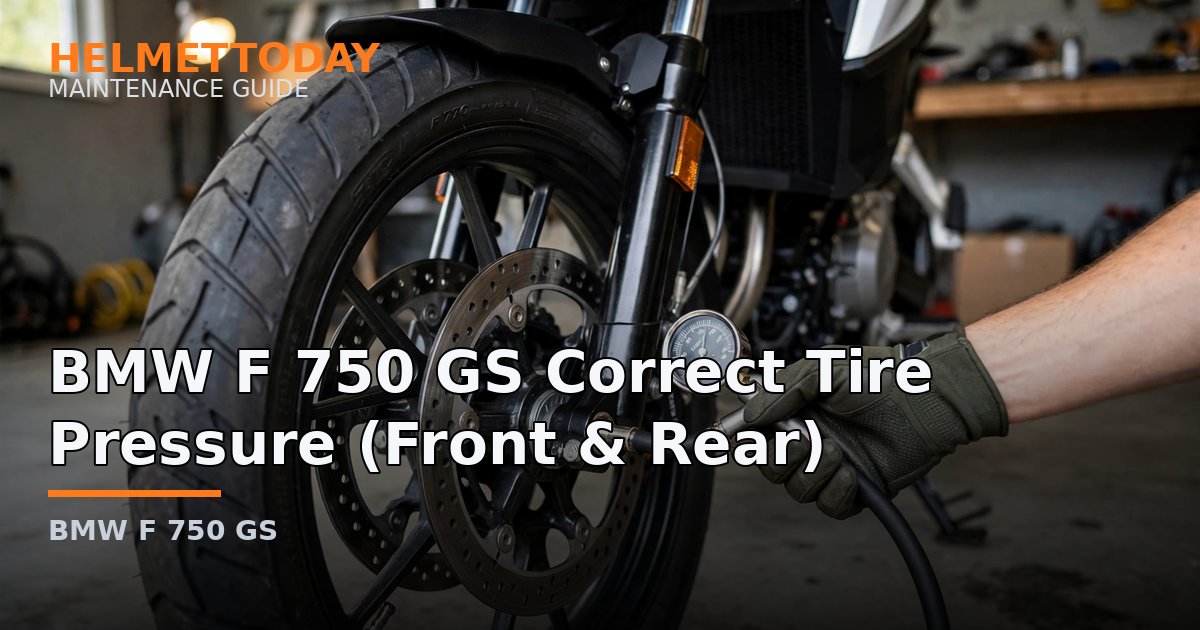
Tire pressure is the simplest performance and safety adjustment on your BMW F 750 GS — and the most neglected. Correct pressures for the BMW F 750 GS are 32 PSI front / 36 PSI rear for solo riding.
Check pressures cold, with a reliable gauge, before every ride. A reading taken after a ride is inflated by heat — tyre pressure can rise by several PSI — so it won’t reflect the true figure.
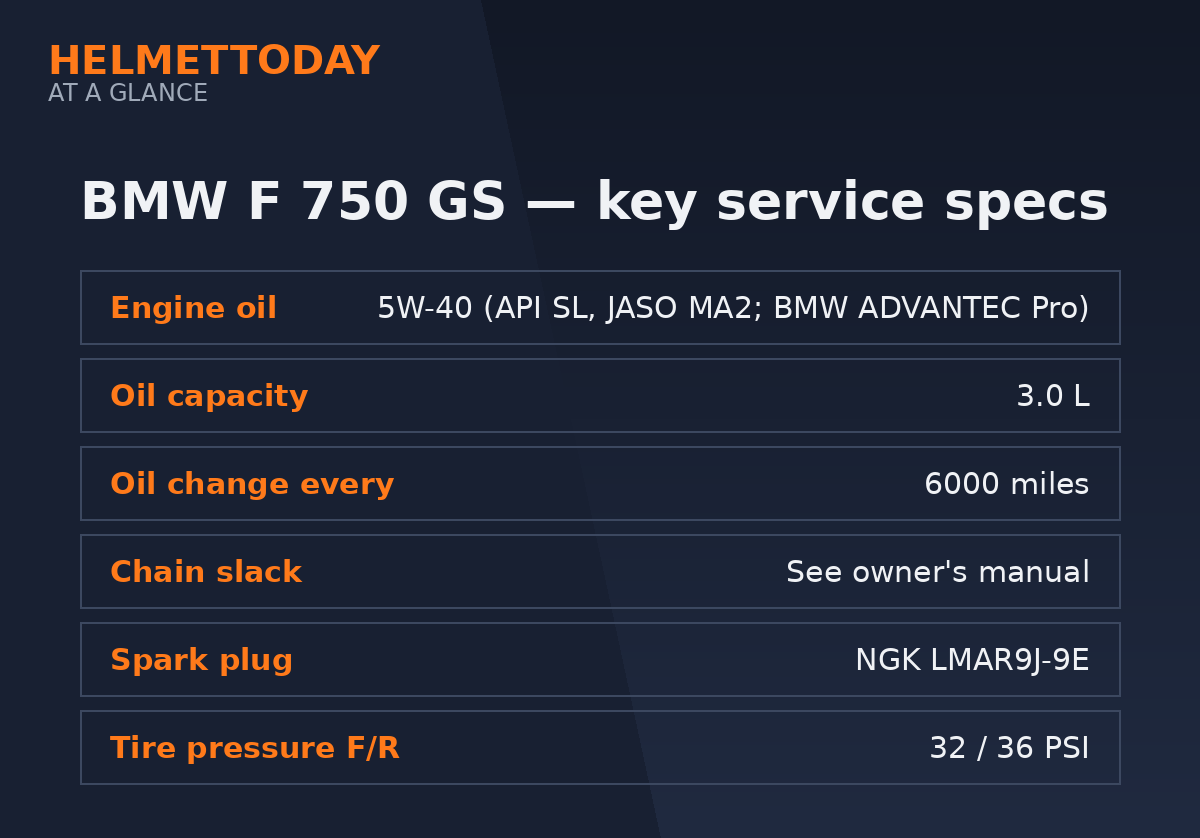
BMW F 750 GS quick service specs
| Item | Specification |
|---|---|
| Engine oil | 5W-40 (API SL, JASO MA2; BMW ADVANTEC Pro) |
| Oil capacity | 3.0 L |
| Oil change interval | 6000 miles |
| Chain slack | See owner’s manual |
| Spark plug | NGK LMAR9J-9E |
| Tire pressure (F/R) | 32 / 36 PSI |
| Battery | your owner’s manual |
How to check and set tire pressure, step by step
- Check cold — before riding, or after at least 3 hours parked.
- Use a quality gauge — the built-in TPMS display is a useful check, but a separate gauge is more accurate.
- Remove the valve caps — keep them somewhere clean and safe.
- Measure both tyres — press the gauge squarely onto the valve and read both front and rear.
- Add air as needed — use a pump or compressor to bring pressures to 32 front / 36 rear.
- Refit valve caps — screw them back on finger-tight.
- Recheck after a ride — if pressures drop again quickly, look for a slow leak.
Common mistakes to avoid
- Checking pressures hot — warm tyres read 3-4 PSI high; always check cold for a true reading.
- Setting one pressure for all loads — add 2-3 PSI at the rear for two-up or loaded touring.
- Trusting the gauge on a gas station pump — they are rarely calibrated; carry a pocket gauge instead.
- Ignoring a slow leak — a tyre that needs topping up every week has a puncture or valve fault — get it fixed.
FAQ
What is the correct tyre pressure for a BMW F 750 GS?
32 PSI front and 36 PSI rear for solo riding. Add 2-3 PSI at the rear for a pillion or luggage.
Should I check pressures cold or hot?
Always cold — a warm tyre reads 3-4 PSI higher than its true pressure, so check before riding or after 3 hours parked.
Why does the TPMS warning stay on?
The sensor needs a few miles to relearn after adjustment, or a sensor battery has failed. Inflate correctly first, then ride a few miles; if it persists, have the sensors checked.
Related guides

Dan Heiman
Writer at Helmet Today, covering helmet reviews, fit and riding safety.