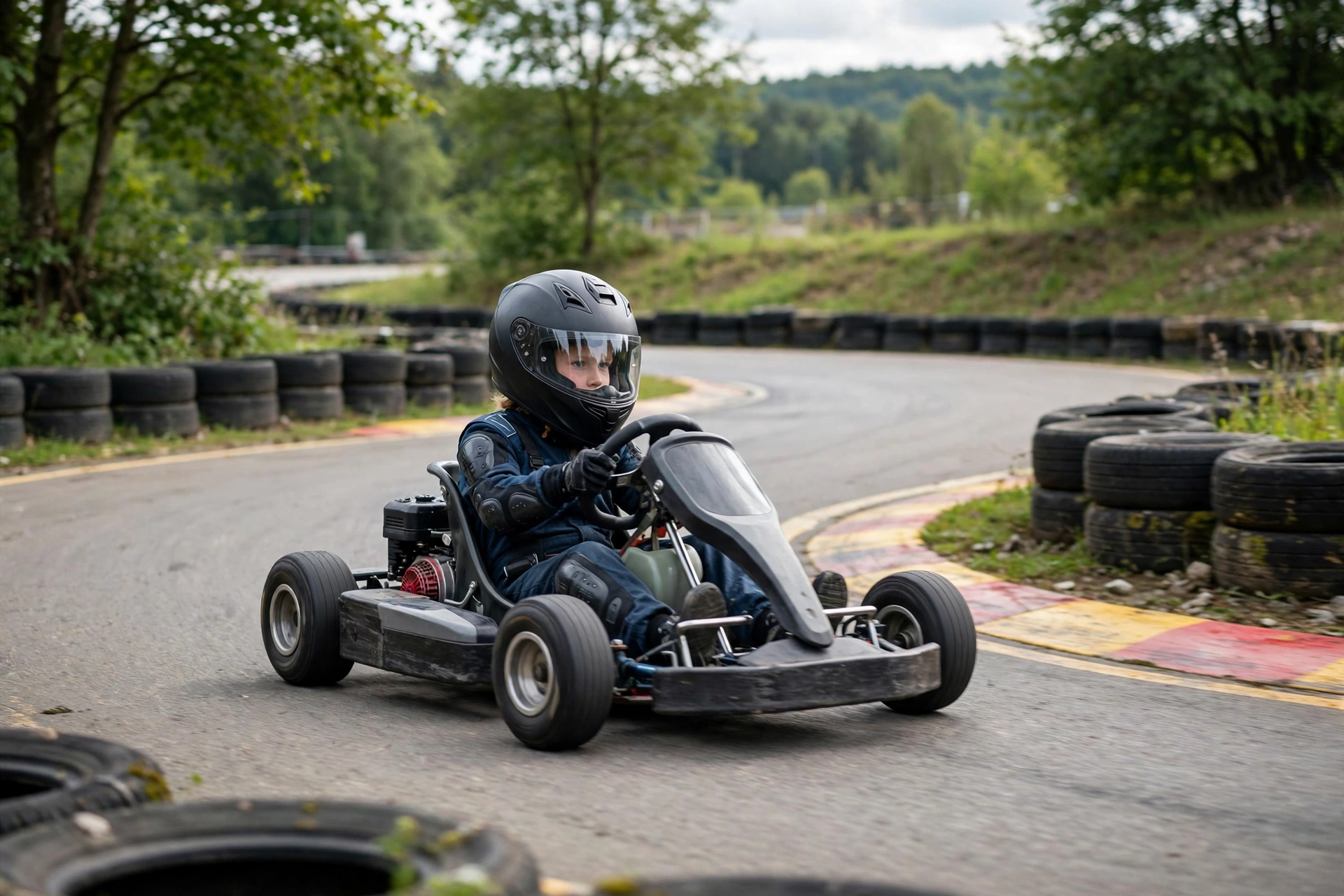
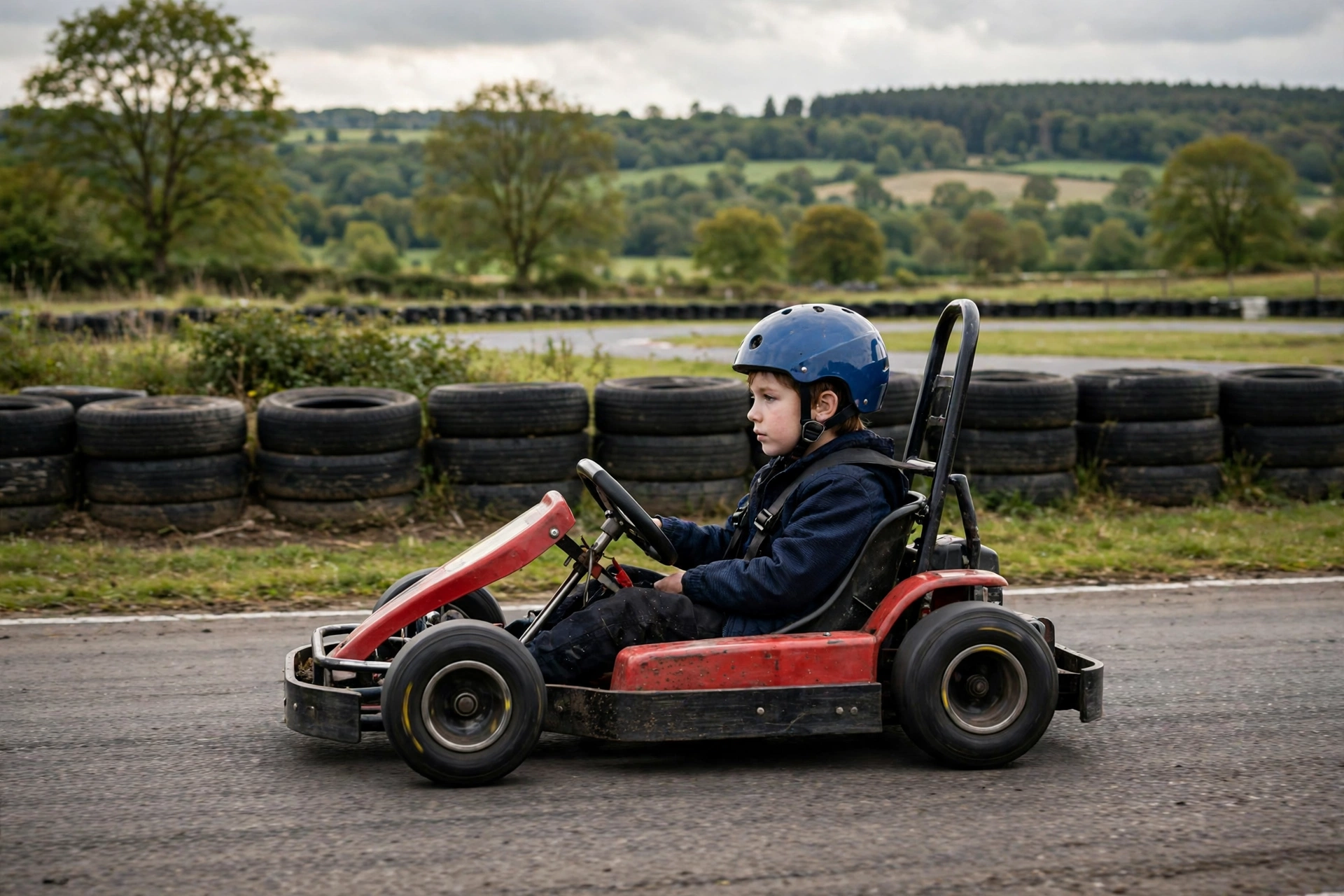
For a first go-kart ride, a child should wear a well-fitting kids’ helmet, with the chin strap snug and the buckle done up, because a helmet is sensible protective gear on a go-kart. Go-karting is fast and exciting, and even on a track designed for children, bumps, spins, and small collisions can happen, so head protection is worth taking seriously.
Most children’s first go-kart ride takes place at a karting centre or a family track, where the karts are smaller and slower than adult karts, and the track is designed for beginners. The child will be learning to steer, brake, and follow the track, and a helmet helps protect them while they learn.
What type of helmet suits a go-kart ride?
A full-face kids’ helmet is a good choice for go-karting, because it protects the whole head and face, including the chin and jaw. Karting tracks can throw up dust and small stones, and a full-face helmet keeps those away from the face as well as protecting the head.
Some karting centres provide helmets for children to use, and these are usually full-face helmets in a range of sizes. If the centre provides one, check that it fits well before the ride starts, and ask for a different size if it is too loose or too tight.
If you bring your own helmet, a kids’ bike helmet is better than no helmet at all, although it does not protect the face in the same way. A multi-sport helmet can also work, but a full-face helmet is the most suitable choice for karting when one is available.
How should a kids’ helmet fit?
A kids’ helmet should sit level on the head, covering the forehead down to about two finger-widths above the eyebrows. It should not tilt back, which leaves the forehead exposed, or tilt forward, which blocks the child’s view of the track ahead.
The helmet should feel snug but not tight. When the child shakes their head gently, the helmet should stay in place, with only a small amount of movement. If it slides around easily, it is too loose, and if it leaves red marks or the child complains that it hurts, it is too tight.
For a full-face helmet, check that the child can see clearly out of the visor or the opening, and that the helmet does not press on their nose or chin. Most karting helmets have pads inside that can be swapped to adjust the fit, so ask the centre staff for help if the fit is not right.
How do you adjust the straps and buckle?
The chin strap should be snug enough that only one or two fingers fit between the strap and the chin. If you can fit more fingers than that, the strap is too loose, and the helmet could come off in a fall or a collision.
Always do the buckle up before the child gets into the kart, and check that it clicks shut properly. A helmet that is not buckled is of little use in a crash, because it can fly off on impact. Make buckling up part of the routine, every time, without exception.
If the helmet has a visor, check that it is clean and that the child can see through it clearly. A scratched or dirty visor makes it harder to see the track, and a visor that fogs up can be wiped or opened slightly to let air in.
What should a child wear for go-karting?
Alongside a helmet, a child should wear comfortable clothes that allow free movement, and closed shoes that cover the whole foot. Avoid loose scarves, hoods, or dangling drawstrings, which can catch on the kart or the track.
Long sleeves and trousers are a good idea, because they protect the arms and legs from scrapes and from hot parts of the kart. Gloves can help too, because they improve grip on the steering wheel and protect the hands.
Tie back long hair before the helmet goes on, so it does not get caught in the strap or the kart. A thin balaclava made for helmets can help keep hair in place and keep a shared hire helmet feeling fresher.
How do you help a child enjoy their first go-kart ride?
Listen to the safety briefing together, and make sure the child understands the basics: how to steer, how to brake, and what the flags mean. A child who knows what to expect will feel calmer and enjoy the ride more.
Encourage the child to start slowly and build up speed as they get used to the kart. Most first rides are about learning the track and the controls, not about going fast, and a relaxed first ride makes a second ride much more likely.
A child should be supervised at all times at a karting centre, and an adult should stay nearby during the ride. After the ride, talk about what the child enjoyed, and praise them for following the rules and wearing their helmet.
What are the basic rules of the track?
Every karting centre has its own rules, but the basics are usually the same: stay on the track, do not bump other karts on purpose, and slow down when you see a yellow flag. Listen carefully to the briefing, because it explains what each flag means and what to do if a kart stops.
The child should keep both hands on the steering wheel and both feet near the pedals, and they should not try to get out of the kart while it is moving. If the kart spins or stalls, the child should stay seated and raise a hand, so the marshals can come and help.
Encourage the child to respect the other drivers on the track. Go-karting is more fun when everyone follows the rules, and a child who drives carefully and politely will enjoy the session far more than one who spends it being pulled off the track for bumping.
Does my child have to wear a helmet on a go-kart?
In general terms, yes. Most karting centres require helmets, and even where one is not required, a helmet is sensible protective gear for go-karting, because bumps and small collisions can happen on any track.
Can my child use their own bike helmet for go-karting?
It is better than no helmet, although a full-face helmet protects the face as well as the head. If the centre provides a full-face helmet, use that one, and check the fit before the ride.
What if the hire helmet does not fit my child?
Ask the staff for a different size. A helmet that is too loose or too tight will not protect properly, and it will be uncomfortable too. If no size fits, it is better to wait than to ride in a helmet that does not fit. If your child’s own helmet has a MIPS liner, the same fit guidance applies.

Olivia
Writer at Helmet Today, covering helmet reviews, fit and riding safety.