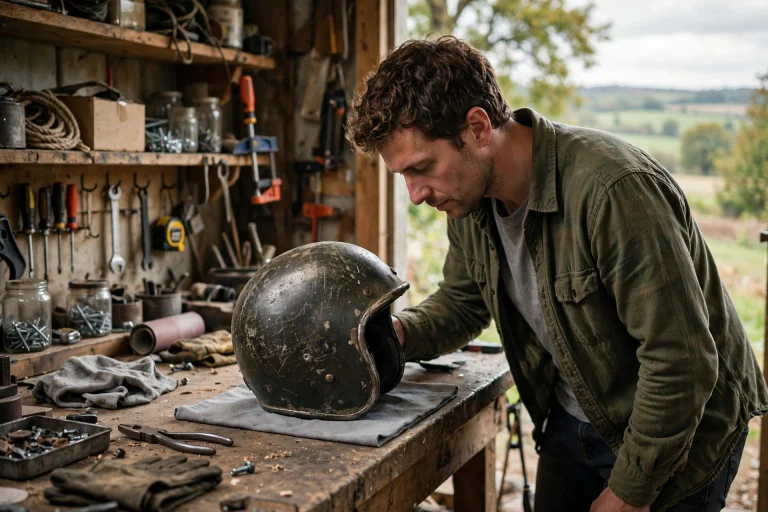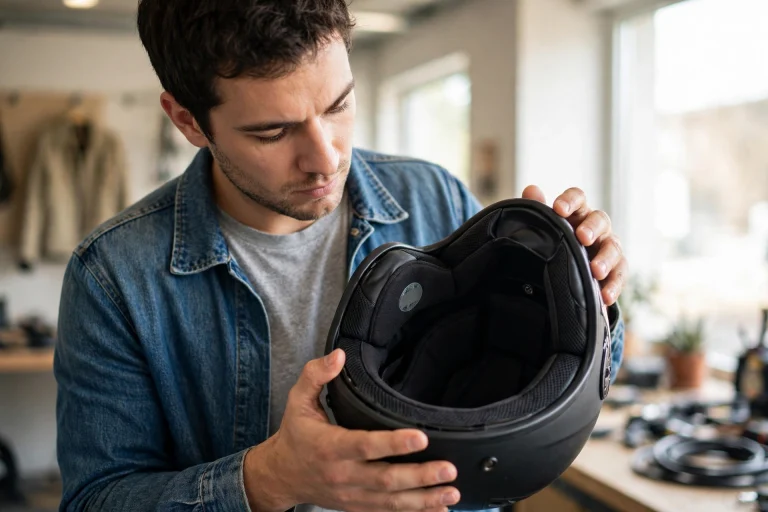
To inspect a helmet for cracks, check the whole shell carefully in good light, inside and out, looking for hairline cracks, chips, dents, and any line or mark that was not there before — and in general terms, if you find a crack in the shell, stop using the helmet. Cracks can be fine and easy to miss, so a quick glance is not enough. A proper check takes a few minutes, uses your hands as well as your eyes, and covers the shell, the vents, the visor mounts, and the lining underneath.
Helmets are made to absorb one hard impact, and a cracked shell may not protect you properly the next time. Small cracks can also grow with use, heat, and vibration, so a crack that looks harmless today can become a real weakness. Checking your helmet regularly is one of the simplest safety habits you can build, and it costs nothing but a few minutes of your time.
When should you inspect a helmet for cracks?
You should inspect your helmet for cracks after every fall, drop, or knock, and as a routine check every few weeks if you use it regularly. A helmet that has been dropped onto a hard floor, knocked off a table, or hit in a crash needs checking straight away, even if the outside looks fine. The shell can crack under the surface finish, and the lining can be damaged without any visible mark on the outside.
It is also worth checking a helmet before a long ride or an event, when you will be relying on it for hours, and when you take it out of storage after a break. In general terms, make the check part of your routine: a quick look before you ride, and a proper inspection once a month or so. If you share a helmet or buy one second-hand, inspect it carefully before you wear it at all.
How do you check the outside of the shell?
Start by cleaning the shell, because dirt and mud can hide cracks. Wipe it with a damp cloth and let it dry, then hold the helmet in good light and turn it slowly, looking at every part of the surface. Pay close attention to the areas around the vents, the visor mounts, and the edges of the shell, because cracks often start at holes, edges, and fittings where stress concentrates.
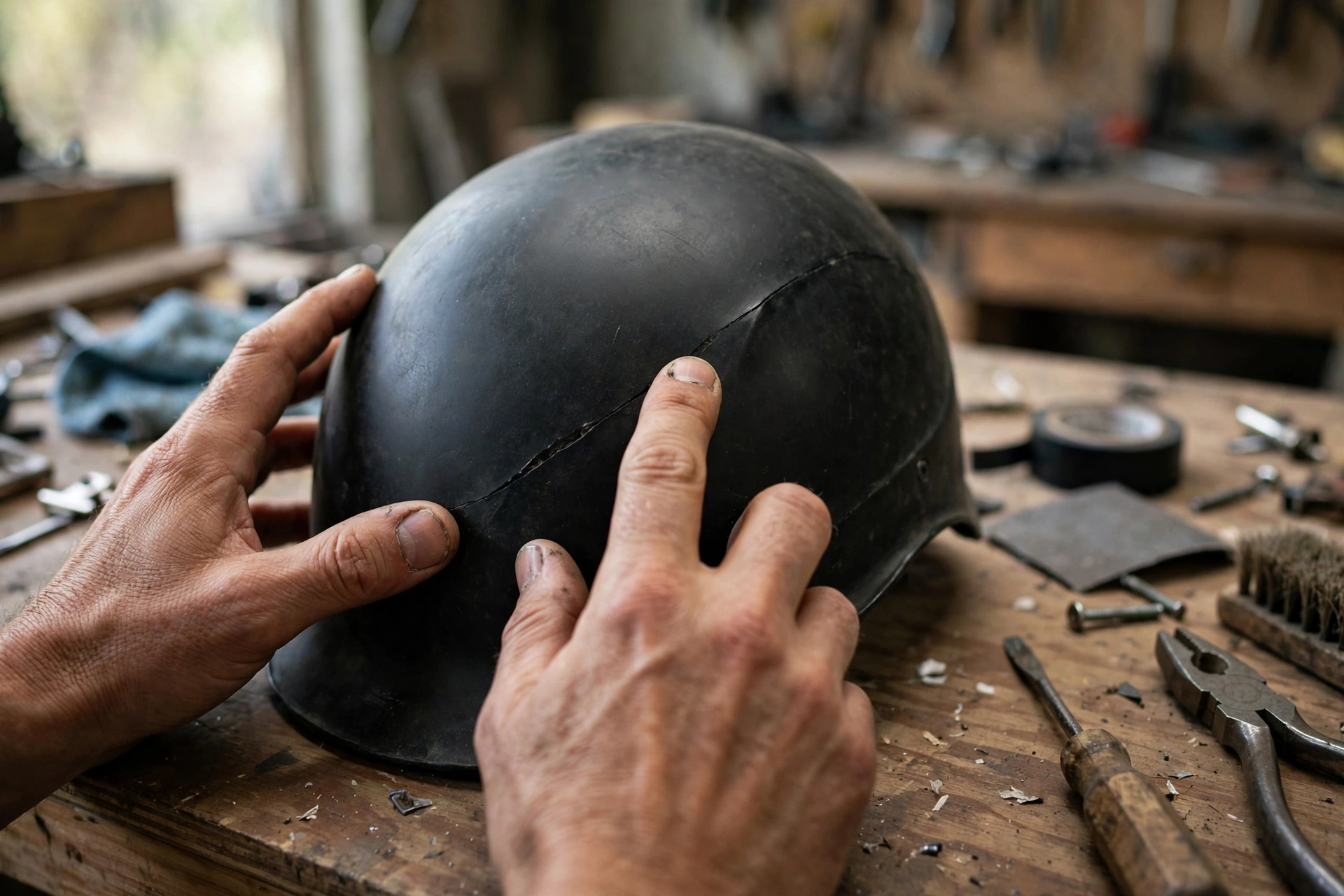
Run your fingertips slowly over the shell as you look, because a hairline crack can be easier to feel than to see. Press gently on either side of any line you find: if the line opens or the shell flexes, it is likely a crack rather than a scratch. Look for chips in the paint or coating too, because a chip can be the start of a crack underneath. If you are unsure whether a mark is a crack or a scratch, compare it with the same area on the other side of the helmet.
How do you check the inside of the helmet?
Take out the lining and padding if your helmet allows it, and look at the inner shell in good light. The inside can show cracks that are invisible from the outside, especially after a hard knock. Look for lines, splits, or crushed areas in the foam liner, and feel the liner with your hands for dents or hard spots that were not there before.
Check the straps, buckles, and fastenings at the same time, because a helmet with a damaged strap is not safe to use, even if the shell is sound. Look for frayed webbing, cracked buckles, and stitching that has come loose. In general terms, the inside of a helmet tells you as much as the outside, so do not skip this step. If the lining is glued in and cannot be removed, look through the vents and feel what you can reach.
What is the difference between a crack and a scratch?
A scratch is a mark on the surface of the shell, usually shallow, that does not go through the material. A crack goes deeper, splitting the shell, and it may run in a line, fork at the ends, or open slightly when you press on either side. Scratches are common on a used helmet and, in general terms, do not mean the helmet is unsafe, although deep scratches that cut through the coating should be watched.
Cracks are different: they weaken the shell and can spread. If you can feel a line with your fingernail, if the line runs across a vent or a fitting, or if it appears after a fall, treat it as a crack until you know otherwise. When you cannot tell, ask a shop or the helmet maker to look at it. Some helmets include a system designed to reduce rotational forces in a fall, such as MIPS, and the liner for that system also needs checking for damage, so look at it as part of your inspection.
What should you do if you find a crack?
If you find a crack in the shell, stop using the helmet. In general terms, a cracked helmet should be replaced, not repaired, because glue, filler, or paint cannot restore the strength of the shell. A helmet that has cracked has already shown that it cannot be trusted to protect you in the next impact, and riding or working in it puts your head at risk.
Do not pass a cracked helmet on to someone else, and do not keep it as a spare. Mark it clearly so nobody uses it by mistake, and dispose of it or recycle it following the maker’s guidance. If the helmet is new and the crack appeared without a fall, contact the shop or the maker, because it may be covered by a warranty. Keep a record of when you bought the helmet and what happened to it, in case you need it.
How do you store a helmet to avoid cracks?
Store your helmet somewhere cool and dry, away from direct sun and heat, because heat and sunlight can weaken the shell and the lining over time. Keep it on a shelf or in a helmet bag, rather than hanging it by its straps or leaving it on the floor where it can be knocked or trodden on.
Do not store a helmet in a hot car, a damp shed, or next to chemicals such as petrol or cleaning solvents, which can damage the materials. A helmet that is stored well is less likely to crack, and a quick check when you take it out of storage will catch any damage early.
Can a small crack in a helmet be repaired?
In general terms, no. A crack in the shell weakens the helmet, and repairs cannot restore its original strength. A cracked helmet should be replaced, not fixed.
Do hairline cracks matter if the helmet looks fine?
Yes, hairline cracks matter. They can grow with use and vibration, and they mean the shell is no longer whole. If you find one, stop using the helmet and replace it.
How often should you inspect a helmet for cracks?
Inspect it after every fall or hard knock, and give it a proper check at least once a month if you use it regularly. A quick look before each ride is a good habit too.

Olivia
Writer at Helmet Today, covering helmet reviews, fit and riding safety.