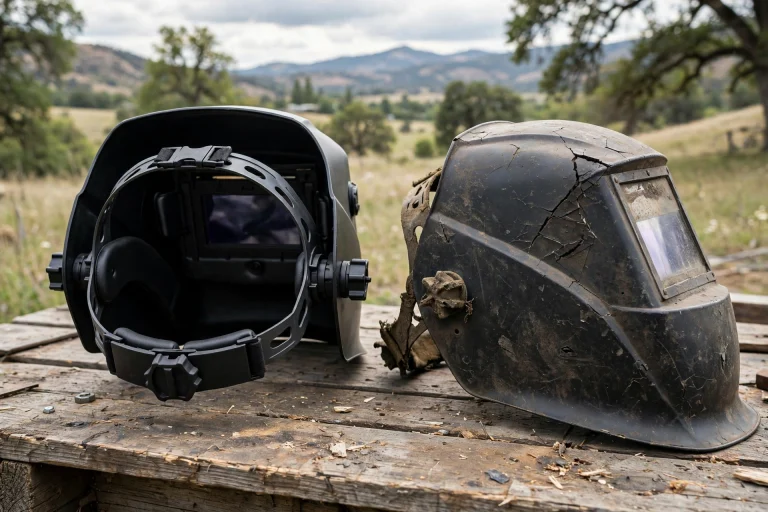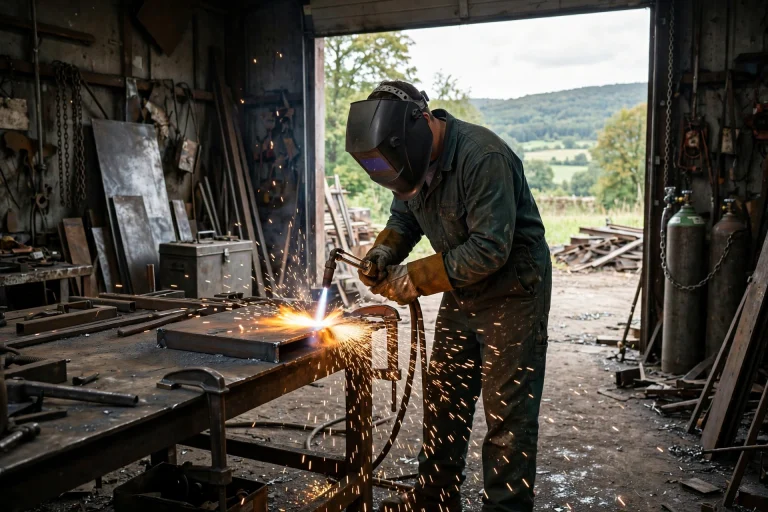
What matters for neck strain is not just how much a welding helmet weighs, but where that weight sits: a lighter helmet that balances close to your head is far kinder over a long session than the same weight hanging front-heavy off the headgear, because every nod down and flip up multiplies the load on the muscles at the back of your neck. If your neck aches after welding, the fix is usually a mix of better balance, better headgear fit, and work position — not simply buying the lightest helmet on the shelf.
Neck strain is the complaint welders mention most after eye fatigue, and it sneaks up: fine for the first hour, a dull ache by lunch, a stiff neck by Friday. This guide explains what actually loads your neck, why overhead work is the worst case, and what genuinely helps.
How Much Does a Welding Helmet Actually Weigh?
In general terms, welding helmets run from the lighter end of roughly a pound or so for compact passive and basic auto-darkening models up to noticeably heavier large-viewing-area and powered air (respirator-integrated) helmets. The filter size, shell material, and any added equipment — magnifying lenses, respirators, headlamps — all add grams.
But a scale number alone is a poor predictor of comfort. Your neck does not carry the helmet like a weight on a hook directly above your spine; it carries it on a lever, your head. Weight positioned further forward — a big filter assembly, a shell sitting too far from your face — pulls on that lever harder than the same weight tucked close.
That is why two helmets with identical listed weights can feel completely different by the end of a shift, and why advertised weight should be the start of the conversation, not the end of it.
Why Does Balance Matter More Than Raw Weight?
Think about nodding. A welding helmet is flipped down to weld and up to inspect, dozens or hundreds of times in a session. Each nod accelerates the mass at the front of your head and then brakes it, and the braking is done by the small muscles at the back of your neck. Front-heavy balance makes every one of those cycles cost more.
Balance is partly the helmet’s design and partly your headgear adjustment. A helmet whose distance setting leaves it hanging far from your face is front-heavy even if the shell itself is light. Bringing the shell closer, setting the top strap so the mass sits over your head’s pivot, and using a rear cradle to spread the load all shift the felt weight dramatically.
Where the helmet parks matters too. If the up position rests stably just above your line of sight, you hold it with posture. If it creeps and you are forever shrugging it back up with neck jerks, you are doing hundreds of tiny extra lifts a day.
Which Welding Positions Strain Your Neck Most?
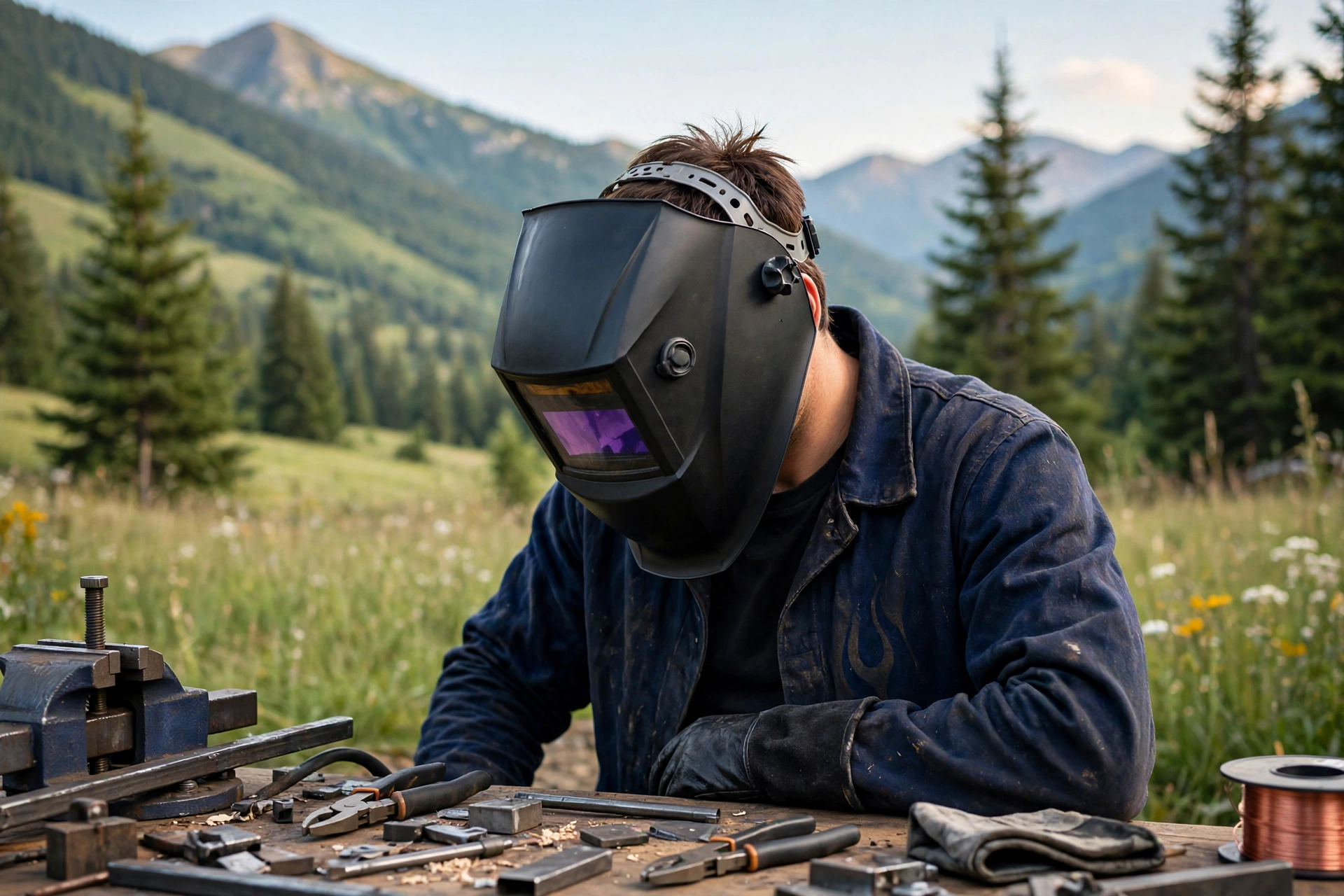
Overhead work is the worst case, and it is not close. Welding above head height asks you to hold your head tilted back with a helmet on the front of it, often while your arms are raised too — your neck extensors are loaded continuously, in a posture they are weakest in, with no nodding relief because the helmet stays down.
Flat bench work is the kindest: your head tilts forward slightly, the helmet’s weight hangs close to your neck’s axis, and you can rest the posture between welds. Out-of-position work — under a vehicle, inside a frame, vertical joints — falls between, with the strain set by how long you must hold an awkward head angle.
If your work is heavy on overhead and awkward positions, helmet choice and setup deserve extra care, and so do breaks: short, frequent posture resets do more for an aching neck than one long break at the end.
What Can You Do to Reduce Neck Strain?
Start with fit, because it is free. Set the headgear so the helmet sits close and balanced, with the top strap carrying its share and the ratchet snug rather than clamped. A helmet that sits right measurably reduces the nodding effort described above.
Then look at your setup. Raise the workpiece where you can, use positioners or stands, and change your stance so your head works in a neutral zone rather than at an extreme tilt. Welders focus on the joint; the joint’s height relative to your body is a neck decision too.
Finally, consider the helmet itself if strain persists: a lighter model, a smaller viewing area you can live with, or upgraded multi-point headgear that spreads load. And pay attention to total worn weight — a helmet plus respirator plus cap lamp is a system, and trimming anywhere helps your neck.
Is a Lighter Helmet Always the Answer?
No. A very light helmet with poor optics, a single sensor that misses low-amp arcs, or flimsy headgear can cost you more in rework, eye strain, and constant re-adjustment than it saves your neck. Light weight is one variable among several, and past a point the trade-offs turn against you.
The honest goal is the lightest total setup that still gives you the view, switching reliability, and protection your work needs — fitted so its mass sits close and balanced. For many welders that turns out to be a mid-weight helmet with excellent headgear rather than the lightest helmet in the catalog.
Treat persistent neck pain seriously, too. Helmet tweaks and posture help ordinary fatigue; pain that lingers, radiates into the shoulders or arms, or keeps returning deserves a medical opinion, not just new gear.
Balance and fit decide how protective gear feels over hours in every field, not just welding. Riders learn the same lesson with certified bike and motorcycle helmets — our explainer on what MIPS is and how it works covers another way helmet design manages forces your body would otherwise absorb.
Frequently Asked Questions
Q: My neck only hurts after overhead welding. Is that the helmet’s fault?
A: Mostly it is the posture: overhead work loads the neck continuously with the head tilted back. A lighter, well-balanced helmet and close-fitting headgear reduce the load, and short breaks between passes help more than any single equipment change.
Q: Should I choose a smaller viewing area to save weight?
A: Only if the smaller window still suits your work. Viewing area adds some weight, but balance and headgear fit usually matter more. Try adjusting distance and the top strap first — many welders find the “heavy” feeling disappears without giving up the big lens.
Q: Does flipping the helmet up and down really add that much strain?
A: Yes, over a full session. Each nod accelerates and brakes the mass in front of your head, and front-heavy balance multiplies the effort. Stable angle stops, a balanced fit, and parking the helmet properly in the up position all cut the cost per nod.

Olivia
Writer at Helmet Today, covering helmet reviews, fit and riding safety.