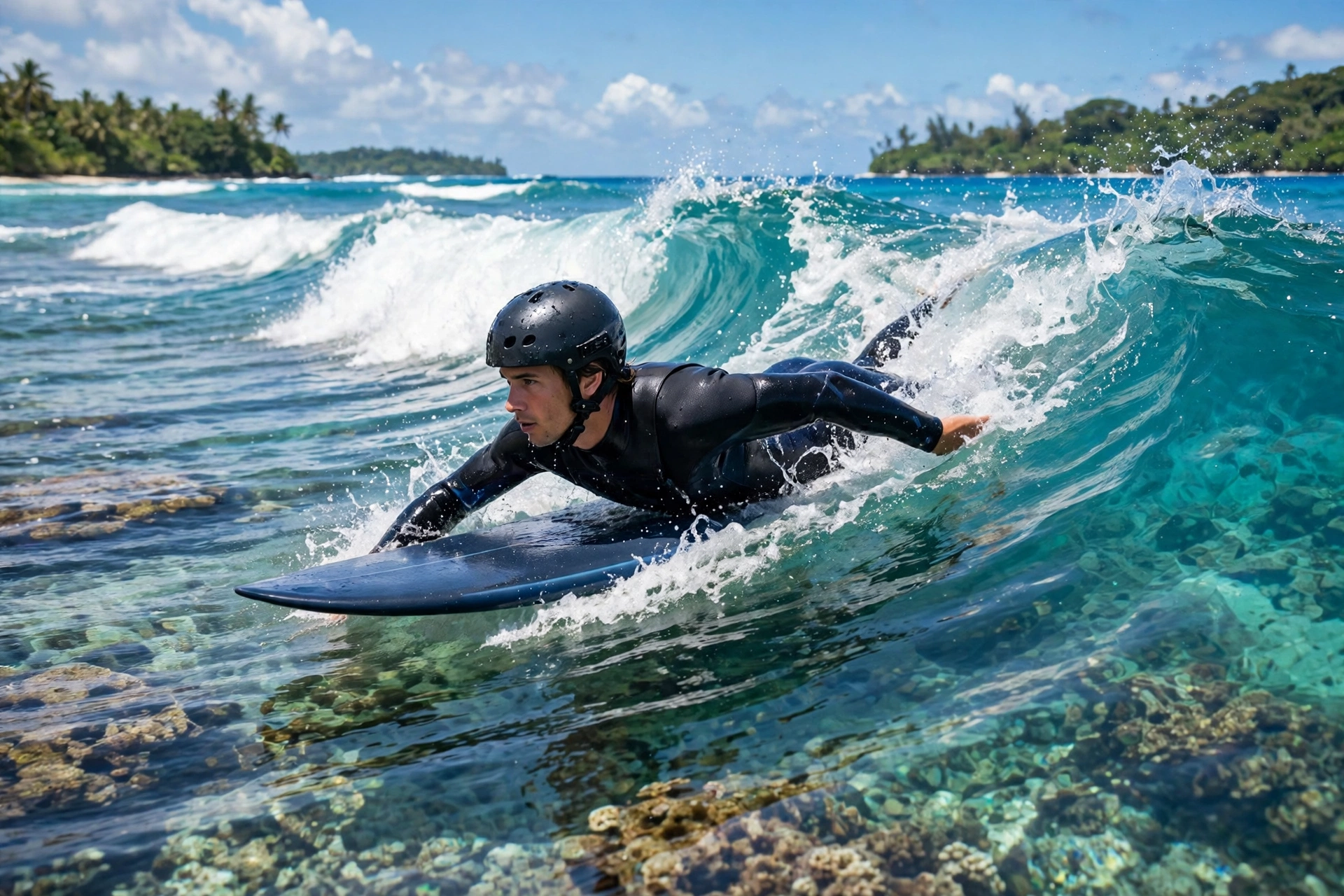
Some surfers do wear helmets, but most surfers at most beaches do not — a surf helmet makes the most sense in crowded lineups, shallow reef or rocky breaks, big and powerful surf, and while learning, when your own board is the thing most likely to hit you. It is a personal, spot-by-spot decision rather than a rule, and the right answer changes with the waves you surf and the risks around you.
Surfing has a long bareheaded tradition, and helmets are still the exception rather than the norm. But head knocks in surfing are real, and they usually come from boards — yours or someone else’s — and from the bottom. This guide looks honestly at when a helmet makes sense, and when most surfers reasonably skip one.
Do Most Surfers Wear Helmets?
No. Walk down to almost any popular beach break and the large majority of surfers will be bareheaded, with helmets appearing only here and there. In general terms, helmet use in surfing has historically been low compared with sports like cycling or snowboarding, where a helmet is simply part of the standard kit.
There are practical reasons for that. Surfing involves duck-diving and wiping out underwater, and anything on your head has to work with that. Some surfers find helmets hot, distracting, or uncomfortable in the water, and there is a cultural side too: surfing’s image has long been relaxed and minimal, and protective gear has been slow to become normal in the lineup.
That picture is slowly shifting. Helmets are increasingly common at certain heavy reef breaks, among big-wave surfers, in surf schools, and with surfers returning after a head injury. The trend is not toward helmets everywhere, but toward helmets where the risk clearly justifies them.
When Does a Surf Helmet Make the Most Sense?
Shallow, hard bottoms top the list. Surfing over reef, rock, or a very shallow sandbar means a wipeout can drive you headfirst into something unforgiving, and a helmet adds a layer of protection in exactly the falls you cannot control. The heavier and hollower the wave, the stronger the case.
Crowded lineups are the second situation. In a packed peak, boards are everywhere — loose boards after wipeouts, beginners dropping in, longboards swinging around in whitewater. Your own board, attached to you by a leash, is itself a common source of knocks, especially in onshore winds when it can blow back at your head. A helmet guards against the board strikes you never see coming.
Learning is the third case. Beginners fall more, control their boards less, and spend a lot of time in shallow whitewater where boards wash around unpredictably — which is why many surf schools put learners in helmets as a matter of course. Surfers with a previous concussion or head injury also often choose a helmet, sensibly, because avoiding a repeat knock matters more to them than it does to most.
What Should You Look For in a Surf Helmet?
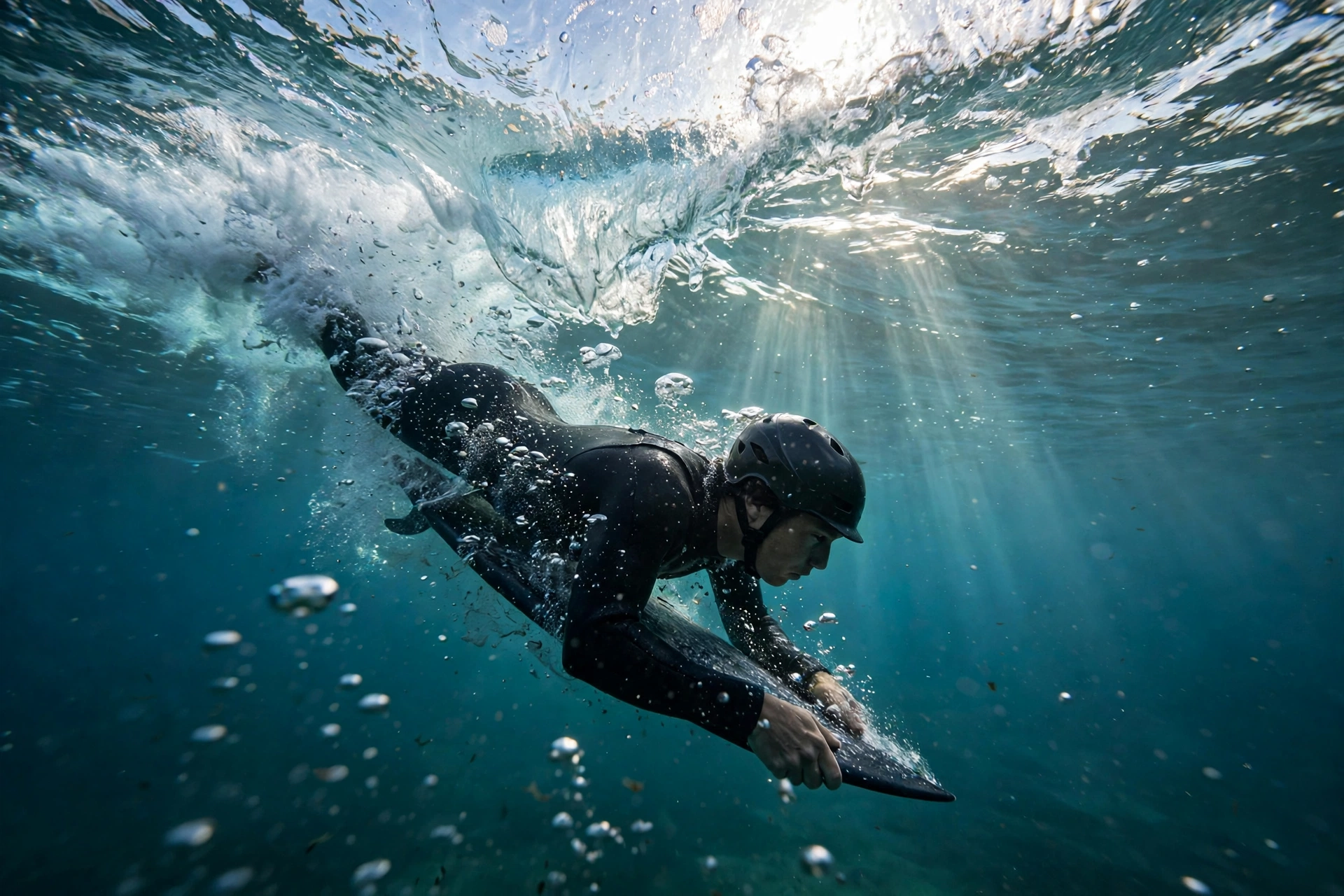
Look for a helmet designed for surfing and water use, not a general sports helmet borrowed from another sport. Surf helmets are typically lightweight and low-profile, with closed-cell foam that does not soak up water, drainage so they do not fill and drag, and a secure chin strap that keeps the helmet in place through hold-downs and tumbling wipeouts.
Soft-shell and hard-shell styles both exist. In general terms, soft or flexible designs are popular with everyday surfers because they are comfortable, less intrusive, and aimed mainly at knocks from boards, while firmer shells offer a harder barrier for reef and rock contact. Either way, check the maker’s description for the standard the helmet is tested to and the use it is intended for.
Fit matters underwater as much as on land. The helmet should sit snug and level, stay put when you shake your head, and not cover your ears so fully that you lose the sound cues surfers rely on — unless it has ear coverage designed to protect the eardrums while still letting sound through. If it shifts every duck-dive, it will annoy you out of wearing it.
Can a Surf Helmet Protect Against Concussion?
A helmet helps most against the direct, visible injuries: cuts, split skin, and hard knocks from boards and the bottom. Those are common in surfing, and preventing them is reason enough for many surfers. For concussion, the honest answer is that no helmet can prevent it entirely, because concussion involves the brain moving inside the skull, which no shell alone can fully stop.
What good design can do is reduce and manage impact energy. Foam liners crush to soften a blow, and modern thinking also addresses angled impacts, which twist the head — learning what MIPS is for helmets is a useful way to understand how low-friction liners aim to reduce rotational forces. Systems like that are still less common in surf helmets than in bike helmets, so treat them as a bonus, not the main buying test.
The main test stays simple: a water-ready helmet, honestly rated for its intended use, that fits snugly and that you will actually wear for the whole session. A helmet left on the beach protects no one.
What Are the Downsides of Wearing a Helmet Surfing?
Comfort is the most common complaint. A helmet can feel warm on a hot day, add drag and a strange sensation on duck-dives, and change how the water feels flowing past your head. Some surfers also feel a helmet affects their balance or confidence at first, simply because it is unfamiliar — most of that fades after a few sessions.
There is also honest debate about risk behaviour. Some surfers worry that feeling protected could tempt a rider into waves or crowds beyond their level, although that is a matter of attitude rather than equipment: a helmet is protection for the falls that happen anyway, not a licence to charge beyond your ability.
Weighed against those downsides is what a helmet prevents: the board-to-head knock in a crowd, the reef tap in shallow water, the cut that ends a surf trip. For many surfers the balance tips by location — bareheaded at a soft local beach break, helmet on at a shallow reef, on a crowded day, or in bigger surf. That spot-by-spot approach is, for most people, the sensible middle ground.
Frequently Asked Questions
Q: Are helmets required for surfing?
A: In general terms, no — ordinary recreational surfing has no helmet requirement at most beaches. Some surf schools, camps, and organised events do require them, especially for learners and children.
Q: What hits surfers in the head most often?
A: Boards — your own board on its leash, or another surfer’s loose board in a crowd — and the bottom in shallow water. Those are exactly the knocks a surf helmet is mainly designed for.
Q: Will a surf helmet protect my ears and eardrums?
A: Some designs include ear coverage that helps guard against hard water slaps when you fall, which can injure an eardrum. Check the design before buying if that protection matters to you.

Olivia
Writer at Helmet Today, covering helmet reviews, fit and riding safety.