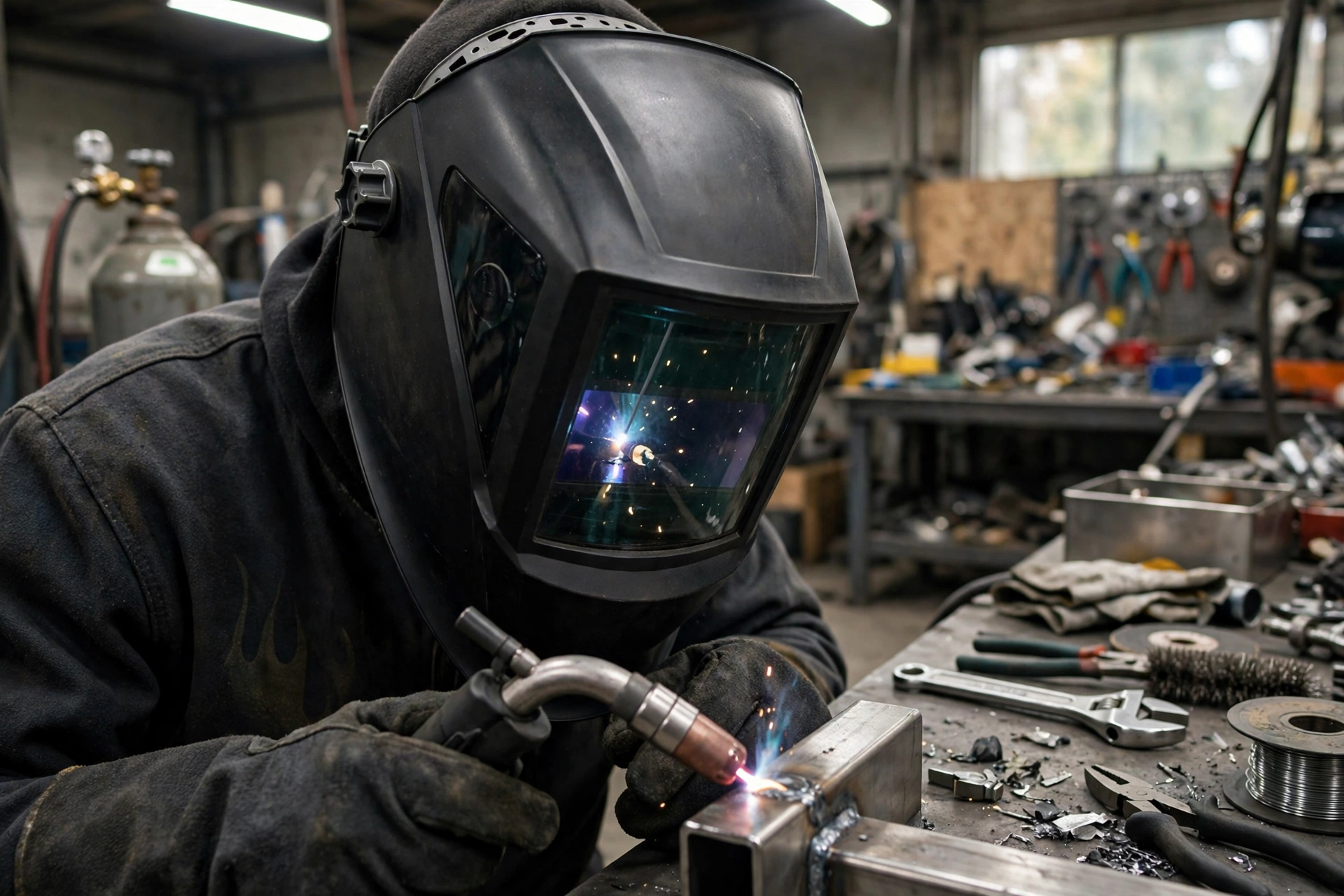
For TIG welding at low amps, look for a welding helmet with a highly sensitive auto-darkening filter that triggers reliably on a small, low-amperage arc, a light shade range that goes down to shade 9 or lower, and a clear, true-colour lens — in general terms, low-amp TIG produces a smaller, dimmer arc than other processes, so a helmet that only triggers on a big bright arc will leave you blinking at best and flash-burned at worst.
TIG welding is precise work, often on thin material at low current, and the arc is correspondingly small and quiet. A helmet built for heavy stick or MIG welding may not notice that arc quickly enough — which is why low-amp TIG has its own helmet requirements.
Why Does Low-Amp TIG Need a Different Helmet?
The arc is smaller and dimmer. At low amps, the TIG arc emits less light than a high-current MIG or stick arc, so a filter sensor set for bright arcs may not trigger, or may trigger late. Even a brief delay matters: repeated late triggering over a day of TIG work adds up to real eye strain and discomfort.
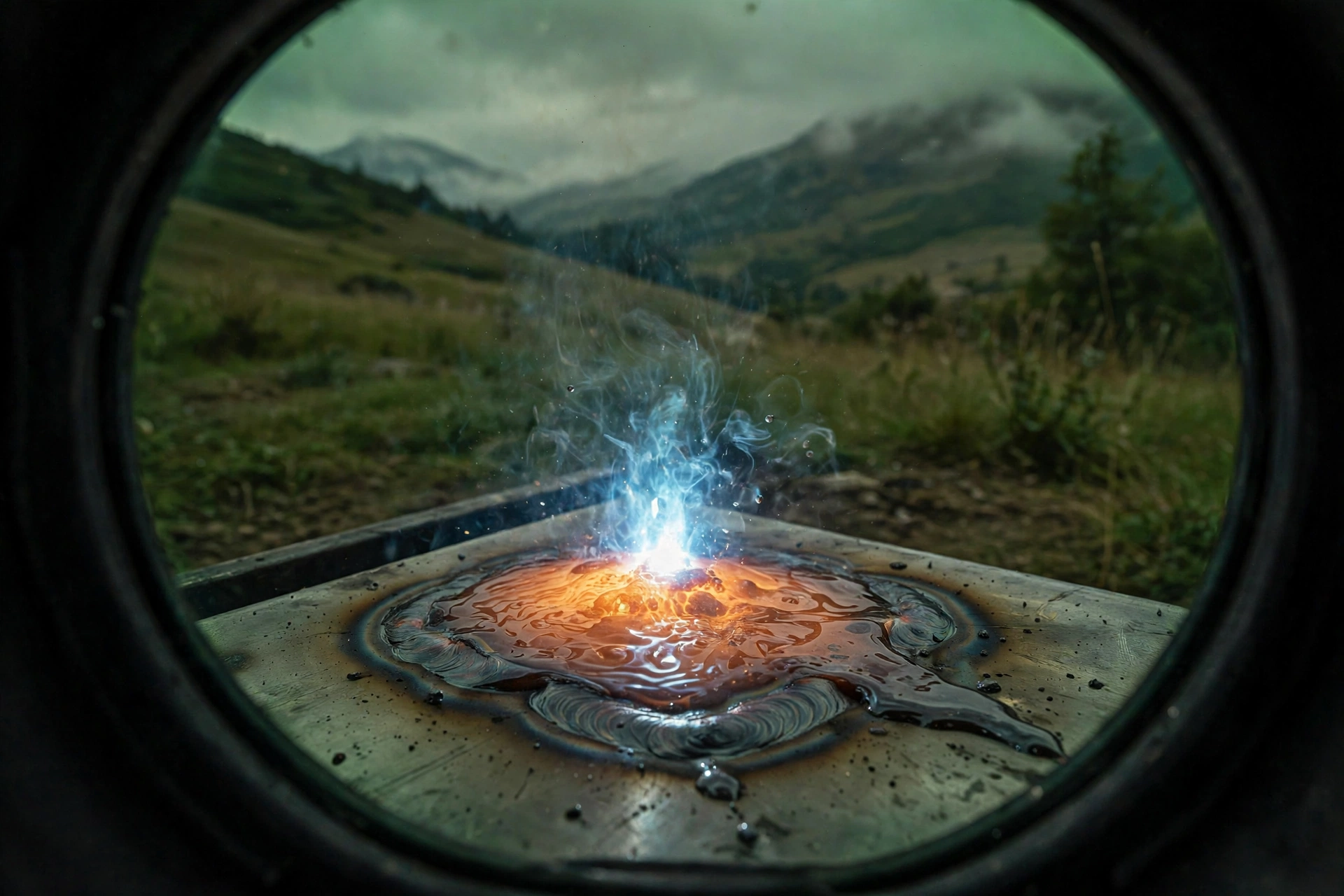
The work is also more precise. TIG welders watch the weld pool closely, judging its size, shape, and colour to control the bead. A dark, green-tinted lens that is fine for heavy welding hides exactly the detail a TIG welder needs to see, so optical clarity matters more here than in any other common process.
Low-amp TIG is often done in varied light. Workshop lighting, daylight from a window, and the arc itself all compete, and a sensor that confuses ambient light with arc light — or that is blinded by it — will behave inconsistently. Sensitivity and sensor placement therefore matter more than raw shade range alone.
What Filter Features Matter Most for Low-Amp TIG?
Sensitivity adjustment is the key feature. A helmet with adjustable sensitivity lets you set the sensors to trigger on a small arc, rather than relying on a fixed threshold tuned for brighter processes. Look for a helmet whose sensitivity range explicitly covers low-amp TIG — the maker will usually say so if it does.
Shade range matters too. Low-amp TIG often needs a lighter shade than heavy welding — shade 9 or 10 rather than 12 or 13 — so a helmet whose lightest dark shade is 10 or 11 may be too dark for fine low-amp work. A range starting at shade 9, or lower on some helmets, gives you room to match the shade to the current.
Sensor count and placement help as well. More sensors, placed around the lens, are less likely to be blocked by the workpiece, your hands, or the torch — a common cause of failed triggering in TIG, where the torch and filler rod sit close to the arc and can shade a single sensor.
What About Lens Clarity and Viewing Area?
True-colour lenses are a genuine advantage for TIG. Older auto-darkening filters tint everything green, which flattens the colours of the weld pool; true-colour filters give a more natural view, so the pool’s colour and edges are easier to judge. For precision TIG work, that clarity translates directly into better welds.
Optical class matters too. Lenses are rated for optical clarity, and a higher optical class means less distortion across the viewing area. Since TIG welders stare through the lens for long periods at fine detail, a low-clarity lens causes eye fatigue even when the shade is correct.
Viewing area is a trade-off. A larger viewing area shows more of the workpiece and your surroundings, which helps with positioning — but it also adds weight and cost. For bench TIG work, a medium-to-large viewing area is usually worth it; for out-of-position work, a lighter helmet with a standard area may be more comfortable.
What Comfort Features Suit Long TIG Sessions?
Weight is the first comfort factor. TIG sessions run long, and the welder’s head is often tilted over the work, so a heavy helmet strains the neck steadily. A lighter shell with well-balanced headgear is worth prioritising over extra features you will not use.
Headgear adjustment matters as much as weight. Good headgear lets you set the helmet’s distance from your face, its tilt, and its tightness, so the helmet sits comfortably for hours and flips up and down smoothly. Poor headgear makes even a good filter feel bad by the end of a shift.
Grind mode is a useful extra. TIG welders often grind tungsten and clean workpieces between welds, and a helmet with a grind mode — which locks the lens light for grinding without removing the helmet — saves constant helmet removal and keeps the face protected during prep.
- Sensitivity: adjustable, and rated for low-amp TIG triggering
- Shade range: down to shade 9 or lower for light currents
- Sensors: multiple, well placed, unlikely to be blocked by torch or hands
- Clarity: true-colour lens with a good optical class
How Do You Test a Helmet for Low-Amp TIG Before Buying?
Test it at your actual working current if you possibly can. Strike a low-amp arc with the helmet on and check that it darkens instantly, every time, from different angles and with the torch in different positions. A helmet that triggers reliably at high amps but hesitates at low amps has failed the test that matters for your work.
Check the view of the weld pool, not just the darkening. With the arc struck, can you see the pool’s edges and colour clearly? If the lens is too dark or too green-tinted to judge the pool, the shade or the lens type is wrong for your work, whatever the specification sheet says.
Finally, wear it for a while. A helmet that feels fine for a minute may press or slip after an hour, and TIG work punishes poor balance and headgear. Comfort over a full session is part of the helmet’s performance, not an afterthought — and the same fitted-and-used-properly principle that underlies protection in every helmet field, including the rotational-force management explained in this guide to what MIPS is for helmets, applies here too: the best filter in the world helps little if the helmet is not worn correctly.
Frequently Asked Questions
Q: Why does my helmet sometimes fail to darken for TIG welding?
A: In general terms, the arc at low amps is too small or dim for the sensor threshold, or a sensor is blocked by the torch, filler rod, or workpiece. Increase the sensitivity setting if your helmet has one, check that sensors are clean and unobstructed, and consider a helmet rated for low-amp TIG.
Q: What shade should I use for low-amp TIG?
A: It depends on the current, but low-amp TIG commonly uses a lighter shade than heavy welding — often around shade 9 or 10. Start at the maker’s recommended shade for your current and adjust until the arc is comfortable without being so dark that you cannot see the weld pool.
Q: Are true-colour lenses worth it for TIG?
A: Yes, in general terms — TIG work depends on judging the weld pool’s colour and edges, and a true-colour lens shows those far more naturally than an older green-tinted filter. For precision TIG, the clarity gain is a practical advantage, not just a comfort feature.

Olivia
Writer at Helmet Today, covering helmet reviews, fit and riding safety.