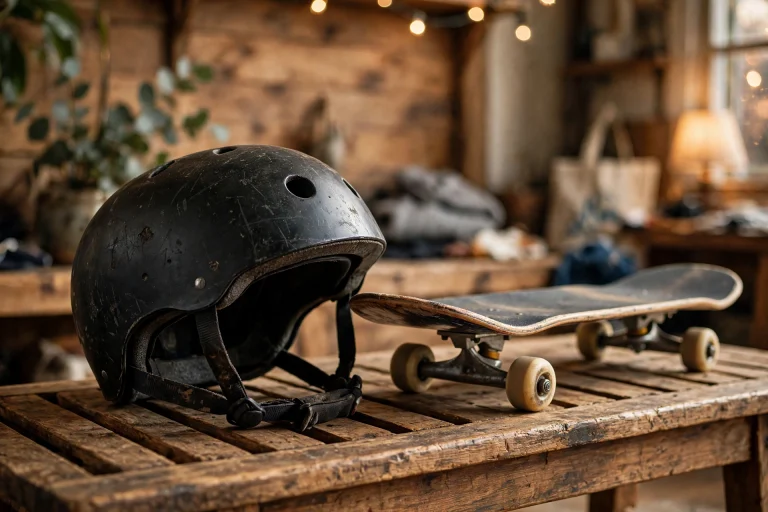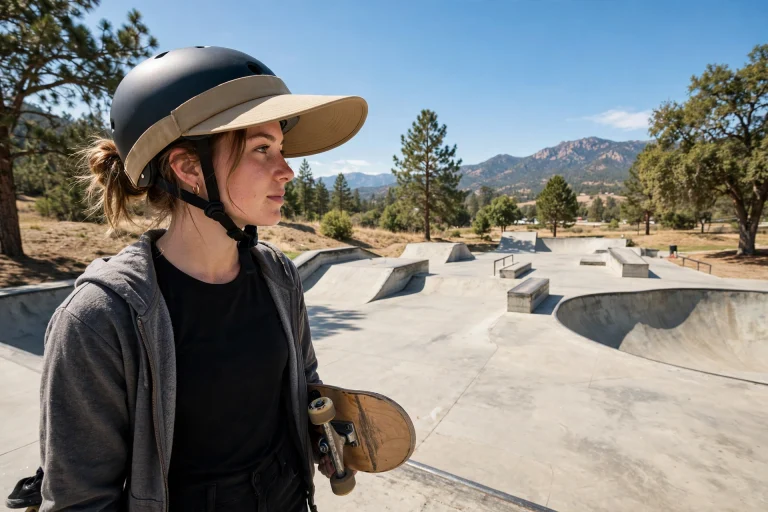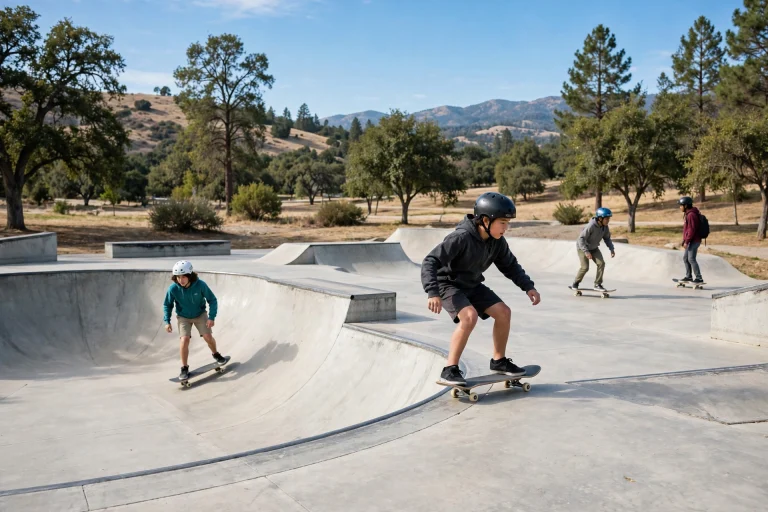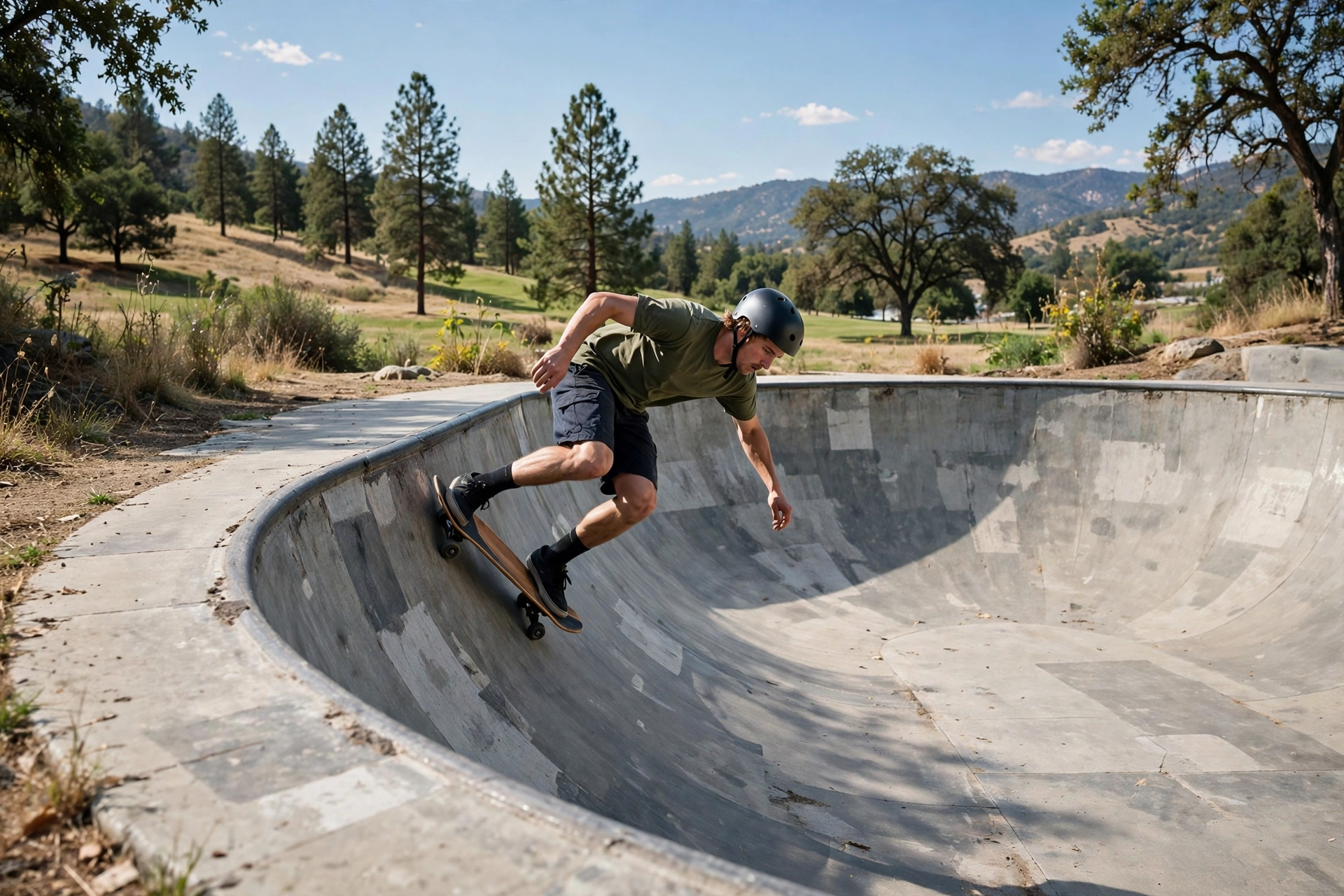
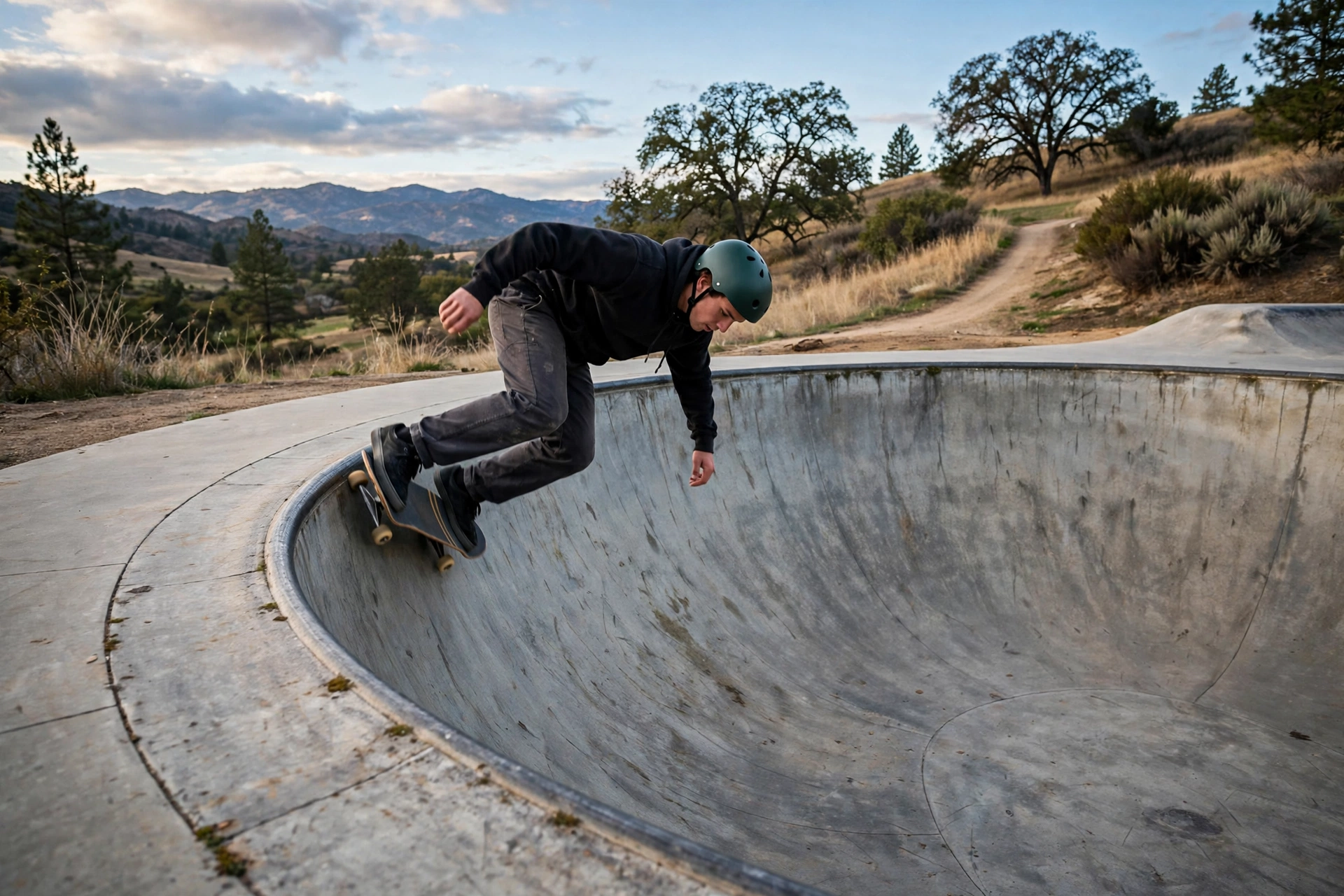
For bowl skating, you want a skate helmet with low, full coverage — one that sits low over the forehead and wraps well down the back and sides of the head. Bowl falls are often backward or sideways onto hard concrete, often from height, so coverage around the lower back of the skull matters more than ventilation or light weight.
A bowl is an unforgiving place to fall. The transitions are steep, the concrete is unyielding, and a skater who loses speed on a carve can go down hard with little warning. This guide explains what coverage means in a bowl helmet, how it differs from other skate helmets, and how to get the fit right.
Why Does Bowl Skating Need More Coverage?
Bowl skating is different from street skating in the way falls happen. On flat ground, most falls are forward onto hands and knees. In a bowl, you are riding curved walls, sometimes well above the flat bottom, and a slip can send you backward or sideways onto the back of your head. The coping at the rim adds another hard edge to the equation.
That is why classic skate-style helmets, with their low profile and extended rear coverage, became the standard for bowl and vert skating. They cover more of the back of the head than a typical road cycling helmet, which is cut higher at the back for aerodynamics. In a bowl, that extra coverage is exactly where protection is needed most.
Speed plays a part too. A skater pumping a deep bowl builds considerable speed, and a fall at speed onto concrete transfers a lot of energy. A helmet with full coverage spreads that impact over a wider area of the skull, which is the basic job any skate helmet is designed to do.
What Does Good Coverage Look Like on a Bowl Helmet?
Start with the forehead: the helmet should sit level, about a finger’s width above the eyebrows, and should not tip back to expose the forehead when you look up. At the back, the shell should come down low enough to cover the base of the skull — run a finger along the lower edge and check that it sits below the widest part of the back of your head.
The sides matter as well. A good bowl helmet wraps down over the temples and toward the ears without pressing on them. Coverage that stops high on the sides leaves the temple area exposed, which is a vulnerable spot in a sideways fall. The helmet should feel like a snug cap, not a shallow bowl perched on top of your head.
Check the fit dynamically, not just standing still. Crouch into a skating stance, look up toward the coping, and shake your head. The helmet should stay level and snug in every position. If it slides forward over your eyes when you look down, or rides up when you look up, the size or shape is wrong for you.
Should a Bowl Helmet Be Certified?
Yes, if you can get one. A certified skate helmet has been independently tested for the kind of repeated, lower-speed impacts that bowl skating produces, and that testing is worth having when the surface you are falling onto is concrete. Look for the certification label inside the helmet and check which standard it meets.
Certification and coverage work together: a certified helmet with poor coverage still leaves parts of your head exposed, and a well-covering helmet without certification is unproven. For bowl skating, aim for both — a certified, low-profile skate helmet that covers the back and sides properly.
Some skaters also look for helmets with rotational impact protection, which is designed to reduce twisting forces in angled falls. Bowl falls are very often angled, since you rarely hit the concrete perfectly square, so this feature is worth understanding. This guide to what MIPS means for helmets explains how one such system is designed to work.
How Should a Bowl Helmet Fit?
Fit is where many bowl skaters go wrong, because a helmet that is slightly too big feels comfortable right up until it shifts in a fall. Measure around your head just above the eyebrows and ears, and compare that number with the maker’s size chart — do not guess from hat size or from a friend’s helmet.
Once it is on, tighten the straps so they form a V under each ear, with the buckle snug under the chin. You should be able to fit no more than one or two fingers between the strap and your chin. If the helmet has an adjustable fit system, use it to take up slack at the back, but remember that the fit system is a fine-tuning aid, not a fix for the wrong shell size.
Comfort padding can be swapped in many helmets to fine-tune the fit. Thicker pads at the front or back can stop minor rocking, but if you need the thickest pads everywhere just to make a helmet snug, the shell itself is probably too big. In that case, size down rather than padding up.
Finally, wear the helmet as you will skate. If you wear a beanie underneath in winter, fit the helmet with it on. A helmet fitted over bare hair in a shop and then worn over a thick beanie at the bowl will sit higher and looser than intended.
When Should You Replace a Bowl Helmet?
Replace a bowl helmet after any hard impact, even if the outside looks fine. The foam liner inside is designed to crush as it absorbs energy, and that damage is often invisible from the outside. A helmet that has already absorbed one serious fall may not absorb the next one as well.
Also replace a helmet that has become loose through compressed padding, that shows cracks in the shell, or where the straps are frayed or the buckle no longer holds firmly. Bowl helmets take a lot of knocks — dropped on concrete, tossed in a bag, left in a hot car — and all of that wear adds up over time.
In general terms, a heavily used bowl helmet that is several years old and showing wear is a candidate for replacement even without a single big crash. Think of it as a consumable, not a lifetime purchase, and budget for a new one as part of your skating kit.
Frequently Asked Questions
Q: Can I use a bike helmet for bowl skating?
A: In general terms, a road bike helmet sits higher at the back and covers less of the lower skull than a skate helmet, so it is not ideal for bowls. A skate-style helmet with low rear coverage suits bowl falls better.
Q: Do I need a full-face helmet for bowl skating?
A: Most bowl skaters wear an open-face skate helmet, which protects the skull while keeping vision and hearing open. Full-face helmets are more common in downhill and high-speed disciplines where face impacts are more likely.
Q: How tight should a bowl helmet feel?
A: Snug all round, without pressure points or headaches. It should not rock, slide, or lift when you shake your head, and the straps should hold it level in a crouched skating stance.

Olivia
Writer at Helmet Today, covering helmet reviews, fit and riding safety.