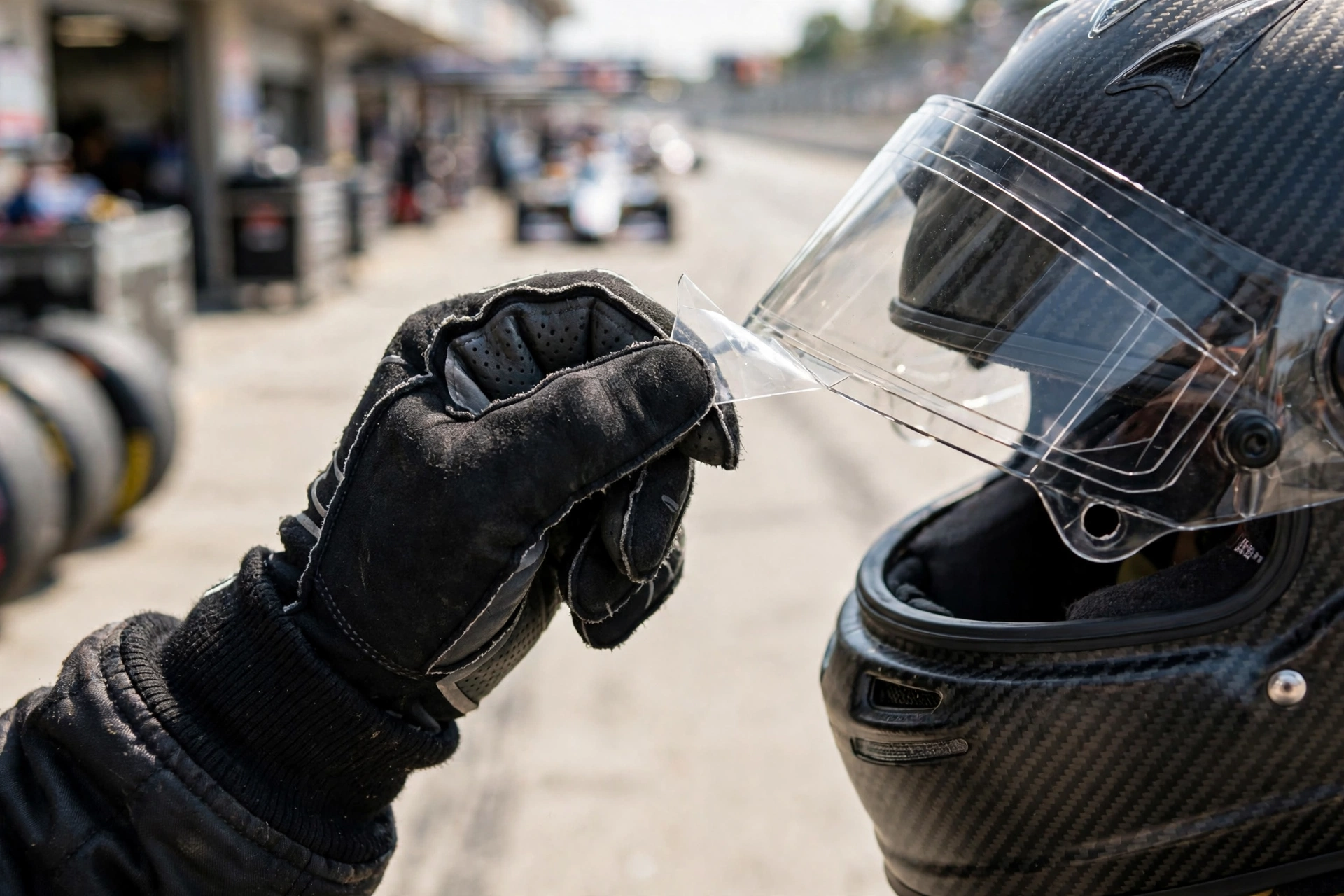
In general terms, motorsport helmet tear-offs are thin, transparent plastic sheets that stick over the visor and can be peeled away during a race, giving the driver a clean layer of vision without stopping — each tear-off is a fresh visor surface, ready in a single pull. They are one of the simplest and most effective visibility tools in motorsport, and they are used everywhere from karting to top-level single-seater racing.
Anyone who has driven in rain, dust, or spray knows how quickly a visor can become useless. Wiping it with a glove smears the grime and can scratch the visor, and stopping to clean it costs time a driver cannot afford. Tear-offs solve that problem by letting the driver discard the dirty layer and reveal a clean one underneath, all while keeping both hands near the wheel.
How Do Motorsport Helmet Tear-Offs Work?
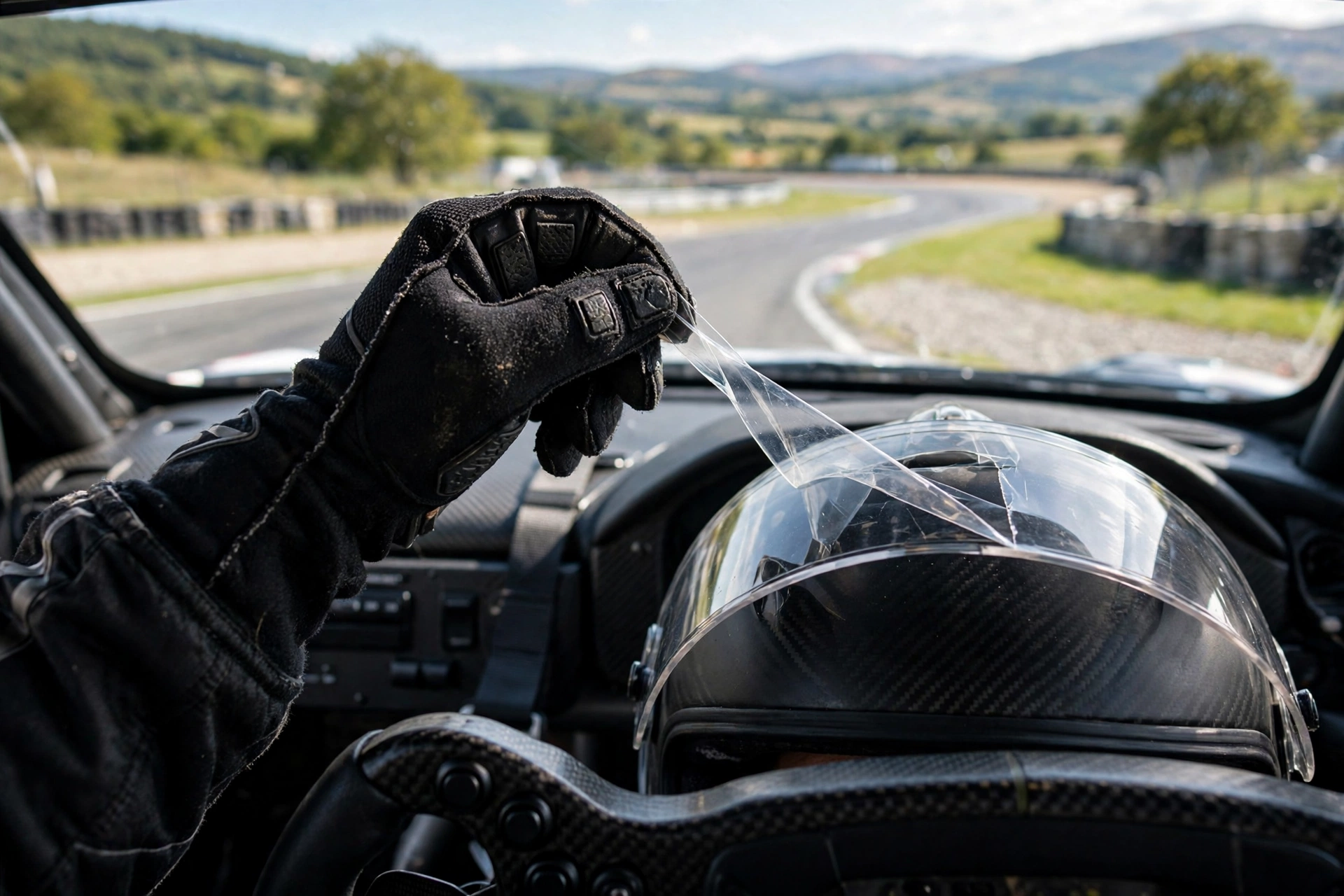
A tear-off is a very thin sheet of clear plastic, shaped to match the visor, with a small tab sticking out at one side. Several tear-offs are stacked on top of each other on the visor before a race, held in place by small posts or pins at the edges of the visor. When the top layer becomes dirty, the driver reaches up, grabs the tab, and pulls — the dirty layer peels away and flies off, leaving the next clean layer exposed.
The layers are designed to peel cleanly, one at a time, without pulling the layers beneath with them. This takes a bit of practice: pull too gently and the layer may tear halfway, pull at the wrong angle and you may take two layers at once. Most drivers practise the motion before a race so it becomes automatic, since fumbling with a visor at speed is the last thing anyone wants.
Tear-offs are disposable. Once pulled, a tear-off is gone — it blows away behind the car — so a driver has only as many clean layers as they stacked before the race. That is why drivers and teams think carefully about how many to fit: too few and the visor may be dirty for the last laps, too many and the stack can distort vision slightly through the extra layers.
When Are Tear-Offs Most Useful?
Tear-offs are most useful in wet or dirty conditions. In rain, spray from the car ahead coats the visor in seconds, and without tear-offs a driver is effectively driving blind within a lap or two. In dusty or muddy conditions — rally, off-road, or a dry circuit with a lot of rubber debris — the same problem appears more slowly but just as surely.
They are also useful in races with a lot of traffic. Following another car closely means driving through its spray, dust, and tyre debris, and the visor takes the worst of it. A driver running alone in clean air may barely need a tear-off all race, while a driver fighting through the pack may use several in a few laps.
In dry, clean conditions, tear-offs matter less, and some drivers run without them. But even on a clear day, a single stone chip or insect strike can smear a visor, and having a tear-off ready costs almost nothing in weight or vision. Many drivers fit them as a matter of routine, just in case.
How Many Tear-Offs Should You Stack on a Visor?
The right number depends on the race length and the conditions, but a common range is three to six layers for a typical race. Short sprint races in clean conditions may need only two or three, while a long wet race may call for more. Stacking too many layers can slightly reduce clarity and make the visor heavier, so more is not always better.
Teams often decide the number based on the weather forecast and the track. A wet race on a dirty track calls for a bigger stack; a short dry race on a clean circuit calls for a smaller one. Some drivers also keep a spare stack or a fresh visor ready in the pits, in case a pit stop allows a visor change mid-race.
It is also worth remembering that tear-offs are not the only visibility tool. Some drivers use a visor with an anti-fog insert for wet races, and some use tinted visors for bright conditions. Tear-offs work alongside these: they protect whatever visor is underneath, keeping its surface clean whatever its tint or coating.
Do Tear-Offs Fit Every Motorsport Helmet?
No — tear-offs only fit helmets whose visors have tear-off posts, the small pins at the edges that hold the stack in place. Most motorsport helmets designed for circuit and open wheel racing have these posts, but some helmets — particularly cheaper or road-oriented models — do not. Check your visor for posts before buying tear-offs, and buy tear-offs made for your visor’s shape, since a poor fit will peel unevenly.
Fitting tear-offs takes a little care. The visor must be clean and dry before the first layer goes on, or dirt trapped underneath will stay there for the whole race. Each layer should be smoothed down gently to remove air bubbles, and the tabs should all line up on the same side so the driver can find them by feel. A rushed fitting job leads to layers that peel badly when it matters.
If your helmet does not have tear-off posts, aftermarket posts can sometimes be fitted, but this is a job to do carefully — drilling or sticking posts onto a visor can weaken it or distort vision. If in doubt, ask the helmet manufacturer or a motorsport retailer whether your model supports tear-offs before modifying anything.
What Should You Know About Tear-Off Safety and Rules?
Tear-offs are generally safe, but they do have rules. Some series limit how many layers can be stacked, and some require tear-offs to be fitted in a particular way, so check your series regulations before a race. Discarded tear-offs are also a litter issue: they blow off the car and onto the track or run-off, and some circuits ask drivers to minimise their use or use biodegradable versions where available.
Vision through a stack of tear-offs is slightly less clear than through a bare visor, especially with many layers, so drivers should test their stack before a race rather than discovering the difference on the first lap. If the stack distorts vision noticeably, reduce the number of layers and accept a mid-race visor wipe as the trade-off.
Finally, remember that tear-offs protect your vision, but vision is only useful in a helmet that fits properly — and fit is what makes any helmet’s protection work, including systems that address angled impacts, as explained in this guide to what MIPS means for helmets. A clean visor on a poorly fitting helmet is still a poorly fitting helmet, so get the fit right first and the tear-offs second.
Frequently Asked Questions
Q: Can you reuse a motorsport helmet tear-off?
A: In general terms, no — tear-offs are single-use. Once peeled off, a tear-off cannot be refitted cleanly, so drivers stack fresh layers before each race.
Q: Do tear-offs work in the rain?
A: Yes — rain and spray are exactly when tear-offs are most useful. Pulling a dirty layer reveals a clean one underneath, restoring vision without stopping.
Q: Are tear-offs legal in all motorsport?
A: Most series allow them, but some limit the number of layers or specify fitting rules, so check your series regulations before fitting a stack for a race.

Olivia
Writer at Helmet Today, covering helmet reviews, fit and riding safety.