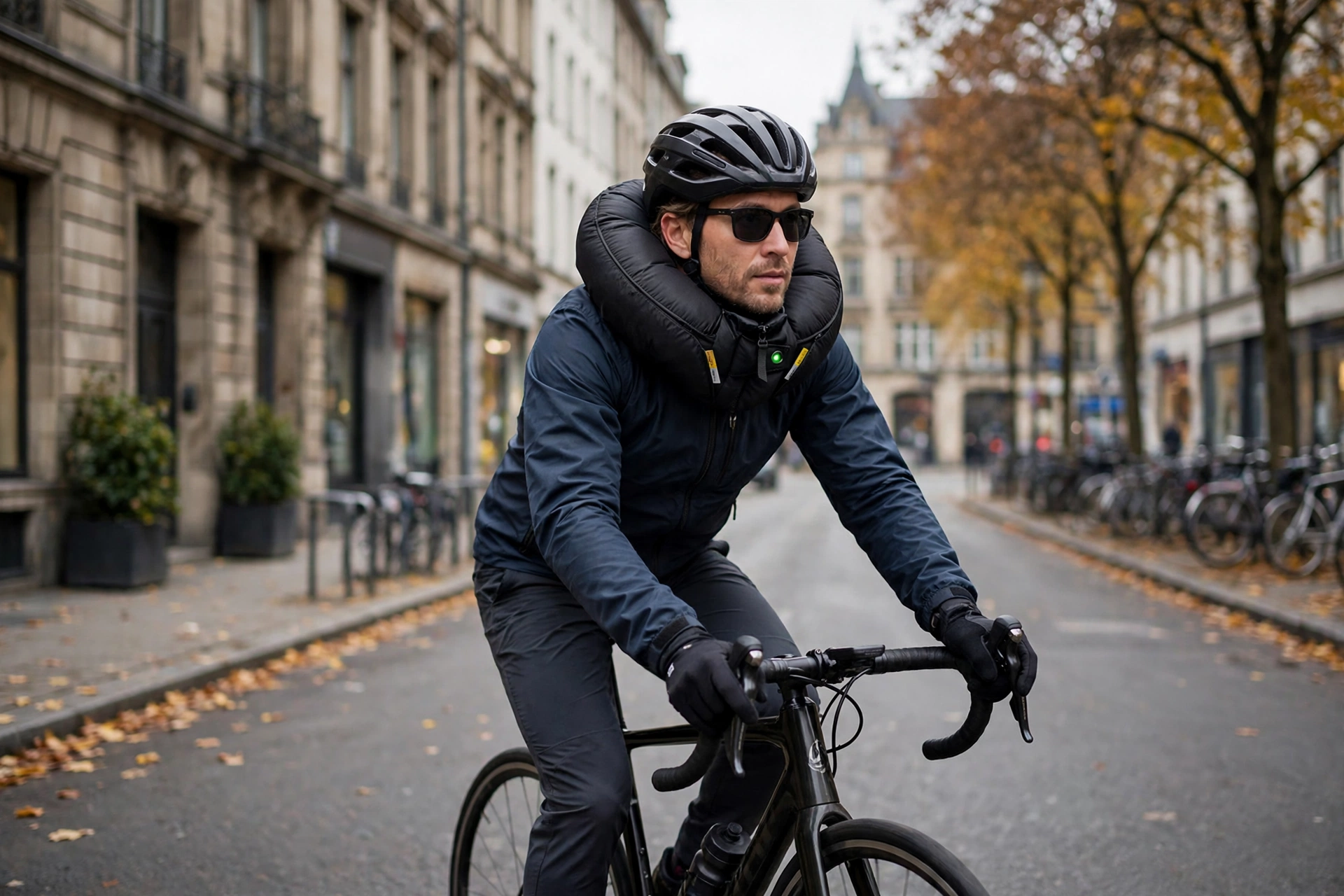
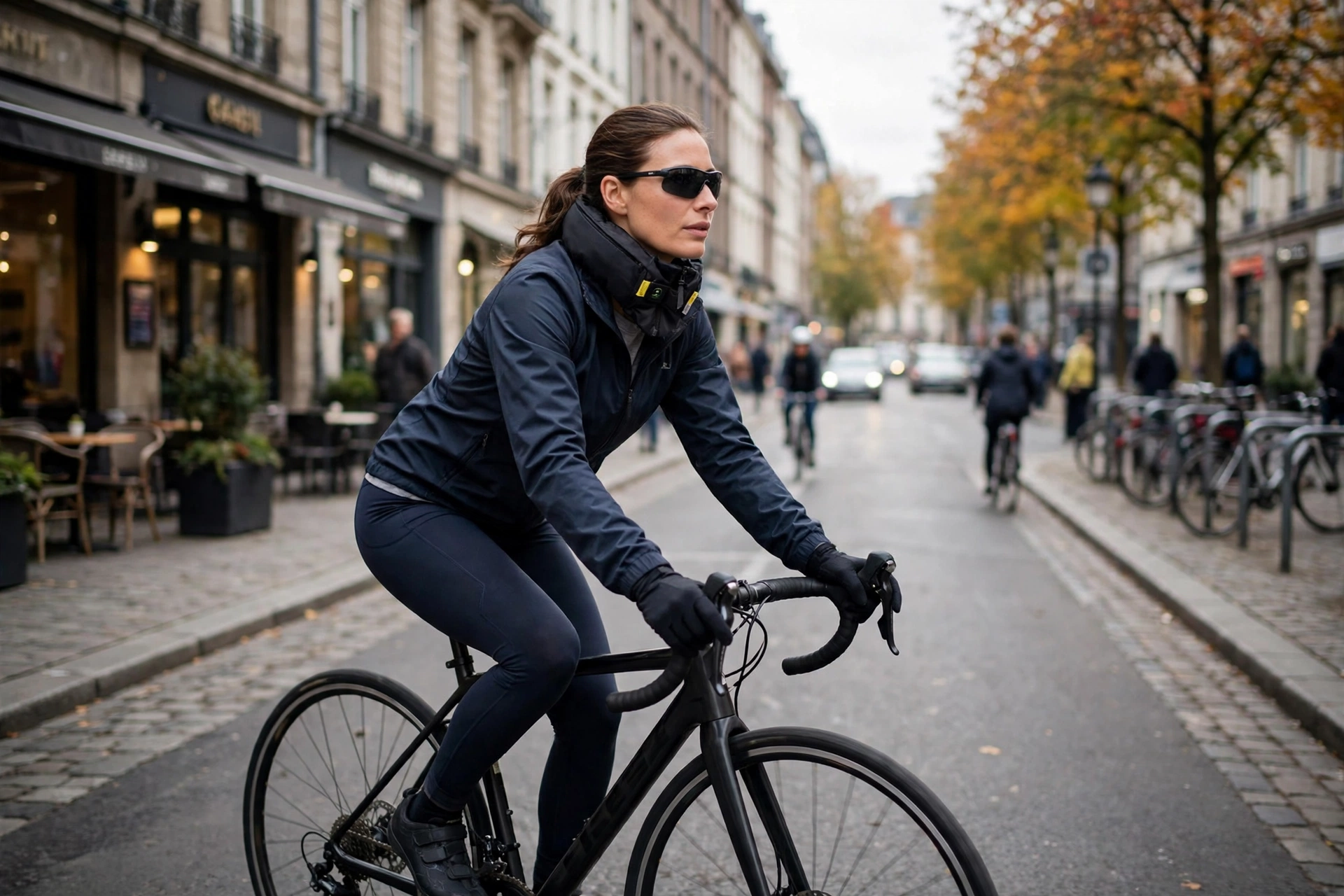
An airbag helmet for cyclists is a collar worn around the neck that inflates into a hood around the head in a crash, instead of using a hard shell and foam liner. Sensors in the collar detect the motion pattern of a fall and trigger inflation in a fraction of a second, so the airbag is in place before the head hits the ground. When it is not triggered, the wearer has no helmet on their head at all — just a soft collar.
Airbag helmets appeal to riders who dislike conventional helmets, especially commuters who want to arrive without helmet hair or carry a bulky helmet into the office. This guide explains how they work, where they do well, where they fall short, and who they suit best.
How Does an Airbag Helmet Detect a Crash?
The collar contains motion sensors — accelerometers and gyroscopes — that continuously track how the wearer is moving. The system’s software compares that movement against crash patterns learned from thousands of recorded falls. When the pattern matches a crash, it fires a gas inflator that fills the airbag hood almost instantly.
The key challenge is telling a crash from normal riding. Bumps, potholes, head turns, and sudden braking all create sharp movements, so the software has to be conservative enough to avoid false inflations while still firing fast enough to help in a real fall. That balance is why airbag helmets rely on complex algorithms rather than a simple impact switch.
Because the system depends on electronics, it needs power. The collar has a rechargeable battery and must be charged regularly, and most systems warn the wearer when the charge is low. A flat battery means no protection, which is a new kind of maintenance that conventional helmets never require.
What Happens When an Airbag Helmet Inflates?
On triggering, the hood deploys up and around the head, covering the skull and the back of the neck. The inflated airbag acts as a cushion between the head and the ground, spreading the impact over a larger area than a hard shell. The hood also supports the neck to some degree, which is a feature conventional helmets do not offer.
After inflation, the airbag helmet is spent. The collar must be sent back to the maker or fitted with a replacement inflator, depending on the design, before it can protect you again. That servicing step costs time and money, and it means you are without protection until the unit is restored.
It is also worth noting that the airbag only helps if it inflates before impact. In a very sudden collision, such as being struck from the side with no warning fall, the system may have less time to react than in a typical loss-of-balance fall. No helmet system covers every crash type, and airbags are no exception.
Are Airbag Helmets as Safe as Conventional Helmets?
In general terms, independent testing has found that airbag helmets can perform very well in the fall scenarios they are designed for, sometimes absorbing impact energy more effectively than a standard foam helmet. The soft, large cushion spreads force widely, and the neck coverage is a genuine extra benefit.
But the comparison has limits. Conventional helmets protect in any crash, powered or not, and they keep protecting after minor knocks. An airbag helmet protects only when its sensors fire correctly and its battery is charged, and it is a single-use device per crash. Testing standards for airbag helmets also differ from those for conventional helmets, so results are not always directly comparable.
For many riders the practical question is different: is an airbag helmet better than no helmet? For a rider who refuses to wear a conventional helmet, an airbag collar they actually wear is clearly better than nothing. For a rider happy in a conventional helmet, the case for switching is less clear-cut.
What Are the Downsides of Airbag Helmets?
Cost is the first downside. Airbag helmets cost considerably more than conventional helmets, and each inflation adds a servicing or replacement cost. For a rider on a budget, a good conventional helmet offers solid protection for much less money.
Weight and comfort are mixed. The collar is heavier than it looks and sits around the neck, which some riders find warm or restrictive, especially in hot weather. Others prefer it to a helmet on the head. Trying one on before buying is essential, since comfort is personal.
Weather and clothing matter too. The collar must sit correctly against the neck to deploy properly, so thick scarves, high collars, or bulky jackets worn over it can interfere. Riders in cold climates need to think about how the collar fits with their winter layers.
Who Should Consider an Airbag Helmet?
Airbag helmets suit urban commuters and leisure riders who ride at moderate speeds, dislike conventional helmets, and will keep the device charged. They are designed around the typical city fall — a loss of balance, a pothole, a car door — rather than high-speed sport crashes, so fast road cyclists and mountain bikers are usually better served by a conventional helmet.
They also suit riders who value arriving presentable. No helmet hair, no helmet to carry or lock up, and a collar that looks more like clothing than equipment are real advantages for someone cycling to work or to a meeting.
Whatever you choose, understanding how helmets manage impact energy helps you judge the options. Conventional helmets increasingly use liner systems that reduce twisting forces in angled falls, and this guide to MIPS technology explains how those systems work and why they matter for real-world crashes.
Maintenance is another everyday consideration. The collar should be kept clean and dry, the battery checked before rides, and the unit inspected for wear on the fabric and fastenings. Most makers also release software updates that refine the crash-detection algorithm, so pairing the collar with its app occasionally keeps the protection as accurate as the maker intends. A rider who treats the collar as a piece of safety equipment, rather than a fashion accessory, will get the best out of it — charged, updated, and worn correctly on every ride.
Frequently Asked Questions
Q: Do airbag helmets need charging?
A: Yes. The collar runs on a rechargeable battery that powers its sensors, so it must be charged regularly. A flat battery means the system cannot deploy in a crash.
Q: Can you reuse an airbag helmet after it inflates?
A: Not immediately. After inflation the unit must be serviced or fitted with a replacement inflator by the maker before it can protect you again.
Q: Are airbag helmets suitable for fast road cycling or mountain biking?
A: In general terms, they are designed mainly for urban and leisure riding at moderate speeds. Fast or off-road riders are usually better served by a conventional helmet built for those conditions.

Olivia
Writer at Helmet Today, covering helmet reviews, fit and riding safety.