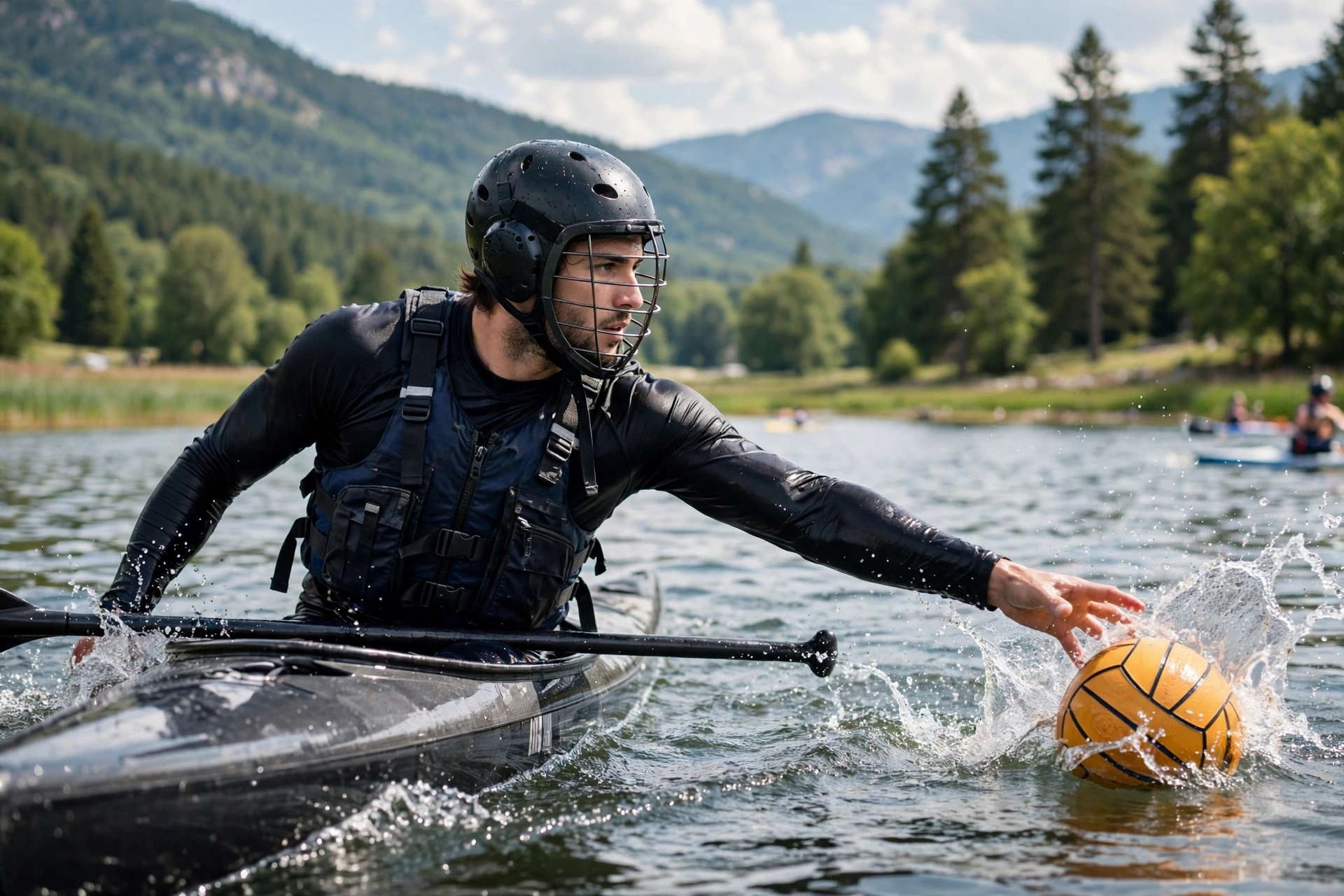
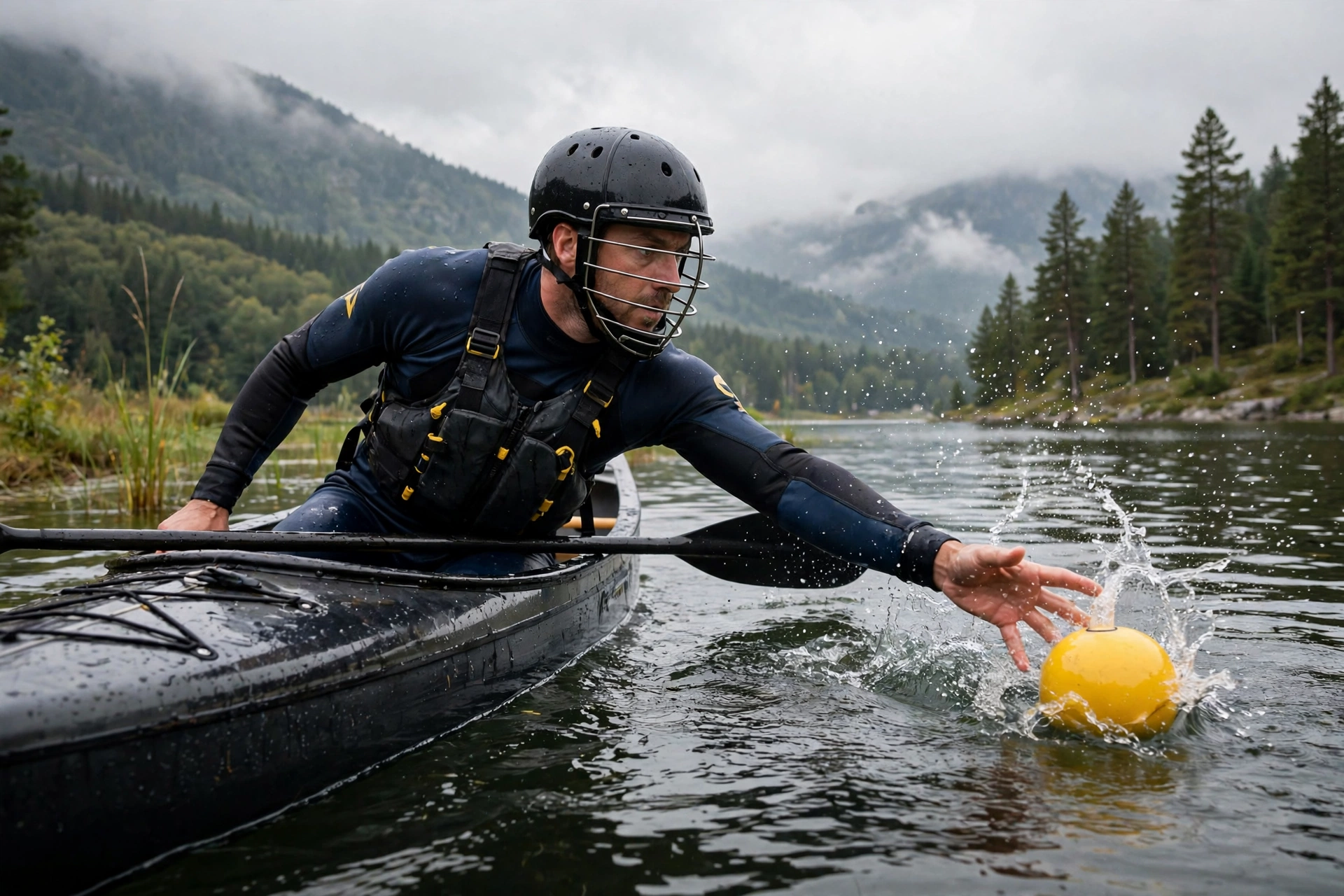
Yes, canoe polo players wear helmets — a canoe polo helmet is a lightweight water helmet with a faceguard, worn by every player during a game. Canoe polo is played in kayaks on a stretch of water, with players throwing a ball into a goal suspended above the water. The helmet protects the head from the ball, from paddles, and from contact with other boats and players in a fast, close-quarters game.
Canoe polo is sometimes called kayak polo, and the two names describe the same sport. Games are short and intense, with players paddling hard, turning sharply, and reaching across the water to block or intercept the ball. This guide explains what a canoe polo helmet is, why it has a faceguard, and what to look for when choosing one.
What Is a Canoe Polo Helmet?
A canoe polo helmet is a hard-shell water helmet that covers the top, sides, and back of the head, with a faceguard across the front. The shell is usually made from a tough plastic, and the inside has padding that holds the helmet in place and cushions the head. The faceguard is a grid of bars that sits in front of the face, leaving enough space to see the ball and the other players clearly.
The helmet is designed for use on the water, so it is light and drains easily. It does not have the thick liner of a bike helmet or the full face coverage of a bobsled helmet. Instead, it is built for the kinds of knocks that happen in canoe polo: a ball thrown at speed, a paddle swinging across the water, or a bump against another kayak.
In general terms, a plain whitewater helmet without a faceguard does not give the same protection in a game where the ball is in the air for much of the time.
Why Does a Canoe Polo Helmet Have a Faceguard?
The faceguard is there because the ball is the main risk in canoe polo. The ball is thrown hard and often at head height, as players pass across the pool or shoot at the goal. Without a faceguard, a ball could strike the nose, teeth, or eyes. The grid of bars spreads the force of a ball strike and keeps the ball away from the face, while the gaps between the bars keep the player’s view open.
The faceguard also helps against paddles. In a crowded game, paddles move quickly in all directions, and a paddle blade can swing close to a player’s head. The bars give the face an extra layer of protection without blocking the player’s vision. The bars need to be close enough to stop a ball, but spaced wide enough to see through.
Some players wear a faceguard that is part of the helmet, while others use a faceguard that clips onto a standard water helmet. Either way, the faceguard should sit firmly and not move about during play.
How Is a Canoe Polo Helmet Different from a Whitewater Helmet?
A canoe polo helmet and a whitewater helmet share the same basic shape, but they are built for different risks. A whitewater helmet is designed mainly to protect against rocks and hard river features, so its shell is often thicker and its coverage extends lower at the back and sides. A canoe polo helmet is built for a ball game, so the faceguard matters more than extra shell thickness.
The fit is also different. In canoe polo, the helmet must stay in place during fast turns, sudden stops, and capsizes, but it must also allow the player to hear teammates and the referee. Both helmets drain water and dry quickly, and both use a chin strap, but the polo helmet is usually lighter, because players wear it for short, intense games rather than all day.
If you already own a whitewater helmet, it may be possible to add a faceguard to it, provided the faceguard is made to fit that helmet. In general terms, a faceguard that does not fit the shell properly is not a safe substitute for a helmet designed for the game.
How Should a Canoe Polo Helmet Fit?
A canoe polo helmet should sit level on the head, covering the forehead without slipping down over the eyes. It should feel snug all round, without pressing hard on one spot. When you shake your head from side to side, the helmet should move with your head rather than sliding about on its own. The chin strap should be fastened snugly under the chin, with no more than a small gap, so the helmet stays on if you capsize.
The faceguard should sit a short distance in front of your face, not touching your nose or chin. You should be able to see the ball clearly in all directions, including up towards the goal, without the bars blocking your view. Try the helmet on with the faceguard in place, and check that you can turn your head freely and hear what is said around you.
Children and smaller players need a helmet sized for their head, not an adult helmet pulled tight. A helmet that is too large will move about and may not protect properly, while one that is too small will be uncomfortable and may not cover the head fully. If you are learning about how helmets handle different kinds of impact, reading about what MIPS is for helmets can help you understand one of the technologies used in modern helmet design.
When Should You Replace a Canoe Polo Helmet?
A canoe polo helmet should be replaced after a hard impact, even if the shell looks undamaged from the outside. The padding and shell can be weakened by a strong blow in ways that are hard to see, and a helmet that has already taken a hard knock may not protect as well next time. In general terms, any helmet that has been hit hard by a ball at close range or struck by a paddle should be checked carefully and replaced if there is any doubt.
Helmets also wear out over time. Sunlight, salt water, and repeated use can weaken the shell and the straps, and padding can become compressed and less effective. Rinse the helmet with fresh water after use in salt water or a chlorinated pool, and let it dry in the shade rather than in direct sun. Store it somewhere cool and dry, away from heavy objects that could press on the shell.
Check the helmet before each game: look for cracks in the shell, loose or bent faceguard bars, frayed straps, and padding that has come away from the inside. If any of these are present, the helmet should not be used until it is repaired or replaced. A helmet in good condition, fitted well, and worn for every game is the simplest way to stay safe in canoe polo.
Frequently Asked Questions
Q: Do all canoe polo players wear helmets?
A: Yes, in general terms every player wears a helmet with a faceguard during a game, because the ball and paddles create a risk to the head for everyone on the water.
Q: Can you wear a bike helmet for canoe polo?
A: No. A bike helmet is not made for water use, has no faceguard, and is built for a different kind of impact. A water helmet with a faceguard is the right choice for canoe polo.
Q: Does a canoe polo helmet protect against concussion?
A: No helmet can guarantee protection against concussion. A canoe polo helmet reduces the risk from ball and paddle strikes, but a hard blow can still cause injury, so any head knock should be taken seriously.

Olivia
Writer at Helmet Today, covering helmet reviews, fit and riding safety.