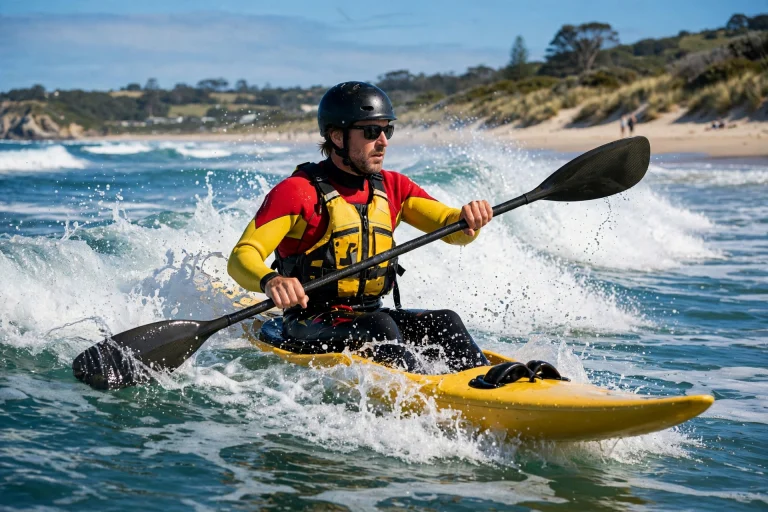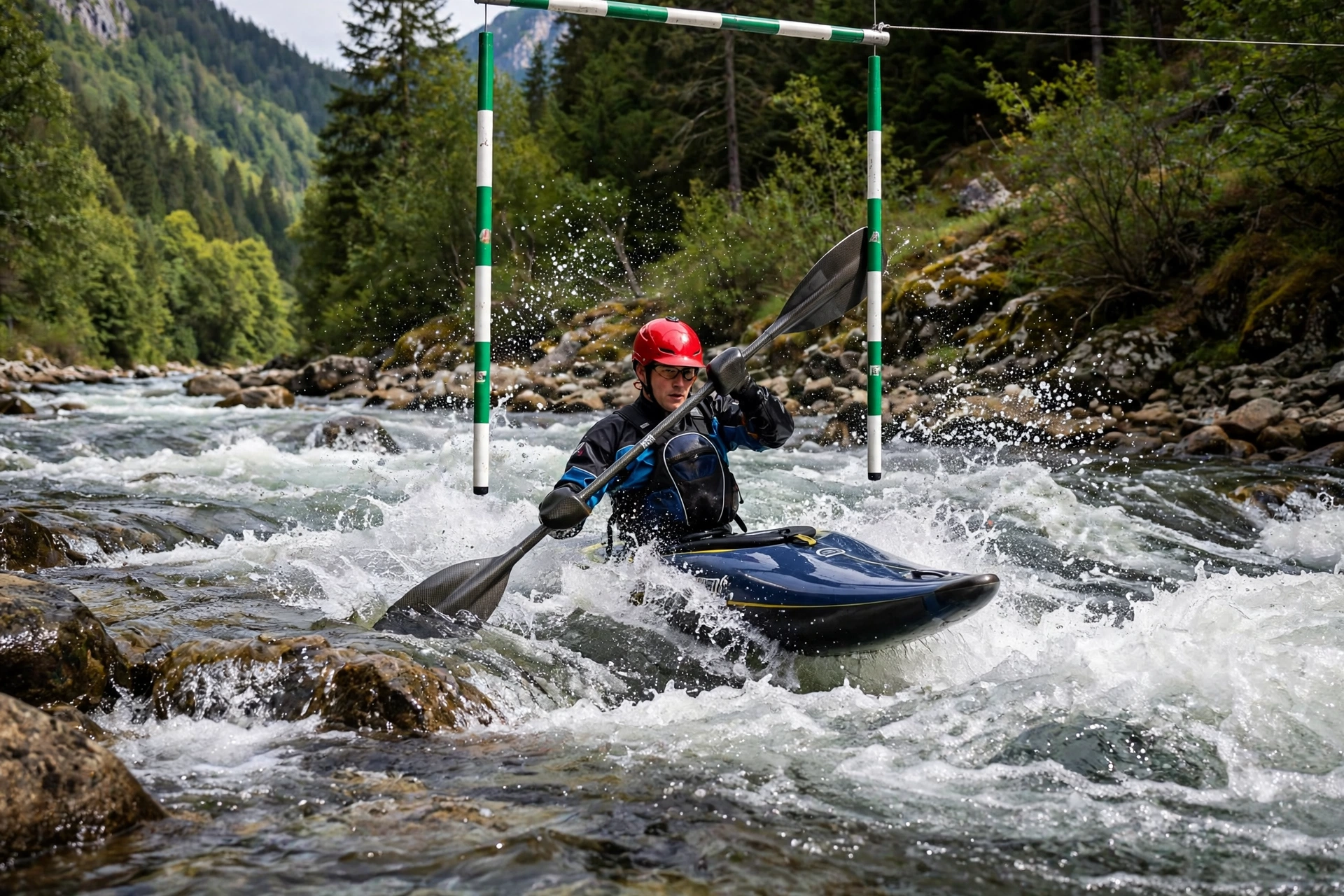
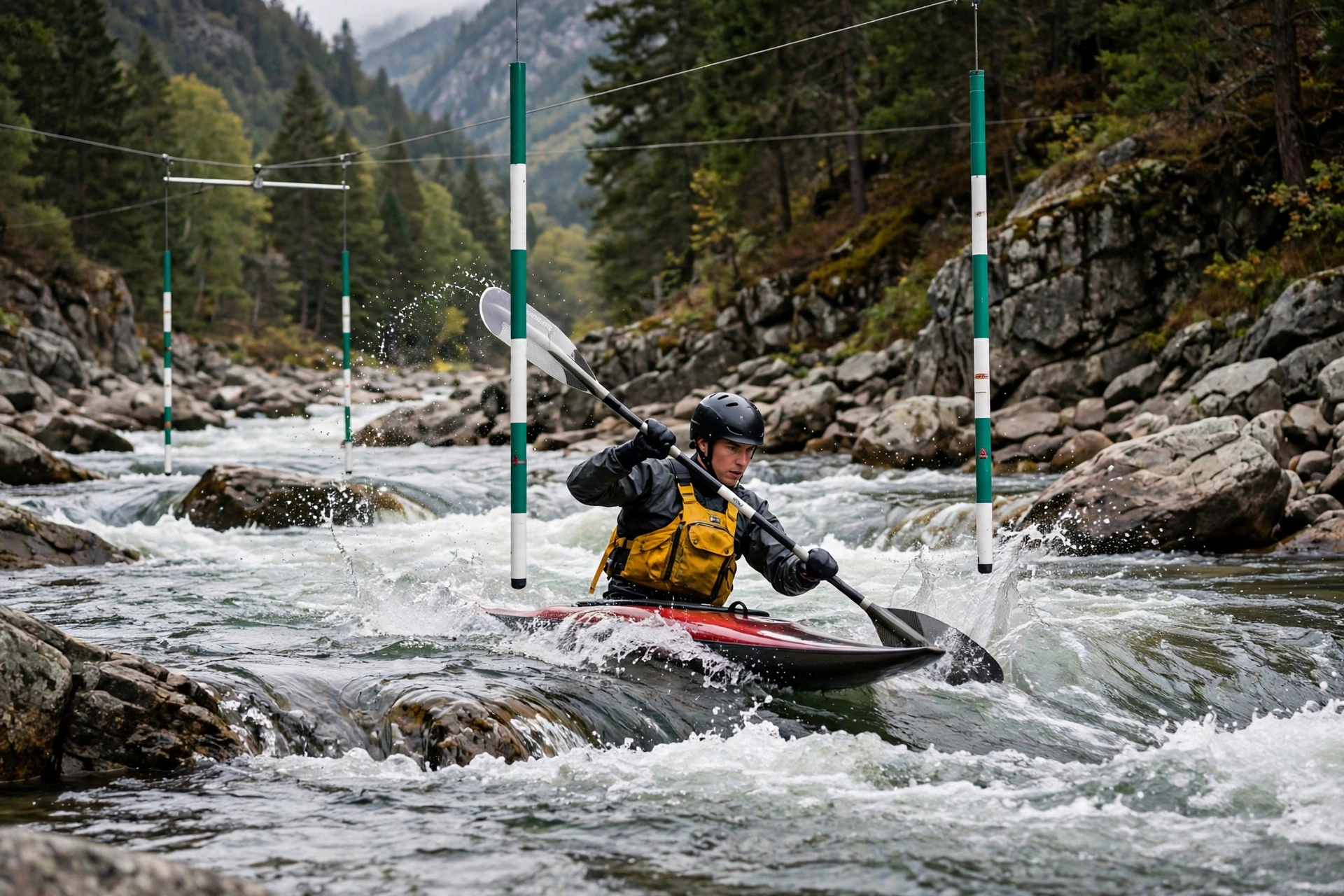
Yes, whitewater slalom paddlers wear helmets — a whitewater slalom helmet is a hard-shell water helmet that protects the head while racing through gates on a fast, rocky river. Whitewater slalom is a timed race in a kayak or canoe, with the paddler steering through a series of gates hung above the water. The river is fast and rocky, and the paddler is close to the water throughout the run.
Slalom is an Olympic sport, and it is also popular at club level on artificial courses and natural rivers. Runs are short and intense, with the paddler making sharp turns and fighting the current. This guide explains what a whitewater slalom helmet is, why it matters on a river, and how to choose one.
What Is a Whitewater Slalom Helmet?
A whitewater slalom helmet is a hard-shell water helmet that covers the top, sides, and back of the head, with extra coverage low at the back and around the ears. The shell is usually made from a tough plastic or composite, and the inside has padding that holds the helmet in place and cushions the head.
The helmet is designed for the kinds of knocks that happen on a river: a strike against a rock, a knock from a gate pole, or a bump against the riverbed in shallow water. The shell spreads the force of an impact, while the padding cushions the head.
Unlike a bike helmet, a whitewater slalom helmet is made for water use and for repeated knocks. It has few vents that could trap water, and its straps are made from materials that cope with being soaked. In general terms, a slalom helmet is one of the most protective water helmets, because the river itself is hard and unforgiving.
Why Is a Helmet Important for Whitewater Slalom?
A helmet matters in whitewater slalom mainly because of the rocks. Rivers used for slalom are rocky, and the water is shallow in places, so a capsize can mean hitting a rock with the head. The current is strong, and a paddler who is upside down in the water cannot always control where their head goes. A helmet protects the head during those moments and reduces the risk of a serious knock.
The gates are another risk. Slalom gates are poles hung above the water, and paddlers pass close to them at speed, often brushing them with their paddle or shoulder. A gate pole striking the head can cause a painful knock, and a helmet covers the parts of the head most likely to be hit. The gates and the rocks together make a helmet essential in slalom.
The speed of the river adds to the risk. Slalom paddlers move fast through the course, and a mistake can mean being swept into a rock or a stopper. A helmet gives the paddler confidence to push hard through the gates, because a knock is less likely to end the run with a serious injury.
How Is a Slalom Helmet Different from a Recreational Kayak Helmet?
A whitewater slalom helmet and a recreational kayak helmet share the same basic shape, but the slalom helmet is usually lighter and lower in profile. Slalom paddlers need to move their heads quickly to see the next gate, so a bulky helmet can get in the way. A recreational helmet may have a little more coverage, because recreational paddlers spend longer on the river and face a wider range of hazards.
The fit is also different. In slalom, the helmet must stay firmly in place through sharp turns, sudden stops, and rolls, without shifting or blocking the paddler’s view. A recreational helmet is often fitted a little more loosely for comfort on long days. Both helmets drain water and dry quickly, and both use a chin strap, but the slalom helmet is usually the lighter and sleeker of the two.
If you already own a whitewater helmet, it may serve for slalom as long as it fits well and gives enough coverage at the back and sides. In general terms, the best helmet for slalom is one that is light, snug, and made for fast river use, rather than a helmet borrowed from flat water paddling.
How Should a Whitewater Slalom Helmet Fit?
A whitewater slalom helmet should sit level on the head, covering the forehead without slipping down over the eyes. It should feel snug all round, without pressing hard on the temples or the back of the head. Shake your head from side to side: the helmet should move with your head, not slide about on its own. The chin strap should be fastened snugly under the chin, with only a small gap, so the helmet stays on if you capsize.
The helmet should cover the back of the head well, because a paddler who capsizes may hit the back of the head on a rock. Check that the helmet does not ride up at the back when you look up towards the gates. You should be able to turn your head freely and to hear the shouts of coaches and other paddlers on the bank.
Children and smaller paddlers need a helmet sized for their head, not an adult helmet pulled tight. A helmet that is too large will move about and may not protect properly, while one that is too small will be uncomfortable and may not cover the head fully. If you are learning about how helmets handle different kinds of impact, reading about what MIPS is for helmets can help you understand one of the technologies used in modern helmet design.
When Should You Replace a Whitewater Slalom Helmet?
A whitewater slalom helmet should be replaced after a hard impact, even if the shell looks undamaged from the outside. The padding and shell can be weakened by a strong blow in ways that are hard to see, and a helmet that has already taken a hard knock may not protect as well next time. In general terms, any helmet that has struck a rock hard should be checked and replaced if there is any doubt.
Helmets also wear out over time. Sunlight, river water, and repeated use can weaken the shell and the straps, and padding can become compressed and less effective. Rinse the helmet with fresh water after use, and let it dry in the shade rather than in direct sun. Store it somewhere cool and dry, away from heavy objects that could press on the shell.
Check the helmet before each run: look for cracks in the shell, dents, loose padding, frayed straps, and a buckle that no longer fastens firmly. If any of these are present, the helmet should not be used until it is repaired or replaced. A helmet in good condition, fitted well, and worn for every run is the simplest way to stay safe in whitewater slalom.
Frequently Asked Questions
Q: Do all slalom paddlers wear helmets?
A: Yes, in general terms every paddler wears a helmet for slalom, from club races to the Olympics, because the rocks and gates create a risk to the head for everyone on the river.
Q: Can you wear a bike helmet for whitewater slalom?
A: No. A bike helmet is not made for water use, is not built for knocks against rocks, and may not stay in place in a capsize. A water helmet made for whitewater is the right choice.
Q: Does a slalom helmet protect against concussion?
A: No helmet can guarantee protection against concussion. A slalom helmet reduces the risk from rock and gate strikes, but a hard blow can still cause injury, so any head knock should be taken seriously.

Olivia
Writer at Helmet Today, covering helmet reviews, fit and riding safety.