
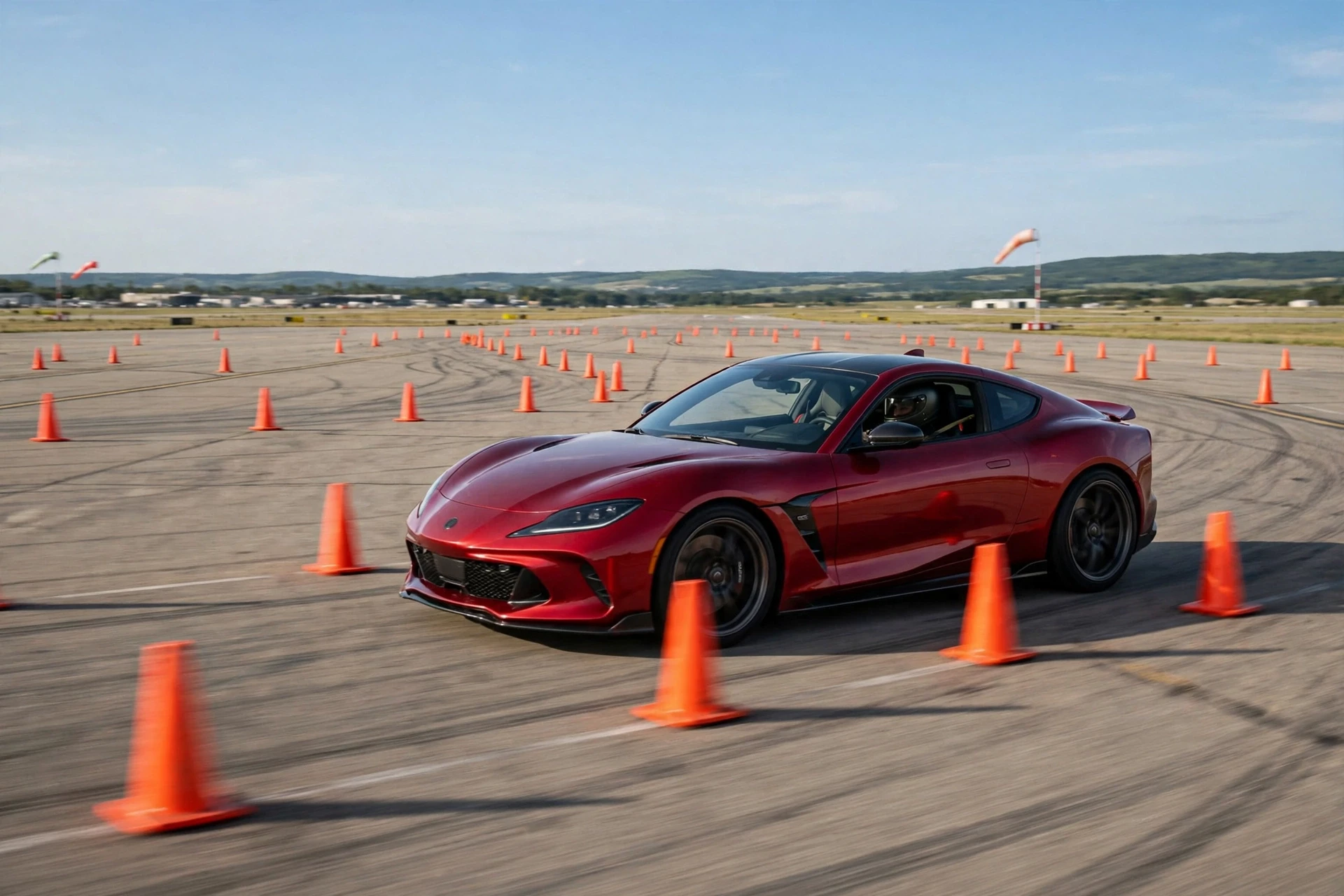
An autocross helmet is a motorsport helmet worn for autocross, a timed driving event in which one car at a time navigates a course marked out with cones, usually on a car park or airfield. Autocross is one of the most accessible forms of motorsport, open to ordinary road cars as well as prepared race cars, and the helmet is required because even a low-speed event carries a risk of hitting a barrier, a kerb, or another obstacle.
What Is Autocross?
Autocross is a driving event in which a driver runs a course alone against the clock, weaving through a series of cones laid out on a large flat surface such as a car park, an airfield, or a disused runway. The course is usually short, taking less than a minute to complete, and the driver gets several runs, with the best time counting. Knocking over a cone adds a time penalty, so accuracy matters as much as speed.
Because only one car is on the course at a time, autocross is a safe way to learn car control, and it is popular with beginners as well as experienced drivers. The speeds are lower than on a race track, but the car is still being pushed hard through tight corners, and a mistake can send it into a kerb, a barrier, or a light pole. In general terms, the helmet is there for the unexpected moment, and most autocross events require one even for a standard road car.
What Kind of Helmet Do You Need for Autocross?
For autocross, most events require a helmet that meets a recognised motorsport safety standard, and many accept helmets made for car or motorcycle use, depending on the rules of the organising body. A full-face helmet is the most common choice, because it protects the whole head and face, but some events allow an open-face helmet. The key point is to check the rules of the event before you turn up, since standards and dates matter.
The helmet should be a proper motorsport or motorcycle helmet, not a bicycle helmet or a hard hat, which are not made for this kind of impact. It should fit snugly, sit level on the head, and be fastened securely before the run. If you want to understand one of the safety technologies used in modern helmets, reading about what MIPS is for helmets is a good place to start, though motorsport helmets use their own specialised systems as well.
How Should an Autocross Helmet Fit?
An autocross helmet should fit snugly all round the head, without pressure points and without wobbling when the driver shakes their head. It should sit level, covering the forehead without slipping down over the eyes, and the back should sit low enough to protect the back of the head. If the helmet can be rocked forwards or backwards easily, it is probably too loose.
The chin strap should be fastened snugly before the run, and it is worth trying the helmet on with any glasses or balaclava that will be worn during the event. A helmet that fits well will stay put under hard braking and tight cornering, while a loose helmet can shift at the worst moment and block the driver’s view. In general terms, comfort matters too: a helmet that pinches or presses will distract the driver, and autocross rewards concentration above all.
What Else Should You Bring to an Autocross Event?
Apart from the helmet, an autocross driver needs a roadworthy car, a driving licence, and a willingness to walk the course before driving it. Walking the course is how drivers learn the layout of the cones, and it is one of the most useful parts of the day. A tyre pressure gauge, a pump, and some basic tools are useful for adjusting the car between runs, and a bottle of water and sun protection are sensible on a warm day.
Some drivers bring a small folding chair, a notebook for recording times, and a camera to film their runs. The helmet works as part of this whole setup: it is the main piece of safety kit, while the rest is about learning and enjoying the event. In general terms, autocross is a low-cost way into motorsport, and most of what a beginner needs is already in the garage.
How Can a Beginner Get the Most From Autocross?
A beginner gets the most from autocross by starting slowly and building up speed as they learn the course. The first run is about finding the way through the cones, not about setting a fast time, and each later run is a chance to smooth out the line and brake later. Looking ahead to the next cone, rather than at the one in front of the car, is one of the most useful habits a new driver can learn.
Talking to experienced drivers helps too. Autocross is a friendly sport, and most regulars are happy to give advice, offer a passenger ride, or look at a beginner’s run and suggest improvements. In general terms, the fastest drivers are often the smoothest, not the most aggressive, and learning to be smooth is a skill that transfers to every other kind of driving.
When Should You Replace an Autocross Helmet?
An autocross helmet should be replaced after a crash or a hard impact, even if it looks fine from the outside. The liner inside a helmet can be damaged by a heavy knock without any visible sign on the shell, and a helmet that has already absorbed an impact may not protect as well the next time. For that reason, a helmet that has been in a crash should be retired rather than kept in use.
Age and wear matter as well. The padding, straps, and visor can wear down over several seasons of use, and the helmet may no longer fit as snugly as it once did. Safety standards also change over time, and an older helmet may no longer meet the rules of the event, so it is worth checking the date and the standard on the label before the season starts. In general terms, a helmet is a piece of safety equipment with a working life, and it should be replaced before it stops doing its job properly.
Do I need a helmet for autocross?
Yes, in general terms most autocross events require a helmet, even for a standard road car, because the car is driven hard through a cone course and a mistake can lead to an impact.
Can I use a motorcycle helmet for autocross?
Many events accept a motorcycle helmet that meets a recognised standard, but it is worth checking the rules of the event first, since some organisers require a helmet made for car motorsport.
Is autocross a good way to start motorsport?
Yes, autocross is one of the most accessible and low-cost ways into motorsport, since it uses ordinary cars, runs one car at a time, and is open to beginners.

Olivia
Writer at Helmet Today, covering helmet reviews, fit and riding safety.