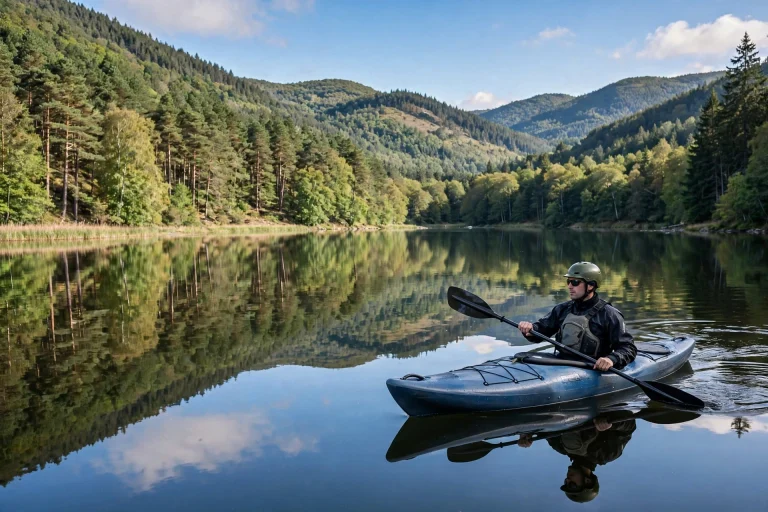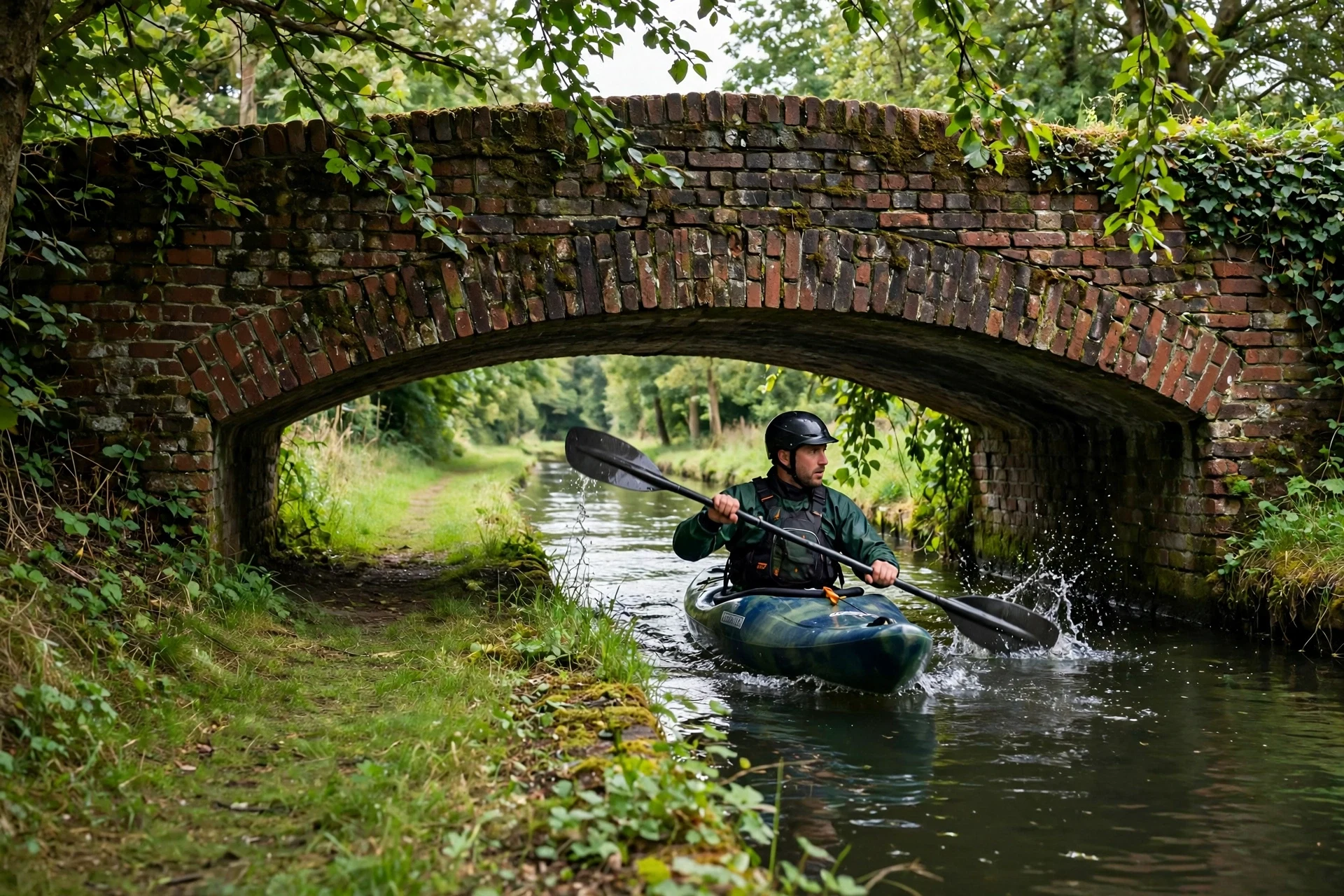
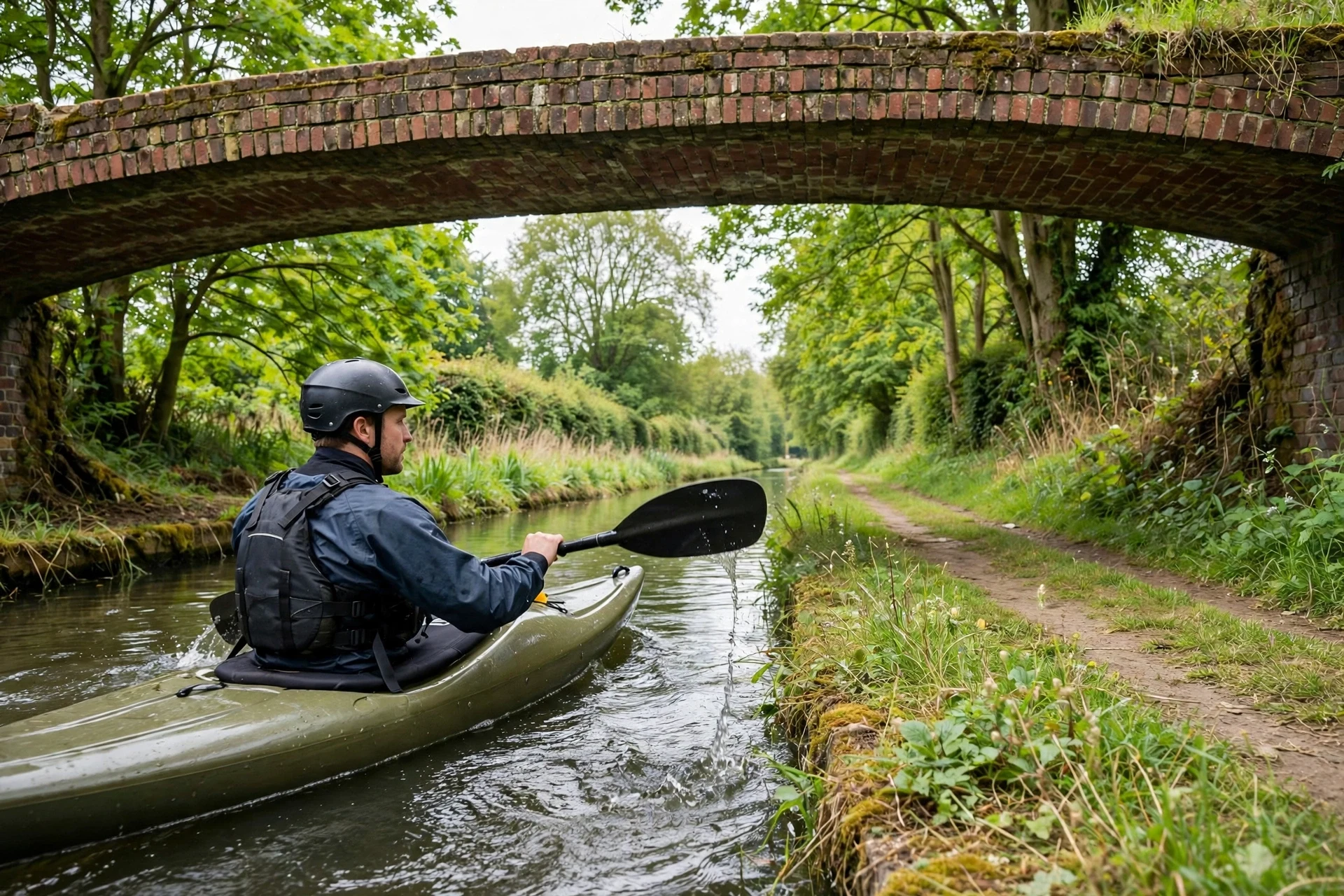
A canal kayaking helmet is a water sports helmet worn for kayaking on a canal, where it protects the head from the paddle, the kayak, low bridges, lock walls, and hard impacts in a capsize. It is a sensible piece of kit for canal paddling, especially where the route passes under bridges, through locks, or close to stone banks and moored boats. Canals look calm and gentle, but they are full of hard structures at head height and at the waterline. A helmet is therefore worth wearing on a canal, and it is a common sight at kayaking clubs and on organised canal trips.
What Is Canal Kayaking?
Canal kayaking is paddling a kayak along a man-made canal, using a double-ended paddle to move through flat, slow-moving water. Canals were built for narrowboats, and they run through towns, countryside, and industrial areas, with locks that raise and lower boats between levels, bridges that cross overhead, and towpaths running alongside. Kayaking on a canal is a relaxed way to explore, and it is popular with clubs, families, and beginners.
Because canal water is still and sheltered, it feels safe, and that can make paddlers complacent. But canals have their own hazards: low bridges with little headroom, lock walls of stone and concrete, metal gates, and moored boats with hard edges. The water can also be shallow near the banks, and the bottom may hide bricks, metal, and other debris. Canal kayaking is gentle, but the structures around it are hard.
How Is a Canal Kayaking Helmet Different From Other Helmets?
A canal kayaking helmet is a water sports helmet, and it is built to cope with water, impacts, and repeated wetting rather than with the kinds of crashes seen on the road or on snow. It usually has a hard outer shell that can take a knock from a bridge or a lock wall, with a liner inside that absorbs some of the force of an impact. The shell often covers the sides and back of the head well, because a kayaker who capsizes in a lock can be hit from many directions.
Many water helmets also have drainage holes or vents that let water flow out rather than pooling inside, and straps that stay secure when wet. Ear coverage varies: some helmets cover the ears for extra protection, while others leave them open so the paddler can hear lock keepers, boat users, and people on the towpath. A light, close-fitting helmet is best for canal paddling, since a heavy helmet can feel tiring on a long trip. If you want to understand one of the safety technologies used in modern helmets, reading about what MIPS is for helmets is a good place to start, though not every water helmet uses that system.
Why Do Canal Kayakers Need a Helmet?
Canal kayakers need a helmet because the canal is full of hard structures that can strike the head. Low bridges are the clearest example: a paddler who misjudges the clearance or who is pushed towards the bridge by wind or a passing boat can hit their head on brick or stone. Lock walls are another hazard, since a kayak in a lock sits close to rough stone and concrete, and a slip or a surge of water can throw the paddler against the wall.
A helmet also helps in a capsize, when the paddler is upside down in shallow water and may hit the canal bed or the side of the kayak while getting out. The water can be shallow near the edges, and the bottom may be hard. A helmet does not make canal kayaking safe in every situation, but it does reduce the force that reaches the head in the kinds of knocks that happen around bridges, locks, and banks.
What Should a Canal Kayaking Helmet Fit Like?
A canal kayaking helmet should fit snugly all round the head, without pressure points and without wobbling when the paddler shakes their head. The helmet should sit level, covering the forehead without slipping down over the eyes, and the back should sit low enough to protect the back of the head. If the helmet can be rocked forwards or backwards easily, it is probably too loose, and it may shift in the water at the worst moment.
The chin strap should be fastened snugly before getting on the water, because a loose strap can let the helmet come off in a capsize or when ducking under a low bridge. It is worth testing the fit with wet hair, since wet hair can change how the helmet sits. In general terms, comfort matters too: a helmet that pinches or presses will distract the paddler, and a comfortable helmet is more likely to be worn for the whole trip along the canal.
When Should a Canal Kayaking Helmet Be Replaced?
A canal kayaking helmet should be replaced after a hard impact, even if it looks fine from the outside. The liner inside a helmet can compress or crack in a heavy knock, and that damage may not be visible under the shell. A helmet that has already absorbed a hard blow, such as a strike against a bridge or a lock wall, may not protect as well the next time, so it is generally sensible to retire it after a serious impact and use a new one.
Age and wear matter as well. Repeated soaking, sun, and knocks can wear down the straps, the liner, and the shell over time, and a helmet that has been used hard for several seasons may no longer fit or protect as it once did. Checking the helmet before each trip is a good habit: look for cracks, loose straps, worn padding, or a shell that feels brittle. If anything seems wrong, or if the helmet no longer fits snugly, it is time to replace it rather than risk using it on the water.
What Other Kit Goes With a Canal Kayaking Helmet?
A canal kayaking helmet is usually worn with a buoyancy aid or life jacket, and that is the most important piece of kit for a kayaker. A buoyancy aid keeps the paddler afloat if they capsize, which matters even in shallow canal water, where a paddler can become disorientated. Many kayaking clubs and hire centres provide a buoyancy aid as standard, and wearing one is expected whenever a kayaker is on the water.
Kayakers also often wear a cag or a waterproof jacket for splash and rain, gloves for grip on a wet paddle, and water shoes for walking on lock sides and towpaths. A dry bag keeps a phone and spare clothes dry in the kayak. The helmet works as part of this whole set: it protects the head, while the buoyancy aid and other kit protect the body and keep the paddler afloat. No single item does the whole job on its own.
Do I need a helmet for canal kayaking?
In general terms, yes, a helmet is recommended for canal kayaking, especially where there are low bridges and locks. The structures are hard and close to the water, so a helmet covers the head against knocks that are easy to misjudge.
Can I use a bike helmet for canal kayaking?
No, a bike helmet is not a good choice for kayaking. Bike helmets are not designed to cope with water, repeated soaking, or impacts against a kayak or a bridge, and a water sports helmet is the right tool for the job.
Do I need a life jacket as well as a helmet for canal kayaking?
Yes. A helmet protects the head, while a buoyancy aid or life jacket keeps you afloat if you capsize. The two work together, so always wear both when you are on the water.

Olivia
Writer at Helmet Today, covering helmet reviews, fit and riding safety.