No, free divers do not typically wear a helmet. Free diving is done underwater on a single breath, and a helmet is not part of the standard kit, because it would trap air, block the ears, and get in the way of equalising pressure as the diver goes deeper. Instead, free divers protect their head in other ways: by diving with a buddy, by knowing the site, and by wearing a hood or a wetsuit hood that gives a small amount of cushioning and warmth. In general terms, a helmet is not a free diving item, and anyone expecting to find one for sale as free diving gear is looking in the wrong place.
What Is Free Diving?
Free diving is diving underwater on a single breath, without scuba tanks or other breathing equipment. The diver takes a breath at the surface, dives down, and comes back up before needing to breathe again. Free diving can be done for fun, for spearfishing, for photography, or as a competitive sport, with disciplines that include diving to depth, swimming as far as possible underwater, and holding the breath for time.
Because the diver holds their breath, free diving is as much about relaxation, breathing technique, and safety as it is about depth or distance. Divers usually dive in pairs, with one diver watching the other, because a blackout underwater is a real risk and a buddy is the main safety measure. In general terms, the sport is quiet and slow, with the diver moving gently through the water rather than rushing, which is very different from fast water sports where helmets are normal.
Why Don’t Free Divers Wear a Helmet?
Free divers do not wear a helmet for several practical reasons. First, a helmet would trap air around the head, and that air would compress as the diver goes deeper, which could cause discomfort and make it harder to equalise the pressure in the ears. Equalising is essential in free diving: the diver must gently balance the pressure in the ears and sinuses as they descend, and anything that blocks the ears or the nose would get in the way.
Second, a helmet would add buoyancy and drag, making it harder to dive smoothly and to stay streamlined underwater. Free divers work hard to move efficiently through the water, and extra bulk on the head would fight against that. Third, the risks in free diving are different from the risks in sports where helmets are worn: there are no rocks to hit at speed, no boards to collide with, and no hard landings, so a helmet would solve a problem that free divers do not really have.

What Head Protection Do Free Divers Use Instead?
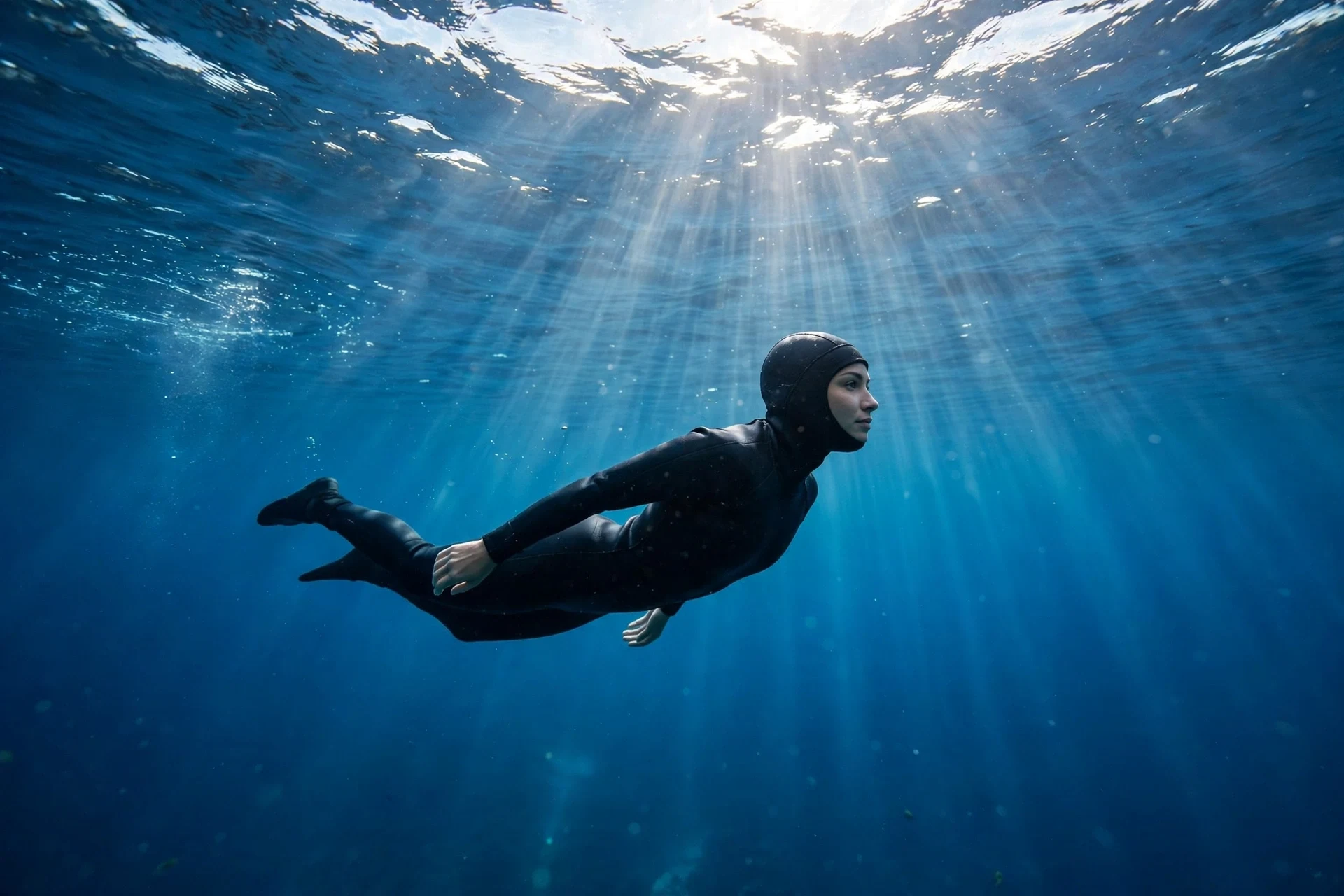
Free divers protect their head mainly with a wetsuit hood, which is a close-fitting neoprene cover that keeps the head warm and gives a small amount of cushioning. A hood also protects the scalp and ears from sun, cold water, and jellyfish stings, and it helps the diver stay warm during a long session. Some divers wear a thin swim cap or a hood with a face seal, depending on the water temperature.
A dive mask is also part of the kit, and it protects the eyes and helps the diver see clearly underwater. The mask sits over the eyes and nose, and the diver equalises the pressure inside it as they descend. Together, the hood and the mask cover most of the head, and they do the job that a helmet would do in another sport, without blocking the ears or trapping air. If you want to understand one of the safety technologies used in modern helmets, reading about what MIPS is for helmets is a good place to start, though that system is not relevant to free diving, where helmets are not worn.
Are There Any Situations Where a Free Diver Wears a Helmet?
In general terms, a helmet is not worn for ordinary free diving, but there are a few edge cases where head protection of some kind appears. Cave divers and wreck divers, who swim through tight overhead spaces, sometimes wear a helmet or a hard hat to protect against bumps on rock or metal, but these are usually scuba divers rather than free divers, and the helmet is chosen for that specific environment.
Some free divers who dive around boats, piers, or rocky entries wear a hood and take care at the surface, where a boat or a rock is more of a hazard than it is at depth. At the surface, the main protection is awareness: checking for boats, diving with a buoy, and staying clear of propellers. In general terms, if a free diver is in a place where a helmet seems necessary, it is worth asking whether the site is a safe place to free dive at all.
How Do Free Divers Stay Safe Without a Helmet?
Free divers stay safe mainly by diving with a buddy, by knowing their limits, and by learning proper technique. The buddy system is the most important safety rule in free diving: one diver stays at the surface and watches the other, ready to help if something goes wrong. A diver should never dive alone, and should never push past their comfort level in depth or time.
Training also matters. A free diving course teaches breathing, equalising, rescue skills, and how to recognise the signs of trouble, such as the urge to breathe and the early signs of a blackout. Divers also use a brightly coloured buoy and a dive flag to mark their position, so boats can see them and stay clear. In general terms, safety in free diving comes from training, planning, and a buddy, rather than from protective equipment on the head.
What Other Kit Goes With Free Diving?
Free diving kit usually includes a wetsuit with a hood, a mask, a snorkel, fins, and a weight belt. The wetsuit keeps the diver warm, the mask lets them see, the snorkel lets them breathe at the surface without lifting the head, and long fins give efficient power underwater. The weight belt helps the diver sink and stay neutrally buoyant at depth.
Many free divers also use a dive computer or a depth gauge to track depth and dive time, and a lanyard that connects the diver to the dive line in depth training. A float and a flag mark the dive site for boats. The kit works as a whole set: it keeps the diver warm, lets them see and move efficiently, and helps them stay safe. A helmet is not part of that set, and in general terms it would add problems rather than solving them.
Is a helmet worn for free diving?
No, in general terms free divers do not wear a helmet. A helmet would trap air, block the ears, and make it harder to equalise pressure, and it would add drag underwater. A wetsuit hood is the usual head covering.
What should I wear on my head for free diving?
A wetsuit hood is the usual choice. It keeps your head warm, gives a small amount of cushioning, and protects against sun and jellyfish stings, without blocking your ears or your ability to equalise.
Is free diving safe without a helmet?
Free diving has its own risks, but they are managed through training, diving with a buddy, and knowing your limits, rather than through a helmet. Never dive alone, and take a recognised free diving course before diving to depth.

Olivia
Writer at Helmet Today, covering helmet reviews, fit and riding safety.