There is no underwater rugby helmet in the usual sense: players do not wear a hard helmet underwater, because the sport is played at the bottom of a swimming pool and a hard helmet would be unsafe and impractical in the water. Underwater rugby is a team ball sport played fully submerged, with players diving to the pool floor to pass and score with a ball filled with salt water. Head protection in this sport means a close-fitting water polo style cap and ear guards, worn to protect the ears and scalp, not a hard shell helmet.
In general terms, the question of head protection in underwater rugby is a good one, because players do make contact with each other, the pool floor, and the pool walls. The answer is not a helmet, though. The sport relies on caps, careful play, and pool rules to keep players safe, and anyone looking for head protection should understand what is actually worn and why a hard helmet is not the answer.
What is underwater rugby?
Underwater rugby is a three-dimensional ball sport played in a deep swimming pool, usually with two teams of six players in the water at a time. Players wear fins, a mask, and a snorkel, and they dive to the bottom to move a salt-water-filled ball, which sinks, along the pool floor and into a metal basket at each end. Play moves up and down through the water, and players surface to breathe before diving again.
The sport is fast, physical, and demanding, with tackling and wrestling for the ball allowed within the rules. Players need to be strong swimmers and confident divers, and they need to read the game in three dimensions, since the ball can move in any direction. It is a niche sport, but it has clubs and competitions in many countries, and it attracts swimmers, divers, and water polo players who enjoy its mix of skill and contact.
Do underwater rugby players wear helmets?
No, underwater rugby players do not wear hard helmets. A hard helmet would fill with water, add drag, and make it harder to dive, turn, and surface. It would also be a hazard to other players in close contact, and it would not sit well with a mask and snorkel. In general terms, a helmet designed for impact on land does not translate to a sport played underwater, where buoyancy, drag, and the ability to breathe at the surface matter most.
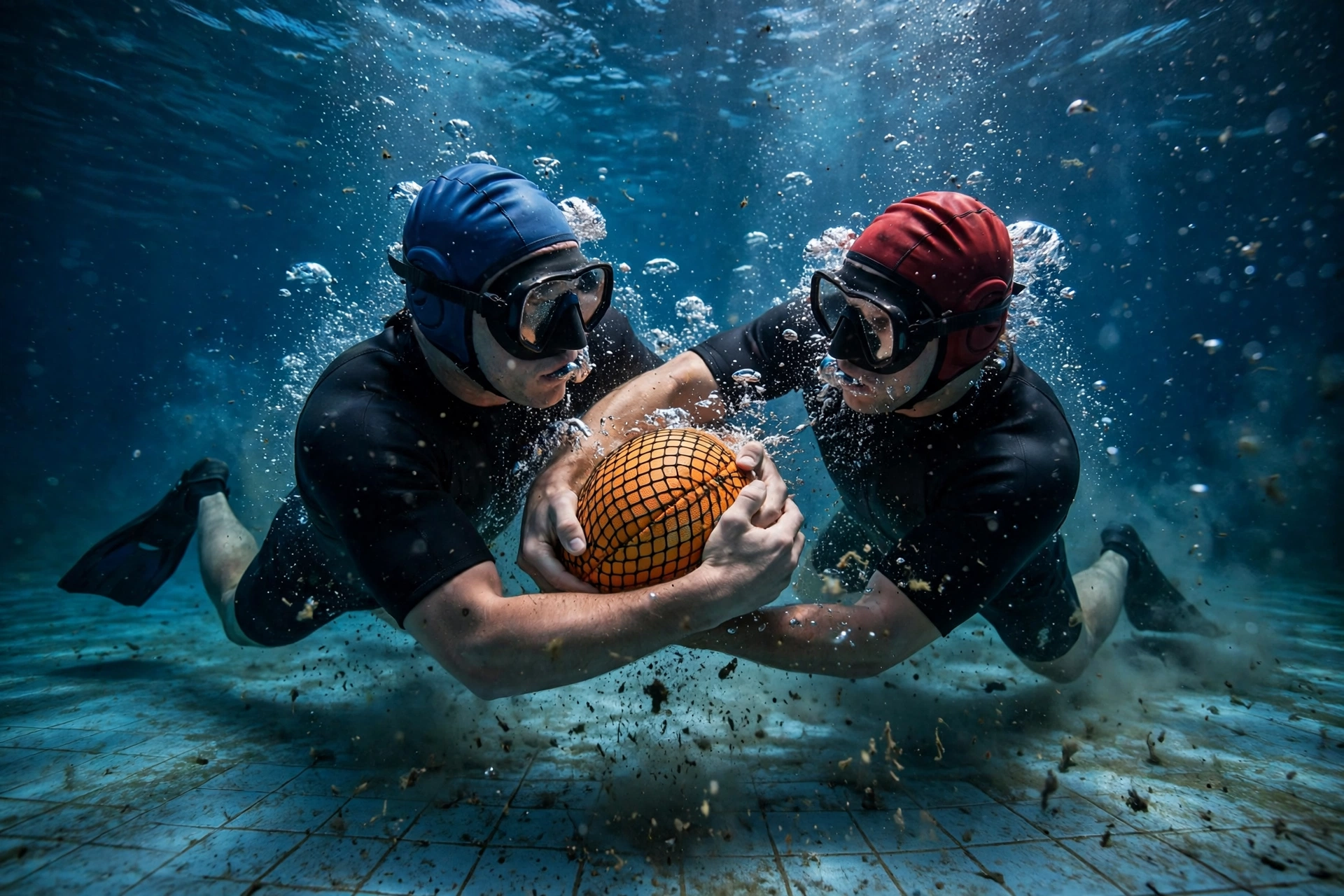
What players do wear on their heads is a close-fitting cap, usually in team colours, similar to a water polo cap, with ear guards built in. The cap keeps hair out of the way, makes players easy to tell apart, and protects the ears and scalp from scrapes and knocks. It is soft, light, and made to be worn in the water, which is the opposite of a hard helmet in almost every way.
What head protection is used instead of a helmet?
The main head protection in underwater rugby is the water polo style cap, with padded ear guards that cover the ears. The ear guards are the most important part, because ears are vulnerable in the water: a knock to the ear, water forced into the ear canal, or repeated pressure changes can cause pain and, in general terms, ear problems over time. The cap holds the ear guards in place and keeps them from slipping during play.
Players also wear a diving mask, which protects the eyes and helps them see underwater, and a snorkel for breathing at the surface. The mask strap and the cap work together to keep everything in place during dives and tackles. Some players also use ear plugs or a hood under the cap for extra ear comfort, but the cap itself is the standard piece of head gear, and it is worn by everyone in the game.
What are the head risks in underwater rugby?
The head risks in underwater rugby come from contact with other players, the pool floor, and the pool walls, as well as from the water itself. Players can be knocked by an elbow or a knee in a tackle, bump their head on the pool floor while diving for the ball, or catch the side of the pool during a fast turn. These are usually glancing knocks rather than heavy impacts, but they can still hurt and can cause cuts or bruises.
Ears are the most commonly affected area, which is why ear guards matter so much. Water in the ears, pressure changes on diving, and knocks to the side of the head can all cause ear pain and discomfort. In general terms, players who look after their ears, wear their cap correctly, and play within the rules reduce these risks a great deal, even without a hard helmet. Hard helmets used on land sometimes include a system designed to reduce rotational forces in a fall, such as MIPS, but a soft cap is not built to do the same job.
What should beginners know about head protection?
Beginners should know that the cap is not optional kit: it is part of the standard dress for the sport, and it should be worn for every game and training session. Make sure the cap fits snugly, the ear guards sit flat over the ears, and the chin strap or ties hold it firmly in place. A cap that slips during play leaves the ears exposed, which defeats its purpose.
Beginners should also learn the rules about contact, since fair tackling and respect for other players are what keep the sport safe. Coaches usually teach new players how to dive, turn, and tackle safely before they play a full game, and they will explain when to surface for air and how to avoid dangerous play. In general terms, good technique and good habits protect your head far better than any piece of equipment could on its own.
How do you look after underwater rugby head gear?
After each session, rinse the cap, mask, and snorkel in fresh water to remove pool chemicals, and let them dry naturally away from direct sunlight. Check the cap for stretched elastic, torn ear guards, or loose ties, and replace it if it no longer fits snugly. A cap that has lost its grip will not stay over the ears, and that is when it stops doing its job.
Check the mask strap and buckles too, since a mask that floods or slips underwater is a distraction and a hazard. Keep your kit in a mesh bag so it dries properly between sessions, and replace worn items before they fail in the pool. In general terms, small kit that is looked after lasts longer and works better, and head gear is no exception.
Is there a hard helmet for underwater rugby?
No, in general terms players do not wear a hard helmet for underwater rugby. The sport uses a soft water polo style cap with ear guards, because a hard helmet would be unsafe and impractical underwater.
What does the cap protect in underwater rugby?
The cap mainly protects the ears and scalp from knocks, scrapes, and water pressure, and it keeps hair out of the way. It is not designed to absorb heavy impacts the way a hard helmet does on land.
Can I wear ear plugs as well as a cap?
Many players do, in general terms, for extra ear comfort. Ask your coach first, and make sure anything you wear under the cap does not make it fit loosely or slip during play.

Olivia
Writer at Helmet Today, covering helmet reviews, fit and riding safety.