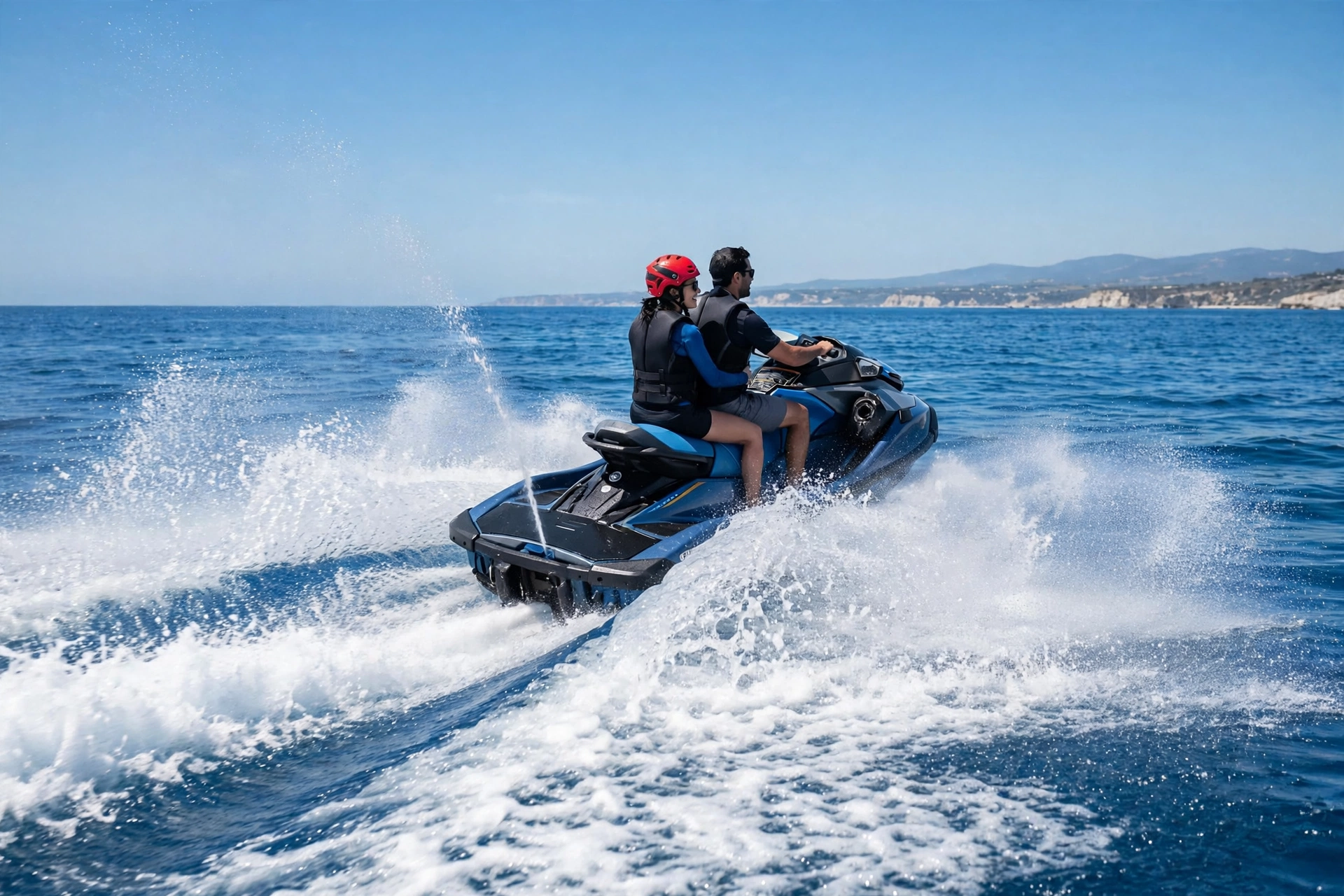
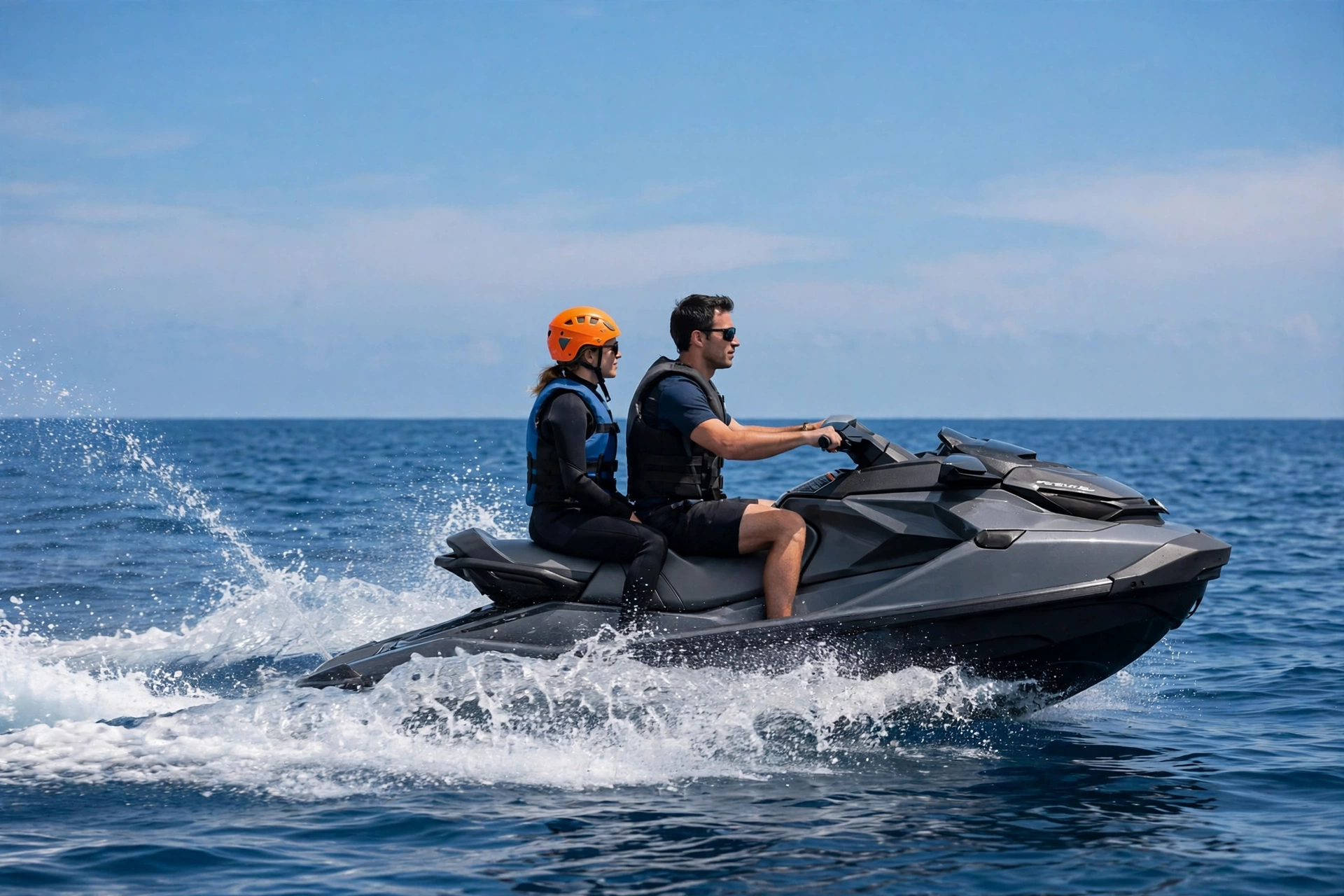
A jet ski helmet for passengers is a water sports helmet worn by the person riding on the back of a personal watercraft, rather than the driver. It protects the passenger’s head from falls into the water, bumps against the driver or the craft, and spray and debris at speed. Passengers face much the same risks as drivers on a jet ski, and in some ways more, because they cannot see what is coming and they have less to hold on to. A helmet made for water sports gives a passenger useful protection without weighing them down or blocking their view.
Why Do Jet Ski Passengers Need a Helmet?
A passenger on a jet ski sits behind the driver, often with little warning before a sharp turn, a wave, or a sudden stop. When the craft hits a wave at speed, the passenger can be thrown forward into the driver or sideways off the craft. A helmet cushions the head in these moments and reduces the chance of a cut or a bruise. It also guards against spray and small debris kicked up from the water, which can sting the face and eyes at speed.
Passengers are also more likely than drivers to fall into the water without warning, and a fall at speed can hit hard. In general terms, a helmet does not make a fall harmless, but it does spread the force of an impact and protect the skull and scalp. For a passenger who is new to jet skiing, or for a child riding on the back, that extra layer of protection is well worth having before the craft leaves the shore.
What Makes a Good Jet Ski Helmet for Passengers?
A good jet ski helmet for passengers is light, comfortable, and made to cope with water. It should have a water-resistant shell and a liner that drains and dries quickly, so it does not become heavy and soggy during a ride. Vents that let water out and air in help keep the helmet comfortable, and a secure chin strap keeps it in place if the passenger is thrown off. A helmet that is built for water sports is a better choice than a bike or motorcycle helmet, which can soak up water and become heavy.
The fit matters as much as the design. If you want to understand one of the safety technologies used in modern helmets, reading about what MIPS is for helmets is a good place to start, though not every water sports helmet uses that system. What matters most for a passenger is a helmet that sits snugly, stays put at speed, and does not block hearing or vision. A bright colour can also help, since it makes the passenger easier to spot on the water.
How Should a Passenger Jet Ski Helmet Fit?
A passenger jet ski helmet should fit snugly all round the head, with no large gaps between the liner and the skull and no pressure points that ache after a few minutes. The helmet should sit level, covering the forehead down to just above the eyebrows, and it should not rock forward or backward when the passenger shakes their head. The chin strap should be tight enough that the helmet cannot be pulled off, but not so tight that it digs into the chin or throat.
Because the passenger cannot always adjust the helmet once the ride has started, it is worth checking the fit on dry land first. Try the helmet on, fasten the strap, and move the head from side to side and up and down. If the helmet slides, tighten the strap or try a smaller size. If it presses painfully on one spot, try a different shape or size, since heads differ and a helmet that fits one person may not fit another.
What Is the Difference Between a Driver and a Passenger Jet Ski Helmet?
In practice, there is very little difference between a helmet for a jet ski driver and one for a passenger. Both need the same basic protection: a light, water-resistant shell, a secure strap, and a comfortable fit. The same helmet model can often be used by either rider, and many families share helmets between the driver and the passenger, as long as each helmet fits the person wearing it.
The main difference is how the helmet is used. A driver can see the water ahead and brace for waves and turns, while a passenger reacts a moment later and may be caught off guard. That is why a passenger helmet needs a particularly secure fit and a strap that will not come loose. Some passengers also prefer a helmet with a wider field of vision, so they can see the water and the driver more easily.
How Do You Look After a Jet Ski Helmet?
A jet ski helmet needs to be rinsed with fresh water after every ride, because salt water and lake water can leave deposits that damage the shell, the liner, and the strap. Rinse the helmet inside and out, shake out as much water as you can, and leave it to air dry in the shade. Avoid drying it in direct sunlight or near a heater, since strong heat can warp the shell and the padding over time.
Check the helmet regularly for damage. Look for cracks in the shell, frayed straps, a buckle that no longer clicks firmly, or padding that has gone flat or started to smell. A helmet that has been dropped on a hard surface or involved in a heavy fall should be inspected closely. Keeping the helmet clean and dry after each ride helps it last longer and stay comfortable to wear.
When Should a Passenger Jet Ski Helmet Be Replaced?
A passenger jet ski helmet should be replaced when it has taken a hard impact, even if there is no visible crack. The protective foam inside a helmet can compress in an impact, and once it has done so it may not protect as well a second time. A helmet that has been in a crash, or one that was dropped hard onto concrete, is best retired rather than risked.
Age and wear are also reasons to replace a helmet. If the liner has flattened, the straps no longer hold firmly, or the shell shows cracks or deep scratches, the helmet is past its best. In general terms, a helmet that is used often in sun and salt water will wear out sooner than one used now and then, so it is worth checking it at the start of each season and replacing it when it no longer fits or protects as it should.
Do jet ski passengers have to wear a helmet?
Rules differ by place, so it is worth checking local rules before riding. Even where a helmet is not required by law, wearing one is a sensible choice for a passenger, who faces the same fall and impact risks as the driver.
Can a passenger wear a bike helmet on a jet ski?
It is not a good idea. A bike helmet is not made for water, so it can soak up water, become heavy, and come loose in a fall. A helmet made for water sports drains and dries quickly and is designed to stay in place in the water.
Can children ride as jet ski passengers with a helmet?
Yes, in general terms a child can ride as a passenger with a well-fitting water sports helmet, as long as local rules and the craft’s age and size limits allow it. The helmet must fit the child’s head snugly, and the child should be able to hold on securely for the whole ride.

Olivia
Writer at Helmet Today, covering helmet reviews, fit and riding safety.