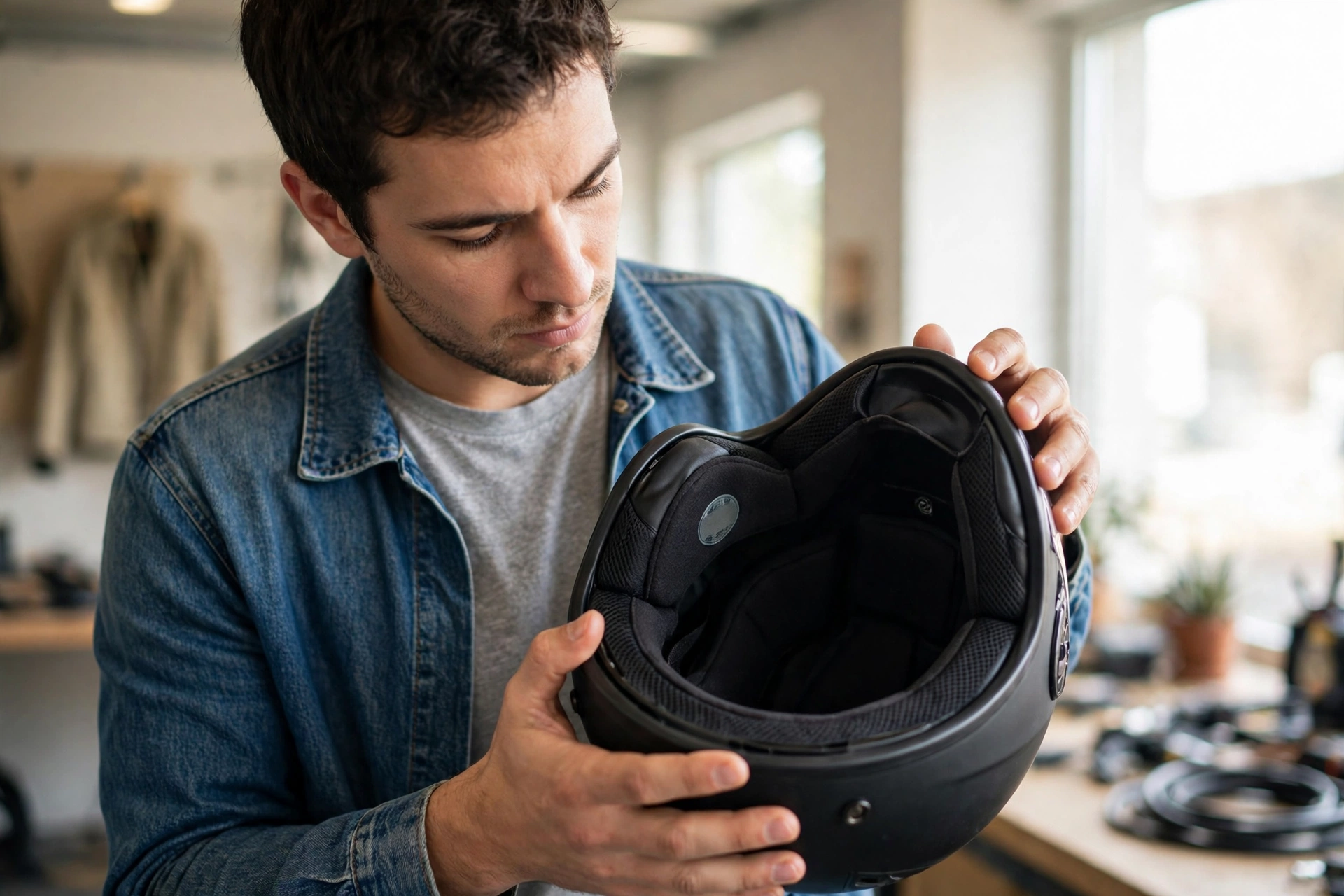
To inspect a helmet for expired certification, look for the certification sticker or label inside the helmet, check any date shown on it, and follow the maker’s guidance on the helmet’s working life — and in general terms, if the certification has expired or the label is missing, do not rely on the helmet. Certification stickers show that a helmet was tested to a recognised standard when it was made, and many carry a date of manufacture or a date marking. What that date means for the helmet’s working life depends on the maker and the standard, so the label alone is only part of the check.
Certification matters because it is the proof that a helmet was built and tested to a standard, not just made to look like a helmet. A helmet with no certification, or one whose certification has lapsed, may still look fine, but you have no assurance that it still meets the standard it was made to. Checking the label is a quick habit that tells you a lot about the helmet you are trusting with your head.
Where is the certification sticker on a helmet?
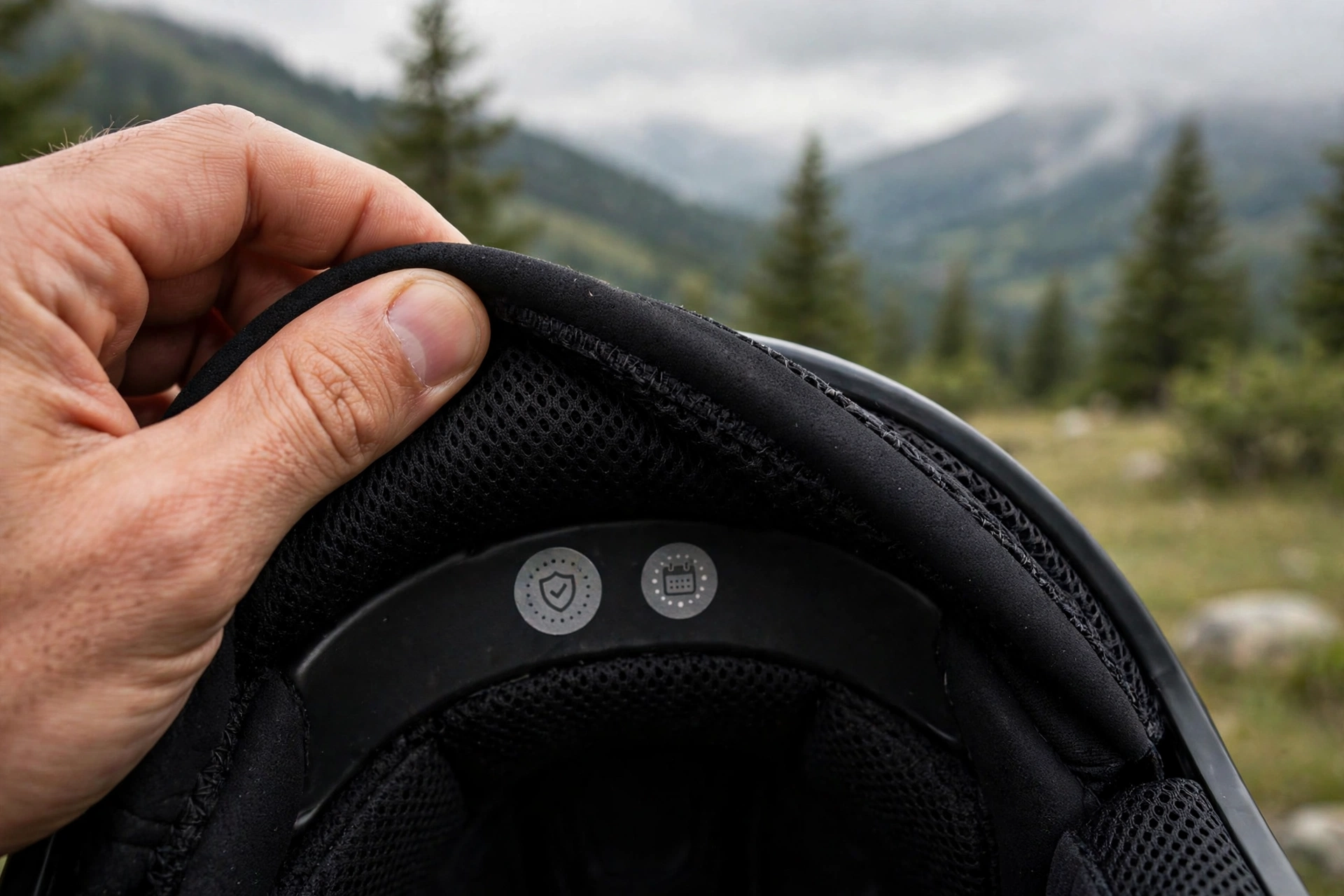
The certification sticker or label is usually found inside the helmet, often under the lining or on the inner shell, and sometimes on the back of the shell or under the peak. It may be a printed sticker, a sewn-in label, or a mark moulded into the shell. The label normally shows the name of the standard the helmet was tested to, and sometimes the maker’s name, the model, and a date of manufacture.
If you cannot find the label, take out the lining if your helmet allows it, and look again with good light. Some labels fade or wear with sweat and use, and some are hidden behind padding. If the label is missing entirely, or so worn that you cannot read it, treat that as a warning sign: you cannot confirm what standard the helmet meets, or when it was made.
What does the date on a certification sticker mean?
The date on a certification sticker is usually the date the helmet was made, or the date the certification was issued, and it is not always an expiry date. Some stickers show a manufacture date only, and the maker gives separate guidance on how long the helmet should be used for. Others may show a date marking that relates to the standard or the production batch. In general terms, the date tells you how old the helmet is, and its meaning for the helmet’s working life comes from the maker, not from the sticker alone.
Do not assume a date on a sticker is an expiry date, and do not assume that a helmet is fine for as long as you like just because no expiry date is printed. Helmets age: the shell, the foam, and the straps all degrade with sun, sweat, heat, and use, even if the helmet looks sound. Check the maker’s guidance for your model, which is usually in the manual or on the maker’s website, and follow it.
How do you check if a helmet’s certification has expired?
Start by reading the label carefully and noting the standard and any date shown. Then check the maker’s guidance for that model: look in the manual that came with the helmet, or search the maker’s website for the model name and its recommended working life. If the maker gives a working life for the helmet, compare it with the date on the label to see whether the helmet is still within it.
If the standard itself has been replaced by a newer version, that does not always mean an older helmet is unsafe, but it is a reason to check the maker’s guidance and, if in doubt, to ask a shop or the maker directly. Keep a note of the label details when you buy a helmet, including the standard and the date, so you can check them later without taking the helmet apart. If you cannot read the label or find the maker’s guidance, treat the helmet as unverified and get advice before using it.
What should you do if the certification has expired?
If the certification has expired, or the helmet is past the working life given by the maker, stop using it for the activity it was made for. In general terms, an expired certification means the helmet can no longer be relied on to meet the standard it was made to, even if it looks undamaged. Replace it with a helmet that carries a current certification for the activity you do.
Do not pass an expired helmet on to someone else, and do not keep it as a spare. Mark it clearly so nobody uses it by mistake, and dispose of it or recycle it following the maker’s guidance. If the helmet is nearly new and you believe the date or the label is wrong, contact the shop or the maker with the model details and photos of the label, because it may be a labelling error or a warranty matter.
Can a helmet be recertified or retested?
In general terms, no, an individual helmet cannot be recertified by its owner. Certification applies to the helmet model and its production, not to a single helmet after years of use, and there is no simple test you can do at home to prove a used helmet still meets its standard. Some organisations recondition helmets, for example checking and replacing parts on team helmets, but that is not the same as recertifying an expired helmet.
Some helmets include a system designed to reduce rotational forces in a fall, such as MIPS, and the liner for that system should be checked as part of any inspection, but it does not change the certification position. If you are unsure whether a helmet is still certified, the safest step is to check with the maker and, if there is any doubt, replace it.
How do you keep a helmet’s certification label readable?
Keep the label dry and clean, and avoid scrubbing it when you wash the lining. If the lining comes out, take it out gently rather than pulling it, so you do not tear the label underneath. A photo of the label taken when the helmet is new is a useful backup if the label fades later.
When you buy a helmet, check that the label is present and readable before you leave the shop, and keep the receipt and the manual with the model name and standard. If the label is already worn when you buy, ask for a different helmet.
Does an old helmet lose its certification?
In general terms, a helmet’s certification relates to the standard it was tested to when made, and the maker’s guidance sets its working life. Once it is past that working life, or the label cannot be read, you should not rely on it.
What if the certification sticker is missing?
If the sticker is missing, you cannot confirm the standard or the date of manufacture. Treat the helmet as unverified, check with the maker if you know the model, and replace it if you cannot confirm its certification.
Does a newer standard make an older helmet unsafe?
Not automatically. A helmet that is within its working life and in good condition may still be sound, but a newer standard can mean better protection. Check the maker’s guidance and replace the helmet if it is past its working life.

Olivia
Writer at Helmet Today, covering helmet reviews, fit and riding safety.