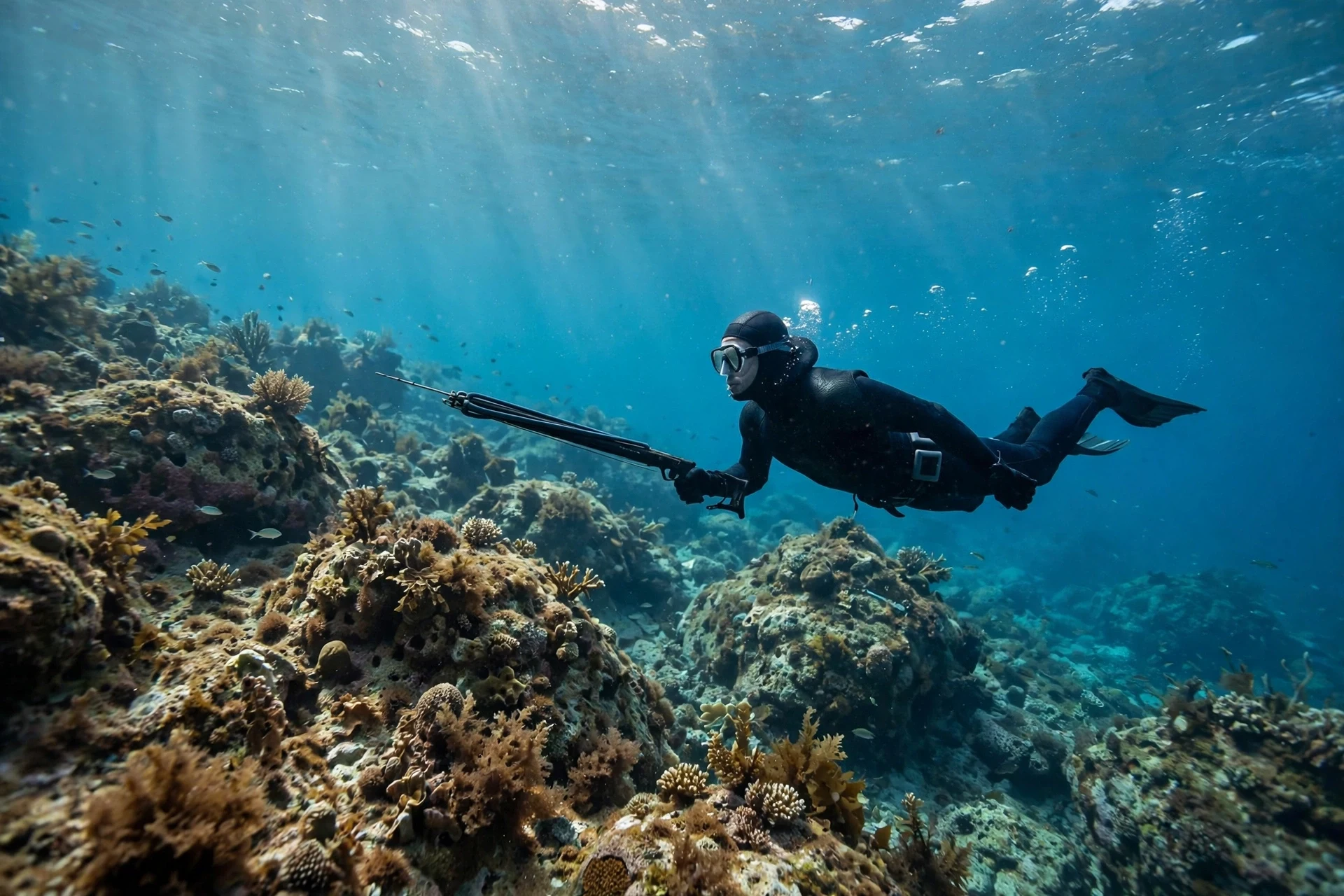
Spearfishers do not wear helmets, so there is no spearfishing helmet as such; the headgear used in spearfishing is a diving mask, usually with a wetsuit hood, and head safety in the sport comes from good diving practice, a buddy, and care around rocks and boats. Spearfishing is underwater fishing, in which a diver swims down, finds a fish, and catches it with a speargun. It is done in the sea, often around reefs and rocks, and the diver’s head is protected by water, not by a hard shell.
That answer surprises some people, because spearfishing takes place in a wild setting with rocks, currents, and boats overhead. But a hard helmet would be a poor fit for the sport: it would make it harder to see, to hear, to equalise the pressure in the ears, and to move smoothly through the water. Spearfishers rely on a mask for vision, a hood for warmth, and careful diving habits to stay safe.
What is spearfishing?
Spearfishing is a form of underwater fishing in which a diver hunts fish with a speargun while freediving, which means diving on a single breath without a breathing tank. The diver swims down from the surface, moves quietly along the seabed or reef, aims at a fish, and fires the speargun. The fish is then brought to the surface, and the diver rests and breathes before diving again.
Spearfishing is practised in the sea all over the world, from shallow reefs to deeper water, and it is done alone or with a buddy, though diving with a buddy is the safer way to do it. It calls for strong swimming, good breath control, and knowledge of the sea, the weather, and the fish. Because the diver works underwater in a natural setting, awareness and calm are as important as any piece of kit.
Why don’t spearfishers wear helmets?
Spearfishers do not wear helmets because a helmet would get in the way of the things a diver needs to do underwater. A diver must equalise the pressure in their ears as they descend, and that means being able to pinch the nose and swallow, which a hard helmet would make difficult. A helmet would also cover the ears and reduce hearing, which matters when a diver is listening for a boat or a buddy.
A helmet would also create drag and make the diver less streamlined, and it would make the mask harder to fit and seal. The risks in spearfishing are different from those in contact sports: there is no ball or stick to strike the head, and the main dangers are running out of breath, getting caught in a line, or being hit by a boat at the surface. These risks are managed by diving with a buddy, using a float and a flag, and knowing your limits, rather than by wearing a helmet.
What do spearfishers wear on their heads?
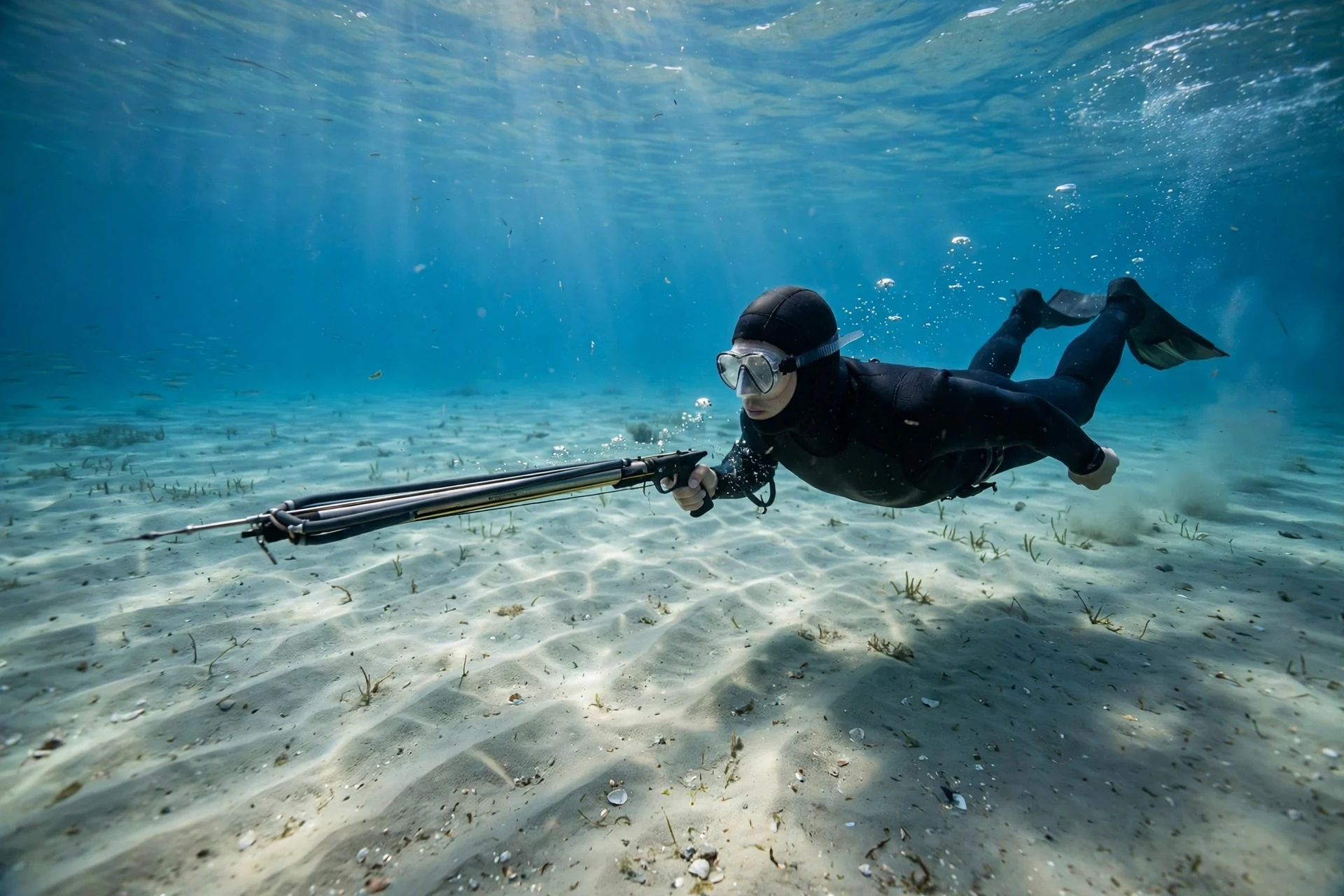
Spearfishers wear a low-volume diving mask, which sits over the eyes and nose and lets the diver see clearly underwater. The mask is made of soft silicone with a glass lens, and it is held in place by a strap around the back of the head. A good mask fits closely, seals well, and gives a wide view, which matters when scanning a reef for fish.
Most spearfishers also wear a wetsuit hood, which covers the head and neck and keeps the diver warm in cold water. The hood is made of neoprene and fits snugly, with an opening for the face where the mask sits. It also gives a little protection against scrapes from rocks and against the sun. Together, the mask and hood are the headgear of the sport, and they are chosen for vision, warmth, and comfort in the water.
How do spearfishers stay safe without a helmet?
Spearfishers stay safe by diving with a buddy, using a float and a dive flag, and knowing their own limits. A buddy watches from the surface while the other dives, and they take turns, so someone is always watching. A bright float with a flag tells boats that divers are below, which is important in busy water. Divers also plan their dives, rest properly between dives, and come up well before they run out of breath.
Care around rocks and the speargun matters too. Divers keep the speargun pointed safely, load it only in the water, and never point it at a buddy. They watch for currents, waves, and boat traffic, and they stay clear of rocks in rough water. A knife is often carried to cut free from a tangled line. These habits, rather than a helmet, are what keep a spearfisher safe, and they are taught by experienced divers and clubs.
Are helmets used in any diving?
Yes, helmets are used in some kinds of diving, but not in spearfishing. Commercial divers working underwater with tools wear heavy diving helmets as part of a surface-supplied diving rig, and some helmet diving experiences for tourists use a similar setup. These helmets supply air from the surface and are made for work in murky water or around machinery, not for free swimming.
Recreational scuba divers and freedivers, including spearfishers, do not wear helmets. They wear a mask, and they rely on training, a buddy, and good habits for safety. The heavy helmets used in commercial diving would make freediving impossible, as they are too heavy and too bulky to swim in. Some helmets in other sports include a system designed to reduce rotational forces in a fall, such as MIPS, but that kind of system is made for hard impacts on land, not for diving in the sea.
What should a beginner spearfisher buy first?
A beginner spearfisher should start with the basics: a well-fitting low-volume mask, a snorkel, a wetsuit with a hood, fins, and a speargun suited to the waters they will dive in. A float and a dive flag are essential safety kit, and a knife and a weight belt complete the setup. A specialist dive shop can help you choose kit that fits well and suits the local conditions.
Do not buy a helmet for spearfishing, as it is not used in the sport and would only get in the way. Instead, take a freediving or spearfishing course, learn to dive with a buddy, and build up your breath control and water skills slowly. Good kit, good training, and a careful buddy are what a beginner needs, and a local club is the best place to learn the sport safely.
Do spearfishers wear helmets?
No, spearfishers do not wear helmets. They wear a diving mask and usually a wetsuit hood, and they rely on a buddy, a float and flag, and good diving practice for safety.
Is spearfishing safe without a helmet?
In general terms, spearfishing is safest when done with a buddy, a float and flag, and proper training, and when divers stay within their limits. The main risks are breath-holding, boat traffic, and tangled lines, which are managed by good practice rather than by a helmet.
What headgear should I buy for spearfishing?
Buy a low-volume diving mask that fits well, and a wetsuit with a hood for warmth. Ask a specialist dive shop for advice, and do not buy a helmet, as it is not used in the sport.

Olivia
Writer at Helmet Today, covering helmet reviews, fit and riding safety.