

We may earn a commission when you buy through links on this page, at no extra cost to you. Learn more
The best 3D printer for small business should do more than produce attractive sample models. It needs dependable first layers, manageable maintenance, sensible material costs and enough speed to keep customer orders moving without constant supervision.
The right choice depends on your workload. Multi-color systems can improve finished products and reduce painting, while enclosed, heated-chamber machines are better suited to demanding engineering materials. Build volume also matters if you make prototypes, fixtures or larger parts.
This roundup includes compact beginner-friendly printers, fast multi-material machines and large-format workhorses. Compare automation, material support, waste reduction and monitoring features alongside the headline print speed to find the best fit for your operation.
| Product | Title | Key Features | Price |
|---|---|---|---|
 |
#1Best Overall Bambu Lab P2S Combo Brand: BAMBULAB
|
|
Check Latest Price |
 |
#2Best Value Bambu Lab P1S Combo Brand: BAMBULAB
|
|
Check Latest Price |
 |
#3Best for Low Snapmaker U1 3D Printer Brand: Snapmaker
|
|
Check Latest Price |
 |
#4Best Plug-and-Play Creality K2 Combo Brand: Creality
|
|
Check Latest Price |
 |
#5Best Industrial Materials FlashForge Creator 5 Pro Brand: FLASHFORGE
|
|
Check Latest Price |
 |
#6Best Budget Bambu Lab A1 Printer Brand: BAMBULAB
|
|
Check Latest Price |
 |
#7Best Large Format QIDI Max4 Combo Brand: R QIDI TECHNOLOGY
|
|
Check Latest Price |
What to Look for in Best 3d Printer For Small Business
- Choose an enclosed printer with a heated chamber if you expect to use ABS, PC, PA or other engineering materials regularly.
- Check whether multi-color printing requires a separate AMS, CFS, AMS lite or QIDI BOX before comparing the complete setup cost.
- Prioritize automatic leveling, flow calibration and failure detection if employees with different experience levels will operate the printer.
- Match build volume to your products so you can print the largest regular part in one piece rather than splitting it.
- Look for independent toolheads when reducing purge waste and material cost is more important than the lowest purchase price.
#1 · Best Overall
Bambu Lab P2S Combo
The Bambu Lab P2S Combo is aimed at small businesses that want a polished, fast workflow with room to grow. The printer reaches up to 600 mm/s, includes automatic calibration and AI failure detection, and can be ready to print in about 15 minutes. Its PMSM Servo Extruder and Active Flowrate Compensation are designed to keep corners, layers and extrusion consistent, making it a strong choice for repeated prototypes or customer-facing models.
The included AMS 2 Pro adds multi-color and multi-material printing, plus filament drying up to 65°C. That combination suits businesses producing branded pieces, visual prototypes and presentation models rather than only basic single-color parts. Adaptive airflow can cool overhangs or maintain a 50°C chamber for engineering-grade materials, while the carbon filter and connected Bambu software make the overall workflow approachable for newer operators.
Pros
- Up to 600 mm/s printing
- AMS 2 Pro includes filament drying
- Automatic calibration and failure detection
- Adaptive airflow and carbon filter
Cons
- Multi-color printing requires the Combo
- Higher cost than the A1 or P1S
- The listed printer price is not the lowest
In daily use, the P2S Combo is particularly appealing when one machine must handle both quick iterations and more polished multi-color output. Quick-swap nozzles reduce routine maintenance friction, while MakerWorld, Bambu Studio and Bambu Handy provide a unified path from model discovery to monitoring. The ability to balance cooling and heat retention is useful for a small shop that may alternate between everyday and more demanding filament types.
Compared with the P1S Combo, the P2S offers higher stated speed, newer flow and airflow features, and a drying AMS 2 Pro. The Snapmaker and FlashForge alternatives focus more heavily on independent toolheads and waste reduction, while the QIDI offers a much larger workspace. For a business wanting convenience, automation and a broad general-purpose workflow, the P2S Combo is the most balanced option here.
#2 · Best Value
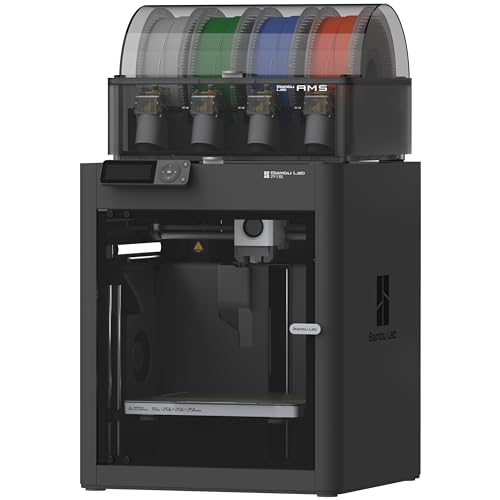
Bambu Lab P1S Combo
The Bambu Lab P1S Combo offers a practical entry into fast enclosed printing without moving to the most expensive machines in this group. It prints at up to 500 mm/s, uses automatic bed leveling and can be set up in about 15 minutes. The enclosed body helps with advanced filaments, making it better suited to a small workshop than an open-frame beginner printer when material flexibility matters.
Its AMS connection enables multi-color and multi-material printing, with support for up to 16 colors. The supported list includes PLA, PETG, TPU, PVA, PET ABS and ASA, while PA and PC are listed as capable materials. Businesses should note that carbon- or glass-fiber-reinforced polymers are not recommended, so this is better for general production and display work than the most demanding composite applications.
Pros
- Up to 500 mm/s printing
- Enclosed design
- Automatic bed leveling
- Supports up to 16 colors with AMS
- Quick setup
Cons
- AMS is required for multi-color printing
- Carbon- and glass-fiber polymers are not recommended
- Less material flexibility than specialist machines
For small-batch work, the P1S Combo offers a useful mix of speed, enclosure and color capability. Automatic leveling removes one common source of failed starts, and the short setup time helps a team begin producing without a lengthy calibration process. Its material guidance is also clear enough for a business to plan around, provided the workload stays within its recommended filament range.
The P1S is a more economical alternative to the P2S while retaining a fast enclosed platform and AMS-based color printing. The Creality K2 offers similar listed pricing and a CFS-based path to 16 colors, while the Bambu A1 is cheaper but open-frame. Choose the P1S when you want a straightforward production machine for common materials and value a mature, compact workflow over extreme engineering-material capability.
#3 · Best for Low
Snapmaker U1 3D Printer
The Snapmaker U1 is built around four independent toolheads rather than repeatedly loading and purging one nozzle. Its SnapSwap system changes toolheads in about five seconds, with preloaded and preheated filaments, making true multi-color and multi-material production notably more efficient. That design is well suited to small businesses printing functional prototypes, articulated models or parts that combine rigid, flexible and soluble-support materials.
Material compatibility is broad, covering PLA, PVA, TPU, PETG, PCTG, ABS, ASA, PA, PC and more. Automatic offset calibration, vibration compensation and fine-tuned extrusion aim to reduce manual adjustment. A 500 mm/s CoreXY system, 270 × 270 × 270 mm build volume, AI monitoring, remote app control and a one-year warranty round out a package intended for both professional users and capable beginners.
Pros
- Four independent toolheads
- Five-second tool changes
- Reduced purge waste
- Broad material compatibility
- Automatic calibration and AI monitoring
Cons
- Higher listed cost than the P1S or K2
- 270 mm cube build volume is not the largest
- Four-toolhead workflows may be more than simple jobs need
The U1 makes the most sense when material changes are frequent and waste affects margins. Switching the toolhead instead of flushing filament can reduce material consumption by up to five times and speed multi-color work by up to five times, according to the product data. That can matter for a shop producing repeated colorful models or multi-material functional parts, where conventional color changes become expensive and slow.
Against the Bambu printers, the U1’s strongest distinction is its independent-toolhead approach, not simply its headline speed. FlashForge uses a similar four-toolhead concept and adds a heated chamber, while the U1 emphasizes accessibility through its built-in model library, touchscreen and Snapmaker Orca software. It is a compelling productivity choice when waste reduction and mixed-material capability justify its higher purchase price.
#4 · Best Plug-and-Play
Creality K2 Combo
The Creality K2 Combo is designed for a business that wants a largely ready-to-use machine. It arrives 95% pre-assembled, offers a 260 × 260 × 260 mm build volume and includes one CFS unit. With up to four CFS units connected, the system can reach 16-color printing. Its 600 mm/s speed, sturdy frame and step-servo motors target fast production while keeping the machine relatively quiet.
Automatic leveling probes only the target print area, and the AI camera watches for spaghetti failures, idling and other issues in real time. The K2 supports PLA, PETG, ABS, PLA-CF and PET, giving it useful everyday and stronger-material options. Silent Mode, dynamic fan balancing and a claimed noise level no louder than laptop typing may also suit a shared office or customer-facing workspace.
Pros
- 95% pre-assembled
- Up to 600 mm/s printing
- Expandable to 16 colors
- AI camera monitoring
- Automatic target-area leveling
Cons
- The Combo includes one CFS unit, not four
- 260 mm cube build volume limits larger jobs
- Less extensive material list than the QIDI Max4
The K2 is a sensible fit for teams that prioritize quick deployment and low operator involvement. Plug-and-play assembly, automatic leveling and a camera that can pause around failures reduce the amount of routine attention needed during production. Its 260 mm cube workspace covers many common products, while the step-servo system is intended to support consistent extrusion, speed and noise control.
At its listed price, the K2 competes closely with the Bambu P1S Combo while offering a higher stated speed and a CFS route to up to 16 colors. The P1S has a similarly enclosed workflow and broader listed filament guidance, whereas the Snapmaker and FlashForge reduce waste through independent toolheads. Pick the K2 when easy deployment, quiet operation and expandable color printing matter most.
#5 · Best Industrial Materials
FlashForge Creator 5 Pro
The FlashForge Creator 5 Pro is aimed at small businesses making engineering parts rather than only decorative models. It combines four independent toolheads with a seven-second FlashSwap changer, avoiding filament flushing during color changes. Its fully enclosed frame and active heated chamber reaching 65°C are designed for ABS, PC and PA, giving production teams more control over warping and demanding materials.
A rigid CoreXY structure, precision linear rails and 600 mm/s printing support high-throughput work. Automated toolhead-offset, vibration and dynamic-flow calibration help simplify setup, while the HD chamber camera supports remote monitoring and time-lapse creation. Dual HEPA 13 and activated-carbon filtration, together with continuous airflow, is a useful consideration when the printer operates in a shared production environment.
Pros
- Four independent toolheads
- Seven-second tool changes
- 65°C active heated chamber
- Supports ABS, PC and PA
- Dual HEPA 13 and carbon filtration
Cons
- Premium listed price
- May be excessive for simple PLA production
- Four-toolhead systems add complexity compared with single-nozzle machines
The Creator 5 Pro’s value appears when a business regularly prints strong parts or runs multi-color jobs where purge waste would erode margins. The independent toolheads can switch without flushing filament, while the heated chamber provides a more suitable environment for advanced materials than open-frame alternatives. Calibration automation and a built-in camera further support repeatable production when the operator cannot watch every print continuously.
This is the closest rival to the Snapmaker U1 in toolhead-based efficiency, but the FlashForge puts more emphasis on industrial material handling, enclosure temperature and filtration. The QIDI Max4 has a larger build area and supports high-temperature materials, while the Bambu P2S offers a more general-purpose workflow. Choose the Creator 5 Pro when material performance, reduced waste and workspace control outweigh its premium positioning.
#6 · Best Budget
Bambu Lab A1 Printer
The Bambu Lab A1 is the most accessible option in this selection for a small business starting with straightforward FDM work. It offers automatic calibration, active flow-rate compensation, a one-clip quick-swap nozzle and a simplified touchscreen interface. Its 10,000 mm/s² acceleration is intended to deliver fast, precise output, while active motor noise canceling makes it more comfortable in a small office or home-based workspace.
Multi-color printing is available through AMS lite, but the printer alone does not include that capability; buyers need the A1 Combo or a separately purchased AMS lite. That makes the base machine best suited to single-color prototypes, fixtures and simple products. Its beginner-friendly operation, quiet behavior and automatic Z-offset and bed-leveling processes reduce the learning curve for a new operator.
Pros
- Lowest listed price
- Full-auto calibration
- Active flow-rate compensation
- Quiet operation
- Quick-swap nozzle
Cons
- AMS lite is required for multi-color printing
- Base printer is less suited to advanced materials
- Open-frame design offers less environmental control
The A1 is a practical way to add in-house prototyping without committing to the cost or complexity of an enclosed production system. Automatic calibration handles key setup tasks, and the flow-rate compensation feature is intended to keep extrusion smooth across prints. The interface and quick-swap nozzle are especially useful when several people share the machine or when maintenance needs to stay simple.
Compared with the P1S, P2S and K2, the A1 gives up enclosure-based material flexibility and comes without multi-color hardware in its base configuration. In return, it has the lowest listed price and an approachable operating experience. It is the right choice for a business making common-material prototypes and small parts, but color production or engineering filaments point toward one of the enclosed alternatives.
#7 · Best Large Format
QIDI Max4 Combo
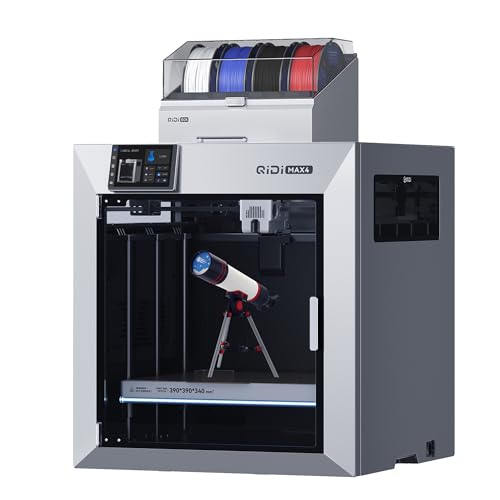
The QIDI Max4 Combo is the large-format choice for businesses that need to produce substantial parts, molds or prototypes without splitting them. Its 390 × 390 × 340 mm build volume is listed as 55% larger than its predecessor’s, and the full-surface silicone heated bed is designed to promote even heating and first-layer adhesion. Closed-loop X/Y motors support up to 800 mm/s printing and 30,000 mm/s² acceleration.
This machine also targets demanding materials, with a 65°C active heated chamber, 40 mm³/s high-flow hotend and hardened-steel nozzle. It supports PLA and ABS as well as abrasive options such as carbon-fiber-reinforced nylon, while the Polar Cooler is not included and must be purchased separately. AI monitoring can detect abnormalities and pause the print, and QIDI BOX can add up to 16-color printing.
Pros
- Largest listed build volume
- Up to 800 mm/s printing
- 65°C active heated chamber
- Supports abrasive materials
- AI failure monitoring
Cons
- Highest listed price
- Polar Cooler is sold separately
- QIDI BOX is required for multi-color printing
The Max4 is valuable when part size is the main business constraint. The spacious build area can accommodate large industrial parts and custom prototypes in one piece, while the heated chamber and hardened nozzle support a wider range of demanding applications. Closed-loop motors, a lead screw and anti-backlash nut are intended to improve dimensional consistency and surface quality during high-speed work.
It stands apart from the other six printers through scale and material ambition rather than compact convenience. The FlashForge Creator 5 Pro is more focused on four-toolhead efficiency and filtration, while the Max4 gives you substantially more room and an expandable QIDI BOX color path. Factor in the separate Polar Cooler and multi-color hardware when planning the complete setup, especially if your business needs a turnkey purchase.
Frequently Asked Questions
What is the best 3D printer for a small business just starting out?
The Bambu Lab A1 is the most budget-friendly and beginner-oriented option in this group, with automatic calibration, flow-rate compensation and a simple touchscreen. Choose the Bambu Lab P1S Combo instead if you need an enclosed printer and multi-color capability through AMS.
Which printer is best for multi-color business products?
The Snapmaker U1 and FlashForge Creator 5 Pro use independent toolheads, which can reduce purge waste during color changes. The Bambu P2S, P1S and Creality K2 also offer multi-color workflows, but their required AMS or CFS hardware should be included when comparing the overall setup.
Which model handles engineering materials best?
The FlashForge Creator 5 Pro and QIDI Max4 are the strongest choices for demanding materials because both provide 65°C active heated chambers. The QIDI also lists a hardened-steel nozzle and support for carbon-fiber-reinforced nylon, while the FlashForge lists ABS, PC and PA.
Do these printers automatically detect failed prints?
Several models include failure monitoring: the P2S has AI failure detection, the K2 and Max4 use AI cameras, and the U1 offers AI-powered print monitoring. These features can reduce wasted material, but they do not replace checking the machine and finished parts.
Does the listed printer include everything needed for color printing?
Not always. The P2S Combo includes AMS 2 Pro, the P1S listing includes AMS, and the K2 Combo includes one CFS unit; the A1 requires AMS lite, while the Max4 needs QIDI BOX. Always verify the specific bundle because the base printer may not support the advertised color workflow alone.
Final Thoughts
For most small businesses, the Bambu Lab P2S Combo is the strongest all-round recommendation: it combines speed, automation, adaptive airflow and included multi-color hardware in a polished workflow. If keeping the initial investment lower is more important, the Bambu Lab P1S Combo and Creality K2 offer compelling enclosed alternatives, while the A1 is the simplest low-cost starting point.
Choose the Snapmaker U1 or FlashForge Creator 5 Pro when independent toolheads and reduced purge waste can directly improve margins. Select the QIDI Max4 when large parts and engineering materials define your workload. The best choice is ultimately the machine that matches your materials, part size and expected production volume—not simply the one with the highest speed figure.

Olivia
Writer at Helmet Today, covering helmet reviews, fit and riding safety.


