

We may earn a commission when you buy through links on this page, at no extra cost to you. Learn more
Choosing the Best Glue for PLA Filament depends on the repair, not just the adhesive’s claimed strength. A thin liquid can wick into hairline cracks, while a thicker gel is easier to control on vertical seams, uneven edges and larger joints.
Application matters just as much. Precision tips, anti-clog caps and suitable cure times can make the difference between a clean model repair and a messy surface covered in unwanted residue.
This roundup includes instant adhesives for joining printed parts, plus a PVP glue stick for improving build-plate adhesion. Consider whether you need post-processing strength, gap filling, bulk value or better first-layer grip before choosing.
| Product | Title | Key Features | Price |
|---|---|---|---|
 |
#1Best Overall ARKA 3D Printing Super Glue Brand: ARKA Biotechnologie GmbH
|
|
Check Latest Price |
 |
#2Best Gap Filler ALECPEA 3D Print Glue Brand: ALECPEA
|
|
Check Latest Price |
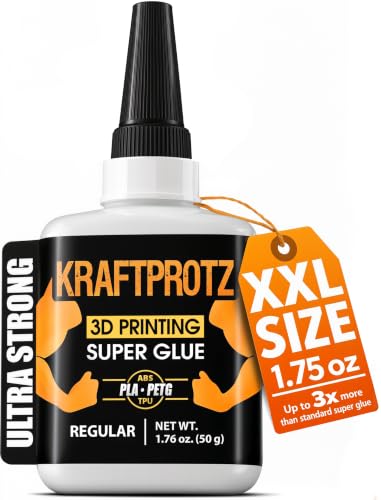 |
#3Best for Fine KRAFTPROTZ Liquid Super Glue Brand: KRAFTPROTZ
|
|
Check Latest Price |
 |
#4Best for Multipurpose KRAFTPROTZ Ultra Liquid Glue Brand: KRAFTPROTZ
|
|
Check Latest Price |
 |
#5Best Quick Setting Y'allCanDiy Plastic Glue Brand: Y'allCanDiy
|
|
Check Latest Price |
 |
#6Best Multipack USKICH Plastic Super Glue Brand: USKICH
|
|
Check Latest Price |
 |
#7Best Build Plate Creality PVP Glue Sticks Brand: Creality
|
|
Check Latest Price |
What to Look for in Best Glue For Pla Filament
- Choose a thin liquid for capillary flow into fine cracks and tight seams, or a gel for controlled beads and small gaps.
- Look for a precision tip or applicator cap when working on miniatures, detailed models and narrow joints.
- Check the stated setting and curing time so the adhesive matches your workflow and clamping needs.
- For build-plate problems, choose a dedicated PVP glue stick rather than a post-processing super glue.
- If you repair frequently, larger bottles, multipacks and anti-clog designs can offer more practical value.
#1 · Best Overall
ARKA 3D Printing Super Glue
ARKA’s gel adhesive is designed for a wide range of filament materials, including PLA, ABS, PETG and TPU, with additional support for ASA and Nylon. Its thick, no-drip consistency suits makers repairing layer breaks, joining functional parts or working on vertical seams. The 1.76-ounce tube also makes sense for frequent users who do not want to replace small bottles repeatedly.
The precision tip and anti-clog needle are useful details for controlled application. Rather than flowing quickly across a model, the gel stays where it is placed, which can help around support structures and complex joints. Its stated resistance to heat up to 110°C and humidity gives it broader usefulness for RC components, outdoor parts and mechanical fits.
Pros
- No-drip gel is easy to control
- Works with PLA, ABS, PETG and TPU
- Large 1.76-ounce tube
- Anti-clog precision needle
- Resists heat and humidity
Cons
- Gel is less suitable for capillary cracks
- Larger tube may be excessive for occasional users
In practical use, this is the most versatile option in the group for general printed-part assembly. The gel format favors deliberate placement and gap-friendly repairs, while the broad filament compatibility reduces the need to keep separate adhesives for common materials. It is particularly appealing when a repair involves a visible seam or a part that cannot conveniently be laid flat.
Compared with the liquid KRAFTPROTZ options, ARKA offers more control but less penetration into microscopic fractures. Its larger size and stated 110°C resistance also make it a practical workshop choice, although shoppers doing only occasional miniature repairs may prefer a smaller bottle or multipack.
#2 · Best Gap Filler
ALECPEA 3D Print Glue
ALECPEA is a 30g high-viscosity CA adhesive aimed at printed parts with warped edges, rough layer lines or small irregular gaps. It is listed for PLA, ABS, PETG, TPU and resin, making it suitable for models, props, prototypes and display repairs. The thicker body remains in the joint instead of immediately running away from an upright surface.
Three precision applicator tips help place a narrow bead around figure limbs, prop sections, housings and detailed edges. The clear formula is intended to keep the bond line discreet when used sparingly. It positions in 45 seconds and reaches full cure in 24 hours, so it offers a useful balance between quick handling and a longer final cure.
Pros
- Bridges small irregular gaps
- Clear formula supports discreet repairs
- Includes three applicator tips
- Positions in 45 seconds
- Works with resin as well as common filaments
Cons
- Full cure takes 24 hours
- Not intended for hinges or repeatedly flexed joints
This is a strong fit for shoppers who struggle with imperfect printed surfaces rather than clean, perfectly matched cuts. The high viscosity gives more control than a runny adhesive, and the included tips make the 30g bottle adaptable to both broad edges and small details. It is especially suited to cosmetic model work and light-duty assembled parts.
The trade-off is patience: although the joint positions quickly, the stated full cure is much longer than the initial setting period. Compared with ARKA’s larger heat- and moisture-resistant gel, ALECPEA focuses more directly on gap filling and clear presentation than on demanding functional or outdoor applications.
#3 · Best for Fine
KRAFTPROTZ Liquid Super Glue
KRAFTPROTZ’s liquid adhesive is built around capillary flow, allowing it to penetrate micro gaps and fine cracks in detailed prints. It is listed for PLA, ABS, PETG, TPU, ASA and Nylon, as well as resin prints. That combination makes it a natural choice for high-resolution models, small fractures and assemblies where a thick bead would be too visible.
The 1.76-ounce bottle provides substantially more adhesive than a typical small thin-CA container, according to the product information. A precision needle tip is intended to deliver pinpoint application without clogging or waste. The formula is also described as resistant to heat and water up to 110°C, supporting use on RC parts, drones, electronics and outdoor components.
Pros
- Flows into micro gaps and cracks
- Broad filament compatibility
- Large 1.76-ounce quantity
- Precision needle tip
- Stated resistance up to 110°C
Cons
- Liquid formula may be harder to control on vertical surfaces
- Not as naturally gap-filling as a thick gel
For a hairline split or tightly fitted seam, the liquid format should be easier to work into the defect than a heavy gel. The needle applicator is particularly valuable on high-resolution models where a broad squeeze of adhesive could obscure texture. It is also a practical option for users who want one bottle for several filament types.
KRAFTPROTZ’s liquid version differs from the otherwise similar Ultra Liquid listing mainly by its placement in this roundup; the supplied features are the same. Against ALECPEA, it offers more penetration and a larger stated bottle, while ALECPEA is the better match when the joint has visible uneven gaps.
#4 · Best for Multipurpose
KRAFTPROTZ Ultra Liquid Glue
The KRAFTPROTZ Ultra Liquid adhesive is intended for precise assembly and repair across PLA, ABS, PETG, TPU, ASA and Nylon, with resin also included in its stated applications. Its ultra-thin consistency uses capillary flow to reach narrow seams and fractures, making it appropriate for detailed models where surface buildup would be unwelcome.
A precision needle tip supports targeted dispensing, while the 1.76-ounce size is positioned as a high-volume alternative to standard thin CA bottles. The product information also cites no blooming, warping or residue and lists heat and water resistance up to 110°C. That combination suits makers working on RC parts, drones, electronics and outdoor-use components.
Pros
- Ultra-thin flow reaches tight seams
- Suitable for many filament materials
- Large bottle for repeated repairs
- Pinpoint needle application
- Listed as heat and water resistant
Cons
- Thin adhesive can run on upright surfaces
- Less suitable for bridging broad gaps
This version makes the most sense when clean penetration matters more than filling space. A careful user can direct the needle into a crack or close-fitting joint, helping preserve fine model detail. The broad material list also makes it convenient for a mixed-material workspace where PLA projects sit alongside PETG, TPU or resin work.
Its main limitation is the same quality that makes it useful: ultra-liquid adhesive needs controlled handling. Shoppers repairing rough, warped or loosely fitting edges may find the ARKA or ALECPEA gels easier to manage. Those prioritizing narrow cracks, a discreet finish and repeated use will likely appreciate this format more.
#5 · Best Quick Setting
Y'allCanDiy Plastic Glue
Y’allCanDiy Plastic Glue is positioned as a heavy-duty adhesive for plastic repairs, models, miniatures, Legos and PLA 3D printing. Its stated compatibility also includes PVC, ABS and acrylic, giving it useful reach beyond filament projects. The product is aimed at everyday repairs as well as model airplanes, model cars, toys and other small plastic work.
The formula is described as setting in 15 seconds, with no clamping required when the pieces are pressed together. A precision applicator tip helps place small amounts on joints, cracks, seams and detailed areas. Users should still allow full curing before heavy use, but the quick initial set can keep small repair jobs moving.
Pros
- 15-second setting time
- No clamping required
- Precision applicator tip
- Suitable for models and everyday plastic repairs
- Works with PLA, PVC, ABS and acrylic
Cons
- The supplied data does not state a full cure time
- 20g size is smaller than the large 1.76-ounce bottles
This is a straightforward choice for shoppers who value fast handling and simple repairs. The 15-second set is shorter than ALECPEA’s 45-second positioning period, and the no-clamping approach is convenient for small parts. Its stated use across toys, miniatures and household plastic also makes it more general-purpose than a filament-only adhesive.
The 20g bottle is not the biggest option here, so frequent repairers may prefer ARKA or either KRAFTPROTZ listing. It also does not offer the supplied heat-and-moisture resistance claims found on those products. For quick model work and routine plastic fixes, however, its applicator and rapid set are appealing.
#6 · Best Multipack
USKICH Plastic Super Glue
USKICH packages six 1-fluid-ounce bottles of clear CA glue for plastic repairs, models, miniatures, toys, Legos and 3D printing. It is listed for PLA, ABS, PVC and acrylic, and the product emphasizes rapid bonding in 5 to 30 seconds. This format is well suited to people who want several bottles available around a home, craft area or workshop.
Each bottle uses a precision tip, side-squeeze design and anti-clog cap. The product information says the adhesive is transparent, odorless and eco-friendly, while the cap is intended to help prevent drying after opening. Six extra applicator caps are included, giving users replacements if a tip becomes clogged during repeated projects.
Pros
- Six one-ounce bottles
- Bonds in 5 to 30 seconds
- Anti-clog caps and extra applicator caps
- Clear adhesive with precision tips
- Side-squeeze design helps vertical application
Cons
- Bulk pack may be unnecessary for occasional users
- Compatibility list is narrower than some alternatives
The main value here is distribution: multiple smaller bottles can be convenient when several people share supplies or when keeping adhesive in different project areas. The fast stated bonding range also suits urgent repairs, and the side-squeeze bottle is designed to reduce dripping during vertical work. Cleaning surfaces and using only two or three drops are part of the supplied instructions.
Compared with Y’allCanDiy, USKICH offers more total bottles and a wider stated 5-to-30-second bonding range, while Y’allCanDiy provides a single 20g bottle and a stated 15-second set. ARKA and KRAFTPROTZ offer broader filament lists and larger single containers, but USKICH is attractive when backup bottles matter most.
#7 · Best Build Plate
Creality PVP Glue Sticks
Creality’s PVP glue sticks serve a different purpose from the liquid and gel adhesives above: they are applied to a 3D printer’s build plate to improve first-layer adhesion. The product is designed to reduce model shedding, warping and printing errors, with stated suitability for PLA, ABS, PETG, PC, PA and TPU filament.
The solid stick is applied only to the effective printing area rather than the entire bed. After the plate cools, residue can be cleaned with water, and the product information recommends replacing the cap after each use to prevent drying. Low odor during printing and use across various print-bed surfaces add practical convenience.
Pros
- Designed for build-plate adhesion
- Helps reduce warping and model shedding
- Water-cleanable after cooling
- Low odor PVP material
- Suitable for several filament types
Cons
- Not intended for bonding broken printed parts
- Requires reapplication to the print bed
Choose this product when the problem happens before or during printing, such as a weak first layer or a model lifting from the bed. It should not be compared directly with CA glues for joining finished pieces. Instead, its value comes from helping the print stay attached while using only a coating over the active print area.
The four-pack format is practical for ongoing printer use, although the supplied information does not specify how long each stick lasts. Unlike the other products, it is water-cleanable after the bed cools, which can make routine maintenance simpler. For post-processing repairs, select one of the liquid or gel adhesives instead.
Frequently Asked Questions
What type of glue is best for PLA filament?
A CA or super glue designed for 3D printing is the most relevant choice for joining PLA parts. Thick gels suit uneven joints and controlled application, while thin liquids are better for fine cracks and close-fitting seams.
Can I use glue to fix a PLA print?
Yes, the listed adhesives are intended for repairs or assembly involving PLA. Clean and dry the surfaces first, apply a small amount, align the pieces and observe the product’s setting and curing guidance.
Is thin or thick glue better for 3D prints?
Thin glue can use capillary flow to reach micro gaps and fractures, but it may run on vertical surfaces. Thick glue stays in place more readily and can help with small irregular gaps, though it may not penetrate a hairline crack as effectively.
How long does PLA glue take to cure?
Initial bonding varies by product: Y’allCanDiy states a 15-second set, USKICH states 5 to 30 seconds, and ALECPEA states positioning in 45 seconds. ALECPEA also specifies a 24-hour full cure, while the other supplied listings do not give a full cure time.
Can a glue stick bond broken PLA parts?
Creality’s PVP glue sticks are intended for build-plate adhesion, not repairing broken printed parts. Use a CA adhesive such as a liquid, gel or plastic super glue for post-print assembly and repairs.
Final Thoughts
For most PLA repair jobs, ARKA is the most balanced choice because its no-drip gel, broad material compatibility, large tube and heat-and-moisture resistance cover a wide range of workshop tasks. ALECPEA is a compelling alternative when small gaps and clear-looking model repairs are the priority.
Choose a KRAFTPROTZ liquid when you need capillary flow into fine cracks, Y’allCanDiy or USKICH when fast handling matters, and Creality when the real issue is build-plate adhesion rather than a broken print. Matching the glue’s consistency to the joint will usually matter more than choosing the largest bottle.

Olivia
Writer at Helmet Today, covering helmet reviews, fit and riding safety.