


We may earn a commission when you buy through links on this page, at no extra cost to you. Learn more
Burning oil usually shows up as falling oil levels, blue smoke, leaks or an engine that sounds harsher than it should. The best oil additive for burning oil may help rejuvenate seals, reduce consumption or quiet wear-related noise, but it cannot repair every mechanical problem.
The right choice depends on the symptom you are trying to address. Seal-focused formulas suit engines with leaks or hardened seals, while thicker stabilizers and treatments are aimed at worn engines, friction reduction and oil-consumption concerns.
This comparison includes targeted stop-smoke products, high-mileage treatments and broader friction-reducing formulas. Pay close attention to compatibility, dosage and the claims that matter most for your vehicle rather than choosing solely by bottle size or price.
| Product | Title | Key Features | Price |
|---|---|---|---|
 |
#1Best Seal Care Liqui Moly Motor Oil Saver Brand: Liqui Moly
|
|
Check Latest Price |
 |
#2Best Worn Engines Lucas High Mileage Oil Stabilizer Brand: LUCAS OIL
|
|
Check Latest Price |
 |
#3Best for Blue Bardahl NoSmoke StopLeak Brand: Bardahl
|
|
Check Latest Price |
 |
#4Best Friction Reduction BestLine Diamond Nano-Lube Brand: DNL
|
|
Check Latest Price |
 |
#5Best Budget Pick STP High Mileage Oil Treatment Brand: STP
|
|
Check Latest Price |
 |
#6Best Application Range Bar's Leaks Oil Seal Repair Brand: Bar's Leaks
|
|
Check Latest Price |
 |
#7Best for Synthetic Lucas Pure Synthetic Stabilizer Brand: Lucas Oil
|
|
Check Latest Price |
What to Look for in Best Oil Additive For Burning Oil
- Choose a seal-focused formula if your main concerns are oil leaks, blue smoke or aging rubber and plastic seals.
- Check the stated vehicle compatibility, especially if you drive a diesel, hybrid, motorcycle or turbocharged vehicle.
- Follow the dosage instructions carefully, since some products are intended for a specific amount of engine oil or each oil change.
- For high-mileage engines, look for features addressing wear, noise, seals and oil consumption together.
- Treat additives as maintenance support, not a substitute for diagnosing severe oil loss or major engine damage.
#1 · Best Seal Care
Liqui Moly Motor Oil Saver
Liqui Moly Motor Oil Saver is aimed at engines losing oil through worn or aged seals. Its stated functions include reducing oil consumption through piston rings and valve guides, preventing blue smoky exhaust and addressing leaks around elastomeric seals. That makes it a focused option for drivers whose symptoms involve both burning oil and seepage rather than a general-purpose friction treatment.
The formula is also designed to regenerate engine seals made from plastic and rubber. It may suit an older engine where seal condition is suspected to contribute to consumption or dripping, particularly when reducing visible smoke and environmental contamination is a priority. Its 300 ml format is more compact than the quart-size stabilizers in this group.
Pros
- Targets piston rings and valve guides
- Addresses rubber and plastic seals
- Helps reduce blue smoky exhaust
- Designed to limit oil drips
- Compact 300 ml format
Cons
- More narrowly focused than friction treatments
- The data does not state a dosage schedule
- Seal care cannot address every cause of oil burning
In real-world use, this product is best matched to a symptom-led maintenance approach: look for oil consumption, smoky exhaust or leakage around aging seals. The feature set specifically connects the additive with elastomeric seals and with oil passing through piston rings and valve guides. That gives it a clearer oil-burning focus than products primarily marketed around lubrication, heat resistance or general engine protection.
At $14.31, Liqui Moly sits above the budget STP treatment and below several larger or more specialized alternatives. Its strongest value is its concentrated, clearly defined purpose rather than broad claims about performance. Compared with Bardahl and Bar’s Leaks, it emphasizes seal regeneration and consumption reduction without the same extensive claims about restoring compression, quieting lifters or covering many engine applications.
#2 · Best Worn Engines
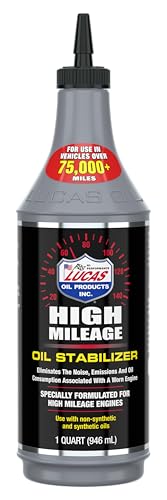
Lucas High Mileage Oil Stabilizer
Lucas Oil High Mileage Oil Stabilizer is designed for engines showing the familiar effects of wear: noise, emissions and oil consumption. The product focuses on lubricating internal engine parts to minimize wear, making it a practical match for owners who want a broad stabilizing treatment rather than a dedicated leak-sealing formula.
Its high-mileage positioning makes it especially relevant to older vehicles where several symptoms may appear together. The supplied information does not specify a particular mileage threshold or dosage, so shoppers should consult the product directions before use. At one quart, it is also presented in a larger format than several smaller treatments here.
Pros
- Designed for high-mileage engines
- Lubricates internal engine parts
- Targets wear-related noise
- Addresses emissions and oil consumption
- Broad stabilizer format
Cons
- No specific seal-regeneration claim is listed
- Dosage information is not provided
- Less targeted than dedicated stop-leak products
This stabilizer makes the most sense when oil burning is part of a wider pattern of aging-engine symptoms. Its stated benefits combine lubrication and wear minimization with reductions in noise, emissions and consumption associated with a worn engine. In comparison, Liqui Moly concentrates more directly on seals, while Lucas takes a broader internal-lubrication approach.
At $15.29, it costs only slightly more than Liqui Moly and substantially more than STP. The value depends on whether you want one product aimed at multiple wear-related symptoms. It is not presented with the detailed compatibility or heat-resistance claims of BestLine Racing, nor the explicit leak and seal language found on Bardahl and Bar’s Leaks, but its purpose is straightforward for high-mileage use.
#3 · Best for Blue
Bardahl NoSmoke StopLeak
Bardahl NoSmoke + StopLeak is built specifically around burning oil, excessive exhaust smoke and leaks in older engines. Its extra-thick formula is intended to fill loose tolerances, while the product also helps restore dry, brittle seals. This combination makes it a strong fit for shoppers dealing with visible smoke alongside oil loss or engine seepage.
Beyond consumption, Bardahl states that the additive can reduce engine noise and quiet noisy lifters, while helping improve compression over time. It is positioned as an older-car treatment that may support cleaner emissions and smoother running. Those broad claims make it more comprehensive than a product focused only on seal regeneration.
Pros
- Directly targets burning oil
- Extra-thick formula fills loose tolerances
- Helps restore brittle seals
- May quiet noisy lifters
- Addresses smoke and emissions
Cons
- Thicker formulas may not suit every preference
- The data does not give a precise dosage
- Claims are especially aimed at older engines
Bardahl is a logical choice when the most obvious symptom is blue or excessive exhaust smoke. Its feature list connects the additive to loose tolerances, oil burning, seal dryness, noise and emissions, so it covers more aging-engine complaints than a simple oil stabilizer. The product is supplied in a 16 oz format, placing it between the smaller treatments and quart-size stabilizers.
At $12.99, it is one of the lower-priced options in this selection and costs more than STP but less than Liqui Moly, Lucas and Bar’s Leaks. Its strongest advantage is the combination of no-smoke and stop-leak positioning. Choose it over a general friction treatment when smoke, worn seals and lifter noise are more important than claims about extreme heat or reduced friction.
#4 · Best Friction Reduction
BestLine Diamond Nano-Lube
BestLine Racing Diamond Nano-Lube takes a different route from dedicated oil-burning sealers. It is described as a high-pressure engine treatment that forms a low-friction film, combines cleaning detergents with protective additives and helps remove existing sludge. The product claims approximately 60% lower friction compared with conventional engines, making it suited to drivers prioritizing wear, deposits and engine smoothness.
The formula is listed as compatible with gasoline, diesel, hybrid and racing engines, plus motorcycles, classic cars and commercial trucks. It also claims lubrication integrity up to 1,800°F and use at one bottle per five quarts of oil, preferably at every oil change. Those details make it the most specification-rich option in this lineup.
Pros
- Targets friction and wear
- Includes cleaning detergents
- Suitable for gasoline and diesel engines
- Listed for hybrid and racing use
- States a one-bottle-per-five-quarts ratio
Cons
- Costs more than every other listed option
- Not primarily a leak-sealing additive
- Its friction claim is manufacturer-stated
In practical terms, BestLine is better suited to an owner seeking broad engine treatment than someone simply trying to stop a seal leak. The stated combination of sludge cleaning, deposit prevention, acidic-oil neutralization and surface treatment gives it a maintenance-oriented profile. The compatibility list is unusually broad, while the specified five-quart ratio makes planning easier than with products that provide no dosage information here.
At $26.99, it is the most expensive product in the comparison. That premium is tied to its concentrated nano-lubrication, heat-resistance and friction-reduction positioning rather than a direct promise to rejuvenate seals. Compared with Bardahl, Bar’s Leaks and Liqui Moly, it is less focused on blue smoke and oil leaks; compared with Lucas Pure Synthetic, it provides more detail about cleaning and treatment use.
#5 · Best Budget Pick
STP High Mileage Oil Treatment
STP High Mileage Oil Treatment + Stop Leak is the most budget-friendly choice in this group and is formulated for vehicles with over 75,000 miles. Its high-viscosity formula creates a thick cushion between moving parts, while ZDDP is included as an anti-wear agent. The product also targets leaks, noise and smoking by helping rejuvenate seals and gaskets.
This is a practical fit for owners of cars, light trucks and SUVs who want to add the treatment during each oil change. The feature list gives clear routine-use guidance and identifies the intended high-mileage audience. It is less specialized than some alternatives, but covers several common symptoms in one inexpensive bottle.
Pros
- Lowest listed price
- Designed for vehicles over 75,000 miles
- Includes ZDDP for anti-wear protection
- Helps rejuvenate seals and gaskets
- Suitable for cars, light trucks and SUVs
Cons
- High-viscosity formula may not suit every engine
- Requires use with each oil change
- Less broad compatibility information than some rivals
STP is easy to understand in everyday maintenance: add it to the engine oil during each oil change, particularly in a vehicle beyond 75,000 miles. Its combination of thickness, anti-wear protection and stop-leak support covers wear, noise, smoking and gasket concerns. The stated vehicle range is useful, although it is narrower than the extensive application lists supplied for some other products.
At $7.18, STP is the clear value choice by listed price. It costs roughly half as much as Liqui Moly and far less than BestLine, making it appealing when affordability matters. Compared with Bardahl, it offers a clearer mileage threshold and routine-use instruction; compared with Lucas High Mileage, it adds explicit ZDDP, seal-and-gasket rejuvenation and a stated oil-change schedule.
#6 · Best Application Range
Bar's Leaks Oil Seal Repair
Bar’s Leaks OS-1 Oil Seal Engine Oil Burning and Leak Repair is aimed at engines consuming oil, leaking from seals or producing blue exhaust smoke. It is designed to renew worn valve seals and guides and repair leaking main seals and gaskets. The manufacturer identifies engines consuming no more than one quart of oil per day as candidates, giving shoppers an important boundary for consideration.
Its stated compatibility is unusually extensive, covering gasoline, diesel, turbocharged, EcoBoost, hybrid and racing engines. The product also lists cars, trucks, vans, SUVs, tractors, boats, RVs, motorcycles, ATVs and lawn equipment. That range makes it appealing for owners with unusual equipment, provided the appropriate dosage level is followed.
Pros
- Targets burning oil and blue smoke
- Renews worn valve seals and guides
- Works with gasoline and diesel engines
- Listed for turbocharged and hybrid applications
- Covers many vehicle and equipment types
Cons
- Not intended for consumption above one quart per day
- Dosage varies by application
- Costs more than Bardahl and STP
Bar’s Leaks stands out for pairing a clear oil-consumption limit with a wide application list. That makes the product easier to screen against a real symptom: it is presented for vehicles using no more than one quart of oil per day, not as a solution for unlimited oil loss. Its focus remains seals, guides, leaks and blue smoke rather than general friction reduction or oil stabilization.
At $23.60, it is among the more expensive choices, but the broad compatibility may justify that cost for owners of specialty vehicles or equipment. Compared with Liqui Moly, it offers more explicit application coverage and a stated consumption boundary. Compared with Bardahl, it emphasizes valve seals, main seals and gaskets across many engine types, while Bardahl places more emphasis on loose tolerances, lifters and emissions.
#7 · Best for Synthetic
Lucas Pure Synthetic Stabilizer
Lucas Pure Synthetic Oil Stabilizer is intended for modern engines requiring newer, lighter oils. It is described as light, slick and long-lasting, with exceptional film strength, and it is designed to stabilize oil pressure in electronically controlled engines. This makes it a better fit for shoppers seeking synthetic-oil support and wear protection than a dedicated stop-smoke or seal-repair product.
The formula is also listed for heavy-duty and high-performance transmissions, gearboxes and engines. Lucas states that it can quiet noisy transmissions, reduce heat and wear and enhance overall performance. Those claims give it broader drivetrain usefulness than many products in this comparison, although the supplied information does not specifically identify a seal-regeneration function.
Pros
- Designed for lighter modern oils
- Stabilizes oil pressure
- Offers strong film-strength positioning
- Suitable for transmissions and gearboxes
- Targets heat, wear and transmission noise
Cons
- Not primarily a burning-oil repair formula
- No seal-restoration claim is listed
- The data does not provide dosage guidance
This product is most relevant when the vehicle uses synthetic or newer, lighter oil and the owner wants a light stabilizer rather than a thick stop-leak treatment. Its emphasis on electronically controlled engines, film strength, heat reduction and drivetrain applications separates it from the seal-focused products. It may help address noise and wear, but the listed features do not directly promise to renew seals or stop blue smoke.
At $16.98, Lucas Pure Synthetic costs more than the high-mileage Lucas stabilizer and STP, but remains below BestLine and Bar’s Leaks. Its value comes from versatility across engines, transmissions and gearboxes, especially where lighter oils matter. For obvious oil burning, Bardahl, Liqui Moly or Bar’s Leaks are more directly aligned; for modern synthetic-oil support, this Lucas formula is the more natural choice.
Frequently Asked Questions
Can an oil additive permanently fix burning oil?
These products are presented as treatments that may reduce oil consumption, smoke, leaks, wear or seal-related problems. They are not guaranteed permanent repairs, and severe oil loss may require mechanical diagnosis.
Which additive is best for blue smoke?
Bardahl NoSmoke + StopLeak, Liqui Moly Motor Oil Saver and Bar’s Leaks specifically address blue or smoky exhaust in their product information. The best match depends on whether you also need seal regeneration, broad application coverage or support for loose engine tolerances.
Are these additives suitable for diesel engines?
The supplied information specifically lists diesel compatibility for BestLine Racing and Bar’s Leaks. Other products should be checked against their individual directions and your vehicle requirements before use.
Which option is best for a high-mileage car?
STP is specifically formulated for vehicles with over 75,000 miles, while Lucas High Mileage and Bardahl are also positioned around worn or older engines. Choose based on whether your main concern is budget, general wear, smoke or leaks.
Should I use an additive at every oil change?
STP explicitly says to add its treatment during each oil change, and BestLine recommends use at every oil change. For the other products, follow the label directions rather than assuming the same schedule applies.
Final Thoughts
For the most direct approach to burning oil and visible smoke, Bardahl NoSmoke + StopLeak is the standout all-rounder, while Liqui Moly is a more focused seal-care choice. Bar’s Leaks is especially compelling when you need broad compatibility and your oil consumption remains within its stated limit.
Choose STP when price and high-mileage maintenance matter most, BestLine when friction and treatment features are the priority, and Lucas Pure Synthetic when your engine uses lighter synthetic oil. Lucas High Mileage remains a sensible middle ground for worn engines with several symptoms rather than one clearly identified leak.

Olivia
Writer at Helmet Today, covering helmet reviews, fit and riding safety.


