
We may earn a commission when you buy through links on this page, at no extra cost to you. Learn more
Choosing the Best Paint Sprayer for Automotive work starts with matching the tool to your coating, compressor and project size. A dedicated spray gun offers adjustable atomization and interchangeable nozzles, while an aerosol can is simpler for small repairs and touch-ups.
Pay close attention to nozzle sizes, air requirements and control adjustments. Primers, basecoats, clearcoats and thicker enamels do not all spray the same way, so flexibility can matter more than headline power.
The five options below cover LVLP and HVLP spray guns as well as a ready-to-use automotive aerosol. They suit different jobs, from full refinishing and repeated DIY work to quick repairs where setup and cleanup matter most.
| Product | Title | Key Features | Price |
|---|---|---|---|
 |
#1Best Versatility AEROPRO R500 LVLP Spray Gun Brand: AEROPRO
|
|
Check Latest Price |
 |
#2Best Accessory Kit KCNKCN R500 LVLP Spray Gun Brand: KCNKCN
|
|
Check Latest Price |
 |
#3Best Budget Gun SRQLNTT 819 HVLP Spray Gun Brand: SRQLNTT
|
|
Check Latest Price |
 |
#4Best Guided Setup InoKraft D1 LVLP Spray Gun Brand: InoKraft
|
|
Check Latest Price |
 |
#5Best for Touch-Ups Rust-Oleum 2X Automotive Enamel Brand: Rust-Oleum
|
|
Check Latest Price |
What to Look for in Best Paint Sprayer For Automotive
- Choose nozzle sizes based on your coatings: smaller openings suit thinner finishes, while larger ones handle thicker products more easily.
- Check the spray gun’s CFM and pressure requirements against your compressor before buying.
- Look for adjustable fluid, fan and airflow controls when you need to fine-tune coverage and atomization.
- A Teflon-coated body, stainless components or disposable cups can make cleanup and repeated use less troublesome.
- For small touch-ups, an aerosol can avoids compressor setup, hose connections and spray-gun cleaning entirely.
#1 · Best Versatility
AEROPRO R500 LVLP Spray Gun
The AEROPRO R500 is a practical choice for automotive painters who want one gravity-feed gun with several coating options. Its 1.3 mm, 1.5 mm and 1.7 mm nozzles cover low-viscosity basecoats and clearcoats, medium-viscosity primers and topcoats, plus thicker or high-solids coatings. The two-stage trigger provides separate control over airflow and paint delivery, making it a useful starting point for DIY refinishing.
This LVLP model uses 3.0–3.9 CFM at 2.0–3.5 bar, so it is designed around controlled air use rather than the higher consumption associated with some spray systems. The package includes a 600 cc cup, air regulator and instruction manual. Its stated uses extend beyond cars to furniture, cabinets, varnish and other projects, which makes it appealing for a mixed workshop.
Pros
- Three nozzle sizes for different coating viscosities
- Two-stage trigger helps control spray delivery
- Efficient 3.0–3.9 CFM LVLP operation
- Teflon-coated body resists paint buildup
- Includes regulator and 600 cc gravity cup
Cons
- Requires a suitable compressor and careful setup
- The package has fewer disposable-cup accessories than some alternatives
In real-world use, the nozzle selection is the main advantage: the 1.3 mm option is suited to basecoats and clearcoats, while the larger sizes broaden its usefulness for primers and thicker finishes. The Teflon-coated body should help reduce accumulated paint, and stainless steel nozzle and needle components are intended for durability. The included manual gives setup and operating guidance for users still learning spray-gun technique.
At $74.99, the R500 sits alongside the similarly priced KCNKCN model but takes a more straightforward approach to accessories. It offers the essential regulator, cup and three nozzles, whereas the KCNKCN adds disposable cups and a separator. Compared with the $119.99 InoKraft, this is a more economical flexible gun; compared with the aerosol, it is better suited to larger, repeatable jobs.
#2 · Best Accessory Kit
KCNKCN R500 LVLP Spray Gun
The KCNKCN R500 is aimed at automotive DIYers who want a low-air-consumption gun plus plenty of consumables in the box. It includes 1.3 mm, 1.5 mm and 1.7 mm nozzle accessories, with the middle size described as a general starting point for automotive paint, furniture and DIY work. The two larger choices also accommodate thicker coatings and larger continuous spraying tasks.
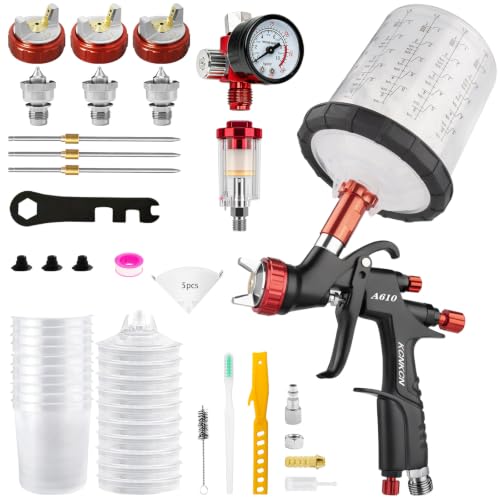
Its 3.0–3.9 CFM, 2.0–3.5 bar LVLP design is intended to provide fine atomization with less overspray than HVLP guns, while the stated spray pattern reaches 280 mm. The kit includes an air regulator, oil-water separator, mixing cup, ten disposable paint cups and liners, connector, adaptor, wrench and cleaning kit. A 600 g body is also presented as a way to reduce arm fatigue during long sessions.
Pros
- Includes ten disposable cups and liners
- Three replaceable nozzle sizes
- Oil-water separator and cleaning kit included
- Designed for 3.0–3.9 CFM air use
- Stainless passages and upgraded seals
Cons
- Disposable-cup systems add consumable waste
- Still depends on a compatible compressor
- The many accessories may be unnecessary for occasional touch-ups
The accessory selection changes the ownership experience more than the basic spray-gun design. Disposable cups and liners can simplify color changes and cleanup, while the oil-water separator adds another useful preparation step. For extended work, the lightweight body and 280 mm pattern may help cover more area efficiently, although final results will still depend on preparation, thinning and compressor performance.
At $74.99, this is a strong alternative to the AEROPRO R500 for buyers who value included supplies. Both offer three nozzle sizes and similar air and pressure ranges, but the KCNKCN supplies more cleanup and cup hardware. It costs less than the InoKraft while offering a fuller consumables package; the $30.99 SRQLNTT is cheaper, but this model presents a more complete repeated-use setup.
#3 · Best Budget Gun
SRQLNTT 819 HVLP Spray Gun
The SRQLNTT 819 is the low-cost spray-gun option for shoppers who want automotive, DIY and broader household versatility without moving to a premium kit. Its 1.3 mm, 1.7 mm and 2.0 mm nozzles are designed for water-based and solvent-based coatings, including car paint, primer, clearcoat and topcoat. The larger 2.0 mm opening also suits thicker materials and wider project types.
Three separate adjustments let users regulate paint flow, fan width and air volume, which is helpful when moving between touch-up work and broader coverage. The gun operates at 2.0–3.5 bar and uses 3.0–3.9 CFM, according to the product information. Its aluminum alloy body, copper atomization cap, stainless nozzle needle and Teflon-coated surface provide a substantial feature list for the price.
Pros
- Lowest-priced spray gun in this selection
- Three nozzle sizes including 2.0 mm
- Adjustable fluid, fan and air controls
- Suitable for water- and solvent-based coatings
- Disposable cup design can reduce cleaning work
Cons
- Fewer included accessories than the two R500 kits
- Factory test oil may remain on the gun
- The product information does not specify a cup capacity
For a first spray-gun purchase, the controls are particularly useful because they allow adjustment of material output, spray width and airflow rather than relying on one fixed setting. The disposable cup design is intended to simplify mixing, spraying, refilling and storage. Buyers should note the manufacturer says a small amount of test oil may remain after factory testing, so inspecting and cleaning the gun before painting is sensible.
At $30.99, the 819 is substantially cheaper than the other compressor-driven guns and is the clearest value pick for occasional projects. It offers more adjustment than the Rust-Oleum aerosol and a wider range of coating support, but the AEROPRO and KCNKCN kits include more clearly specified supporting hardware. Choose this one when entry cost matters most and you are comfortable assembling the rest of your setup.
#4 · Best Guided Setup
InoKraft D1 LVLP Spray Gun
The InoKraft D1 LVLP is built for DIYers who want a more guided route into spray painting. Clearly marked scales and labels on the body are intended to make adjustments easier, while the quick-start guide, full manual and videos provide extra help during setup. It is positioned for automotive, furniture and DIY painting, so it can remain useful beyond a single vehicle project.
This premium kit is described as a one-stop starting solution, including pressure regulators, oil-water separators and frequently used nozzle sizes. Its LVLP system is designed for efficient transfer and even atomization, while the one-piece forged aluminum body has a Teflon coating to improve wear resistance and simplify cleaning. The product information emphasizes a professional-style finish without requiring experienced operation from the outset.
Pros
- Clearly marked controls for easier operation
- Includes regulators and oil-water separator
- Guides include a quick-start guide, manual and videos
- Forged aluminum body with Teflon coating
- Designed for automotive and general DIY use
Cons
- Highest-priced spray gun in this selection
- Exact nozzle sizes and air figures are not specified
- May offer more guidance and kit contents than casual users need
The D1’s main appeal is not a particular nozzle specification but the effort to make setup less intimidating. Visible scales, labeled controls and multiple learning resources can help new users approach pressure and spray adjustments with more confidence. The forged aluminum body and coated surface also target durability and cleanup, useful qualities when a gun will be used repeatedly rather than stored after one repair.
At $119.99, it costs more than both R500 options and the SRQLNTT 819, so its value depends on how much you appreciate the guided setup and included startup hardware. It is a better fit for someone building a repeat-use painting routine than for a single small repair. The Rust-Oleum can is far simpler, but it cannot provide the same kit-based control or workshop versatility.
#5 · Best for Touch-Ups
Rust-Oleum 2X Automotive Enamel
Rust-Oleum 2X Automotive Enamel is the outlier here: it is a ready-to-use aerosol rather than a compressor-powered spray gun. That makes it especially suitable for small automotive repairs, parts and projects where buying a regulator, hose and compressor-compatible gun would be unnecessary. The gloss black formula is also listed for indoor and outdoor surfaces including metal, wood and plastic.
Its 5-in-1 dial offers high-output, standard-output, low-output, vertical-fan and horizontal-fan patterns, while 360° any-angle spraying adds flexibility around awkward surfaces. The product is described as fast drying, touch-drying in 20 minutes, and covering up to 12 square feet per can. It is a straightforward choice when convenience and minimal preparation matter more than bulk refinishing control.
Pros
- No compressor or spray-gun setup required
- Five spray pattern settings
- Sprays from any angle
- Touch-dry in 20 minutes
- Works on metal, wood and plastic
Cons
- Limited to the listed gloss black finish
- One can covers up to 12 square feet
- Less suitable for large automotive refinishing than a spray gun
The aerosol format changes the workflow completely: shake, select a pattern and spray rather than connect equipment and clean a fluid passage afterward. The dial provides more pattern choice than a basic can, and the any-angle feature can help with parts that are difficult to orient. Coverage is finite, however, so larger panels may require multiple cans and careful planning around the stated coverage area.
At $9.49, it is the most accessible option in the roundup and the easiest to justify for a quick repair or small part. It cannot match the nozzle flexibility, cup capacity or adjustable compressor-driven application of the AEROPRO, KCNKCN, SRQLNTT or InoKraft guns. Pick it for speed and simplicity; choose one of the guns when you need broader coating flexibility or a repeatable larger-area process.
Frequently Asked Questions
What type of paint sprayer is best for automotive work?
A compressor-powered LVLP or HVLP spray gun is generally the more flexible choice for automotive primers, basecoats, clearcoats and topcoats. An aerosol such as the Rust-Oleum option is better suited to smaller repairs and parts where setup time matters.
Do these automotive spray guns require an air compressor?
Yes. The AEROPRO, KCNKCN and SRQLNTT models list air-consumption and pressure requirements, and the InoKraft is also an air spray gun. Check your compressor against the gun’s stated requirements before purchasing.
Which nozzle size should I use for automotive paint?
The supplied guidance places 1.3 mm nozzles with low-viscosity basecoats and clearcoats, while 1.5 mm is suited to medium-viscosity primers and topcoats. Larger 1.7 mm or 2.0 mm nozzles are intended for thicker coatings, depending on the model.
Are LVLP and HVLP spray guns different?
Yes. LVLP means low volume, low pressure, while HVLP means high volume, low pressure. In this selection, the AEROPRO, KCNKCN and InoKraft are LVLP models, and the SRQLNTT 819 is described as HVLP.
What is easiest to clean and set up?
The Rust-Oleum aerosol requires the least equipment and avoids spray-gun cleaning altogether. Among the guns, disposable cups on the KCNKCN and SRQLNTT are intended to reduce cleanup, while coated bodies on several models help resist paint buildup.
Final Thoughts
For the best balance of automotive flexibility and price, the AEROPRO R500 is a strong all-rounder with three nozzles, a two-stage trigger and a useful 600 cc cup. Choose the KCNKCN instead if disposable cups, a separator and a cleaning kit are more valuable to you, or select the InoKraft D1 if guided setup and a more premium kit matter most.
The SRQLNTT 819 is the budget compressor-gun pick, offering broad adjustment at the lowest gun price. For a small gloss-black repair with no compressor, the Rust-Oleum aerosol is the practical choice; it is faster to deploy, though not a substitute for a full automotive spray setup.

Olivia
Writer at Helmet Today, covering helmet reviews, fit and riding safety.