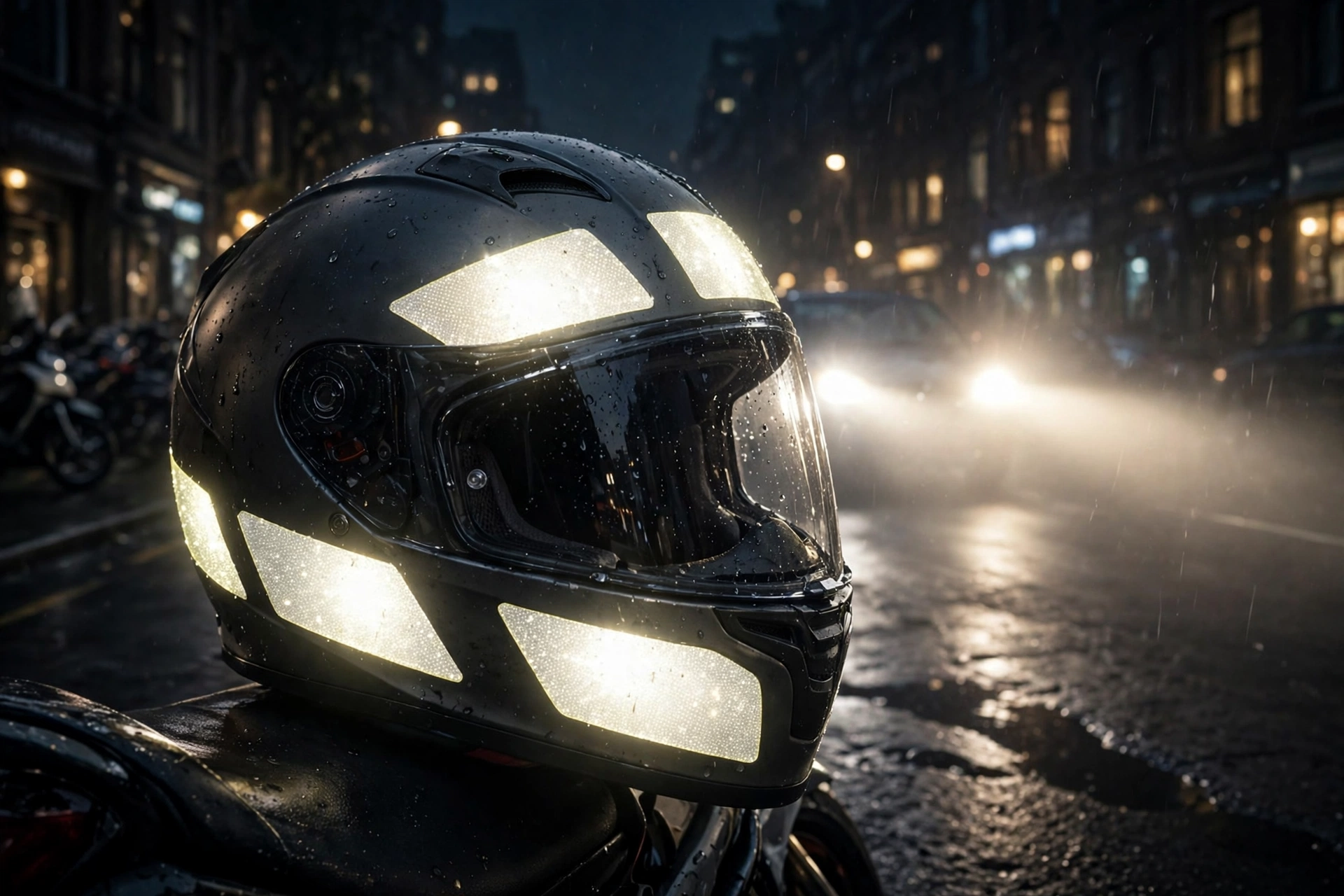
Reflective elements on a helmet make you dramatically easier to see at night — but only when a light source, usually a car’s headlights, is pointed at you. Retroreflective material works by bouncing light straight back toward its source, so a reflective helmet panel lights up brightly in a driver’s beam while doing almost nothing on an unlit road with no traffic. Think of reflective coverage as a powerful partner to your lights, never a replacement for them.
How Does Retroreflective Material on a Helmet Actually Work?
Ordinary bright colors scatter light in every direction, which is why a white jacket looks dim gray at night. Retroreflective material is engineered differently: it uses tiny glass beads or micro-prisms to return incoming light directly back toward where it came from. When a car’s headlights hit your helmet, the reflected light goes back to the driver’s eyes, and the reflective panels appear to glow — far brighter than the surrounding scene. That is the same technology used on road signs and high-visibility workwear.
The catch follows directly from the physics: no incoming light means no returned light. On a dark road with no vehicles, reflective panels are invisible. They also work best within the beam’s path — a driver approaching from the side, above, or outside headlight range may not trigger a strong reflection until they are fairly close. Reflective gear is therefore a system tied to traffic, lights, and angles, and it performs best when it covers enough of the helmet to catch beams from different directions.
What Should You Look for in a Reflective Helmet?
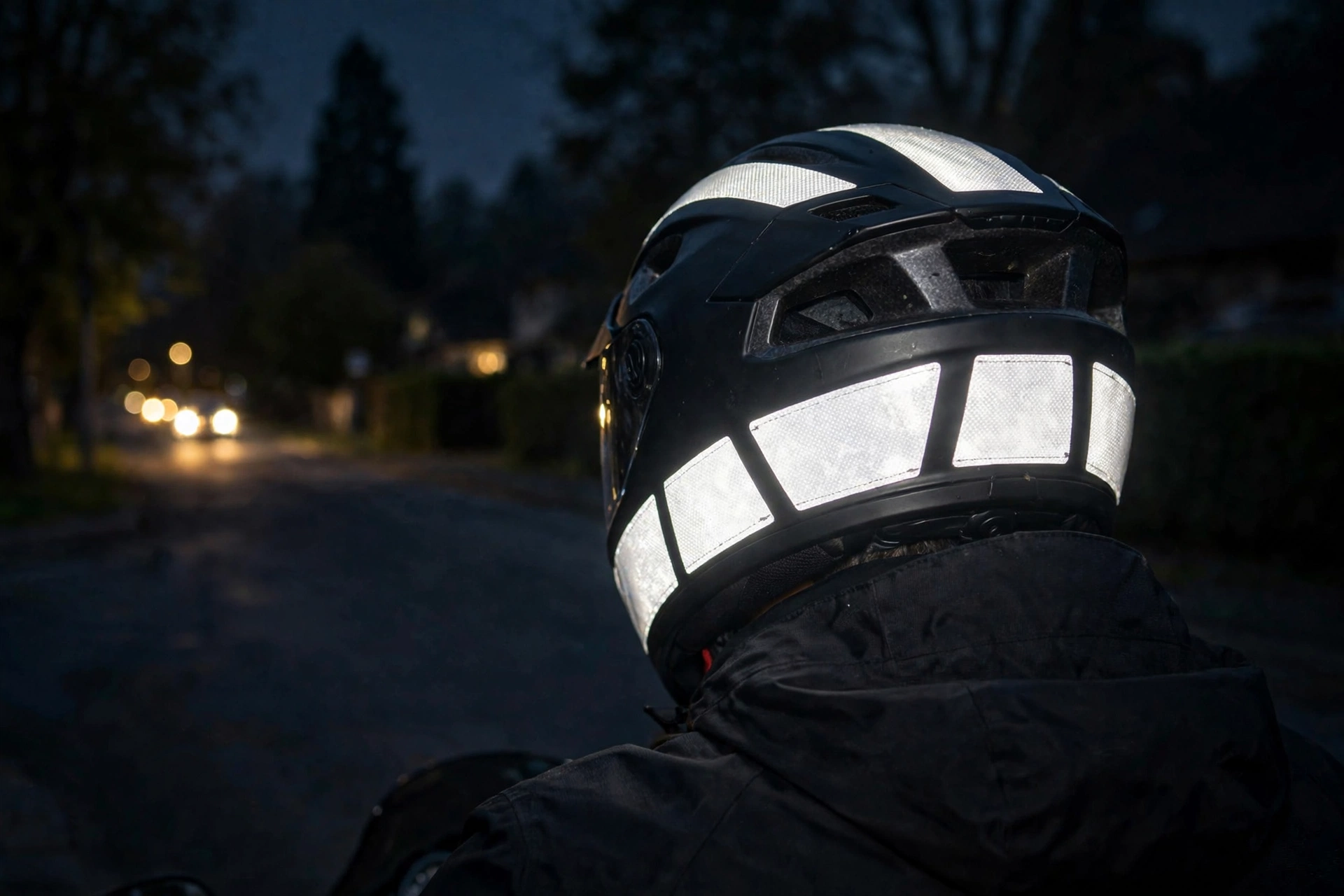
Coverage and placement matter more than a single logo-sized patch. Look for reflective material that wraps around the helmet — front, sides, and especially the back — so you catch light from approaching and following traffic. On bicycle helmets, reflective shells or reflective paneling all the way around the rim work well; on motorcycle helmets, reflective piping, panels, and trim serve the same purpose. Built-in reflective coverage is neater and more durable than add-on stickers, though quality helmet-safe reflective decals are a reasonable upgrade for a helmet you already own.
Check the condition, too. Retroreflective surfaces lose effectiveness when they are scuffed, filthy, or peeling, so wipe them down when you clean the helmet and replace worn decals. And remember that reflectivity is a visibility feature, not a protection feature: the helmet still needs a genuine certification and a proper fit, and safety systems inside the shell — such as the rotational-energy management explained in our article on what MIPS means for helmet safety — do the crash work that no amount of reflective trim can.
How Do Reflective Helmets Compare With Lights?
They complement each other rather than compete. Lights are active: your headlight, taillight, and any auxiliary lights announce you continuously, from any angle, whether or not another vehicle’s beam is aimed at you. Reflective material is passive: silent and batteryless, but dependent on someone else’s light. The strongest night setup uses both — lights for constant presence, reflectivity to flare brightly at exactly the moment a driver is looking your way.
There is also a recognition benefit. A reflective shape at head height, moving with your head as you check mirrors and scan intersections, reads to drivers as “person” faster than a random reflective roadside object. Movement matters: reflective material on moving parts — your head turning, your arms signaling — draws the eye in ways static reflectors do not. That is a real, if hard to measure, bonus of putting reflectivity on the helmet instead of only on the bike.
Do Reflective Helmets Help in Rain, Fog, and Dawn Light?
Partially. In rain and fog, headlights still reach reflective material, but beams are scattered by water and mist, so the returned glow is weaker and visibility distances shrink for everyone — slow down and rely more on your lights and positioning. At dawn and dusk, conditions are mixed: there is enough ambient light that bright colors help, and enough traffic with headlights on that retroreflective panels start to earn their keep. This twilight zone is statistically an awkward time to ride, in general terms, so layering every visibility tool you have makes sense.
One more practical point: keep your visor or eyewear clean and your lights uncovered. A reflective helmet cannot help a driver who cannot see through a rain-spattered windshield, and it certainly cannot compensate for a rider whose own view is fogged. Night safety is a chain — lights, reflectivity, clear vision, sensible speed, and defensive positioning — and the helmet is one strong link in it.
How Can You Add Reflectivity to a Helmet You Already Own?
Use reflective decals or tape designed for helmets, apply them to clean, smooth shell areas — rim, sides, and back — and avoid anything with harsh solvents or aggressive adhesives that could damage the shell finish or, worse, the materials underneath. Never apply stickers over vents in a way that blocks airflow on a bicycle helmet, and never use paint or chemical coatings not approved by the helmet maker. When in doubt, check the manufacturer’s guidance; the sticker is optional, the helmet’s integrity is not.
If your current helmet is near replacement age anyway, the simplest path is to choose your next helmet with reflective coverage built in, prioritizing a fit you will wear on every night ride. Combined with working lights and reflective clothing, a reflective helmet turns you from a shadow into a signal — exactly what you want to be after dark.
Frequently Asked Questions
Q: Does a reflective helmet replace the need for lights at night?
A: No. Reflective material only works when headlights shine on it. Lights announce you in all directions and in all conditions, including empty roads. Use both — lights for constant visibility, reflectivity for a bright highlight when traffic approaches.
Q: Is a fully reflective helmet better than one with reflective panels?
A: Full reflective shells maximize coverage, but well-placed panels around the sides and back capture most of the benefit. What matters most is wrap-around coverage that catches light from front, side, and rear angles — and keeping the reflective surface clean and undamaged.
Q: Can I stick reflective tape on any helmet?
A: Generally yes, if you use decals made for helmets and follow the manufacturer’s guidance. Avoid harsh adhesives and solvents, do not block vents, and never paint a helmet with unapproved coatings, which can damage the shell and compromise protection.

Olivia
Writer at Helmet Today, covering helmet reviews, fit and riding safety.