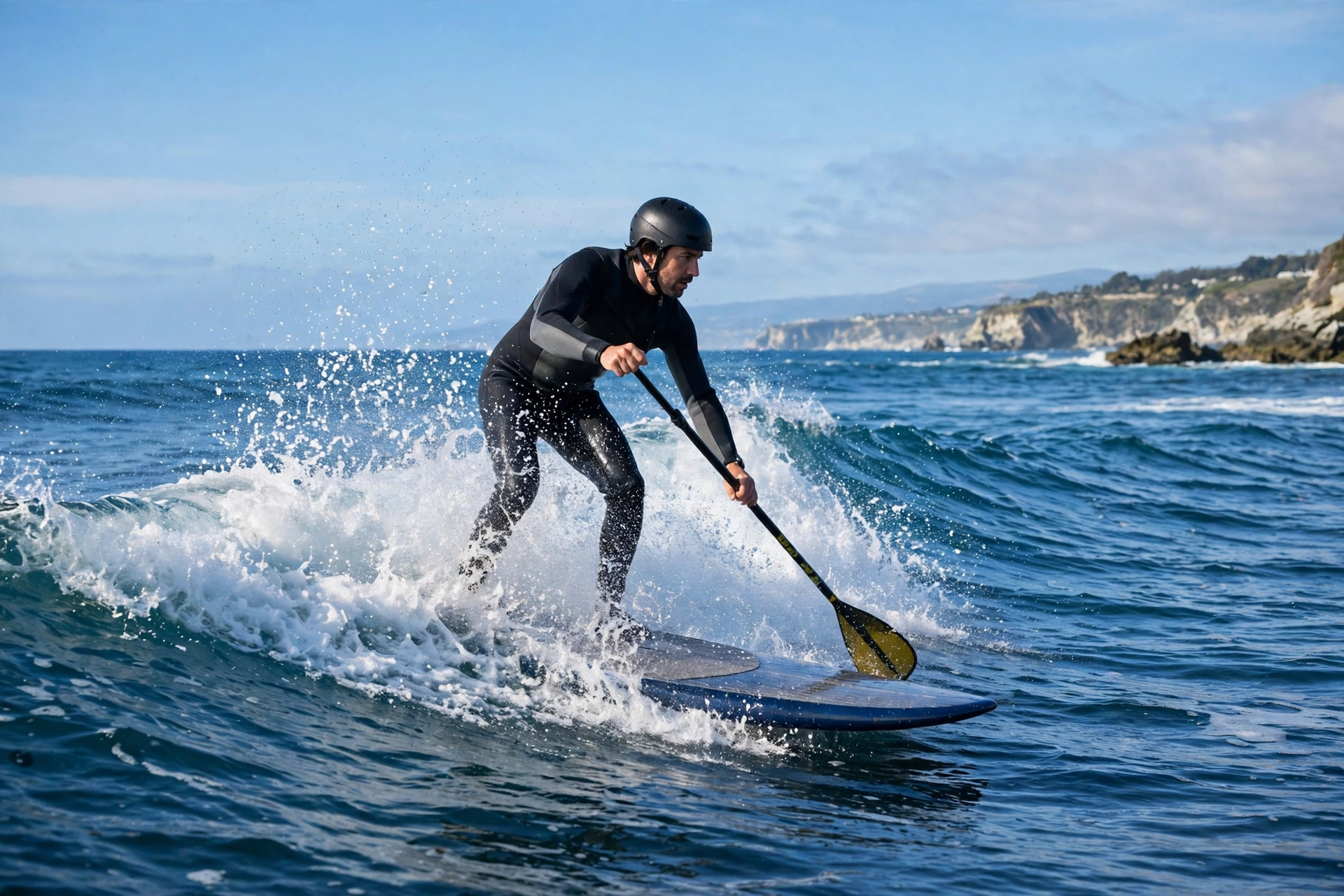
A stand-up paddleboard surfing helmet is a water sports helmet worn when riding waves on a stand-up paddleboard, often called SUP surfing. It protects the head from the board, the paddle, rocks, and the seabed when a rider falls in the surf. SUP surfing looks graceful from the beach, but a fall in shallow water or near a reef can bring the head into contact with hard surfaces very quickly. A helmet gives the rider a layer of protection in those moments, and it is becoming more common as the sport grows.
What Is Stand-Up Paddleboard Surfing?
Stand-up paddleboard surfing, often shortened to SUP surfing, is a form of surfing in which the rider stands on a large, stable board and uses a long paddle to catch and ride waves. The boards are bigger and more buoyant than a normal surfboard, which makes them easier to balance on and easier to paddle into a wave. Once on the wave, the rider uses the paddle for balance, steering, and extra power, and the sport blends the feel of surfing with the feel of paddling.
SUP surfing can be done on small, gentle waves or on larger, more powerful surf, and the risks grow as the waves get bigger and the water gets shallower. In a fall, the rider may land on the board, be hit by the paddle, or be pushed towards the seabed by the wave. The board itself is large and heavy compared with a surfboard, so being struck by it can cause a painful knock. In general terms, the helmet is there for those falls that cannot be predicted or controlled.
Why Would a SUP Surfer Wear a Helmet?
A SUP surfer might wear a helmet because the board, the paddle, and the seabed are all hard objects that the head can meet in a fall. When a wave closes out or the rider loses balance, the board can flip up and strike the head, or the paddle can swing round and catch the rider. In shallow water, the seabed may be sand, rock, or reef, and a wave can drive the rider down onto it with surprising force.
A helmet also helps when several people are surfing the same break, because another rider’s board can be a hazard too. In general terms, a helmet does not make SUP surfing safe in all conditions, and it cannot protect against every kind of impact, but it does reduce the force that reaches the head in the kinds of knocks that happen most often in the surf. For riders learning the sport, or surfing over reef or rock, that extra protection is a sensible choice.

How Is a SUP Surfing Helmet Different From Other Water Helmets?
A SUP surfing helmet is a lightweight water sports helmet, and it is designed to be comfortable enough to wear for a long session in the surf. It usually has a hard outer shell with a liner that absorbs some impact force, and it sits close to the head so that it does not catch the water or throw the rider off balance. Vents or drainage holes let water escape, so the helmet does not fill up and become heavy after a duck dive or a fall.
Some SUP helmets are based on the same designs used for whitewater kayaking, while others are made specifically for surfing, with a lower profile and less bulk. Ear coverage varies, and some riders prefer open ears so they can hear the waves and other surfers. If you want to understand one of the safety technologies used in modern helmets, reading about what MIPS is for helmets is a good place to start, though not every water helmet uses that system.
What Should a SUP Surfing Helmet Fit Like?
A SUP surfing helmet should fit snugly all round the head, sitting level and covering the forehead without slipping down over the eyes. It should not wobble when the rider shakes the head, and it should not press uncomfortably on any one spot. A helmet that is too loose can shift in a fall and leave part of the head exposed, while a helmet that is too tight can cause headaches and distract the rider from the waves.
The chin strap should be fastened snugly before paddling out, because a loose strap can let the helmet come off in the surf. It is worth checking the fit with wet hair, since the helmet can feel different once the rider is in the water. Some riders wear a thin neoprene hood under the helmet in cold water, and if that is the plan, the helmet should be tried on with the hood in place. In general terms, a comfortable, secure fit is what makes a helmet useful rather than a nuisance.
When Is a Helmet Most Useful for SUP Surfing?
A helmet is most useful for SUP surfing when the waves are breaking over a shallow reef, rocks, or a hard sandbank, because the seabed is close and the wave can push the rider onto it. It is also useful when the surf is crowded, when the waves are large and powerful, or when the rider is learning and falling often. In these situations, the chance of a knock to the head is higher, and the helmet gives a margin of protection that is hard to get in any other way.
In small, clean waves over deep sand, some experienced riders choose not to wear a helmet, and that is a personal judgement about the conditions. The risk is lower there, though it is never zero, because a board or paddle can still strike the head. In general terms, the decision comes down to the spot, the size of the surf, and the rider’s own comfort with the risks. A helmet is a sensible default, especially when the conditions are unfamiliar.
How Do You Care for a SUP Surfing Helmet?
A SUP surfing helmet should be rinsed with fresh water after each session, because salt water can wear down the straps, the liner, and the fittings over time. Rinsing takes only a few minutes and helps the helmet last longer and smell better. The helmet should be left to dry in the shade rather than in direct sun, since strong sunlight can weaken some materials and fade the shell.
It is also worth checking the helmet regularly for cracks, loose straps, worn padding, or damage to the shell. A helmet that has taken a hard impact should be replaced, even if it looks fine, because the liner inside may have compressed and may not protect as well next time. Storing the helmet somewhere cool and dry, away from heavy objects that could crush it, is another simple habit. In general terms, a helmet that is looked after will protect better and need replacing less often.
Do all SUP surfers wear a helmet?
No, not all SUP surfers wear a helmet. It is more common over reef or rock, in bigger surf, and among learners, while some experienced riders in gentle conditions choose not to wear one.
Can I use a kayak helmet for SUP surfing?
Yes, in general terms a whitewater or water sports helmet can work for SUP surfing, as long as it fits well, stays secure when wet, and is comfortable enough for a long session in the surf.
Will a helmet make it harder to hear in the surf?
It can muffle sound slightly, especially if it covers the ears. Many SUP helmets leave the ears open so the rider can hear waves and other surfers, so it is worth choosing a design that suits you.

Olivia
Writer at Helmet Today, covering helmet reviews, fit and riding safety.