

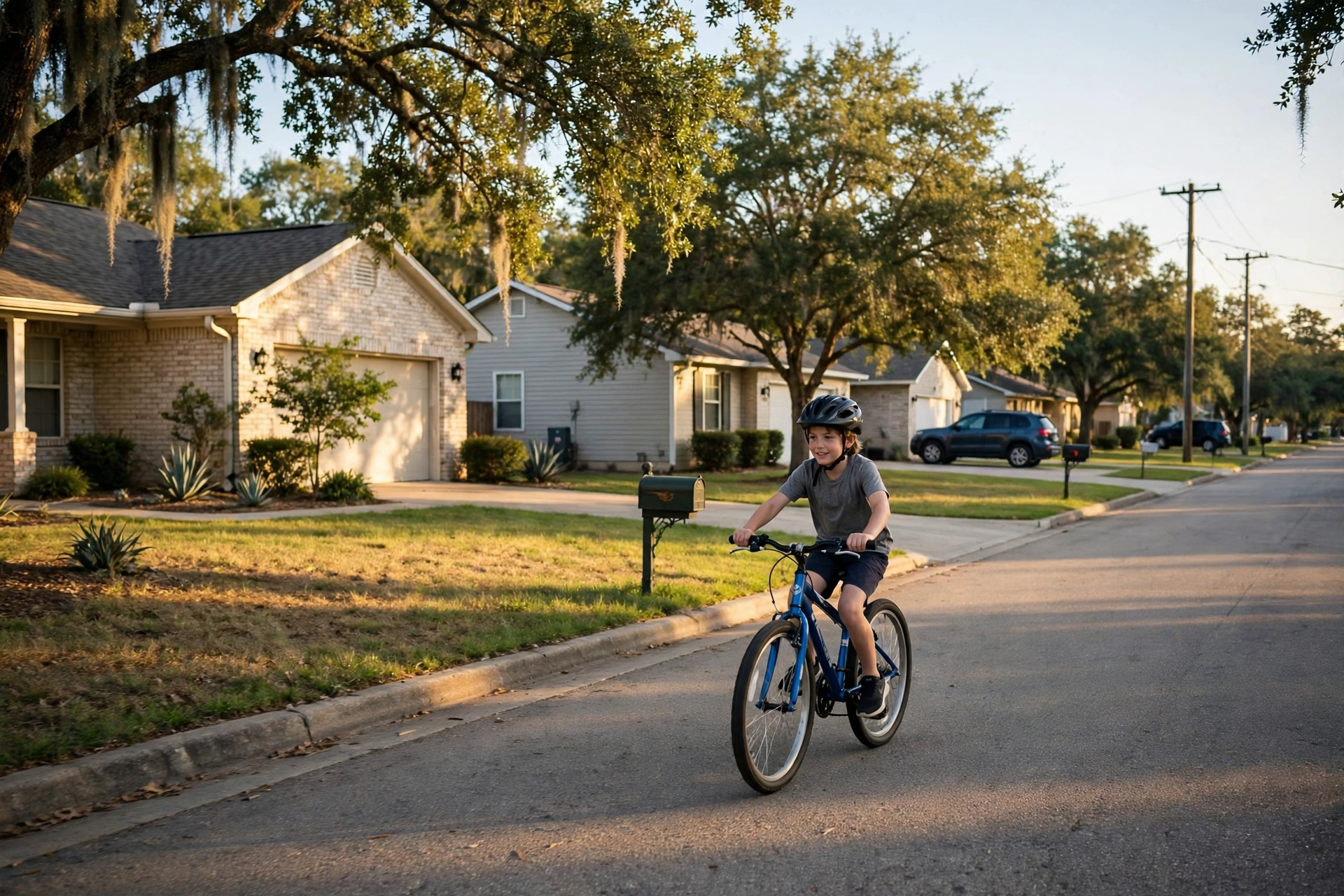
There is no age at which Texas state law requires a child to wear a bicycle helmet, because Texas has no statewide bicycle helmet law at all. Some Texas cities have passed their own ordinances, typically covering riders under 18, so the rule your child actually faces depends on the city. Check your local ordinance, because city rules vary and can change over time.
The Statewide Answer: Texas Sets No Helmet Age
Parents often ask this question expecting a number, 12, 14, 16, or 18, because so many states do set one. Texas is not one of them. The Texas Transportation Code lays out rules for bicycles, including where to ride, lights and reflectors for night riding, brakes, and carrying passengers safely. It does not include a helmet requirement for riders or passengers of any age.
So, at the state level, a child of 6, 12, or 17 is in the same legal position as an adult: no helmet is required by Texas law. There is no state helmet fine for a child, and no state age at which a helmet stops or starts being required. If you compare states, you will see how different the picture can be: our guide to which states do have helmet laws shows the states that chose to set an age, and Texas is not among them. Our helmet laws by state overview gives the same comparison in a broader state-by-state format.
As in other no-mandate states, the absence of a law is not a judgment that helmets are unnecessary. It simply means the Texas legislature has left the decision to families, and, importantly, to cities, which have used that freedom in different ways.
City Ordinances: Where Texas Age Rules Come From
The age limits Texans hear about are local. Several large Texas cities, including Austin, Houston, Dallas, and Fort Worth, have had bicycle helmet ordinances of their own, typically applying to children and teenagers under 18. That pattern, a local rule for minors rather than a state rule for everyone, is the single most useful thing to understand about helmets and the law in Texas.
The details are not identical from city to city. Ordinances can differ on the exact age covered, whether they apply to passengers as well as riders, where they apply, and how they are enforced. They can also be amended, narrowed, or repealed, and cities have revisited these rules over the years. An ordinance described in an old article or a neighbor’s memory may not match the code on the books today, and a suburb can differ from the big city next door, even on the same school route.
So treat under 18 as the typical pattern, not a guarantee. Before you rely on it, check the current municipal code for your own city, or ask the local police department’s non-emergency line. If your child rides across a city boundary to school, a park, or a friend’s house, the stricter local rule along that route is the sensible one to follow. And remember that schools, camps, and youth programs can require helmets for their activities regardless of what any ordinance says.
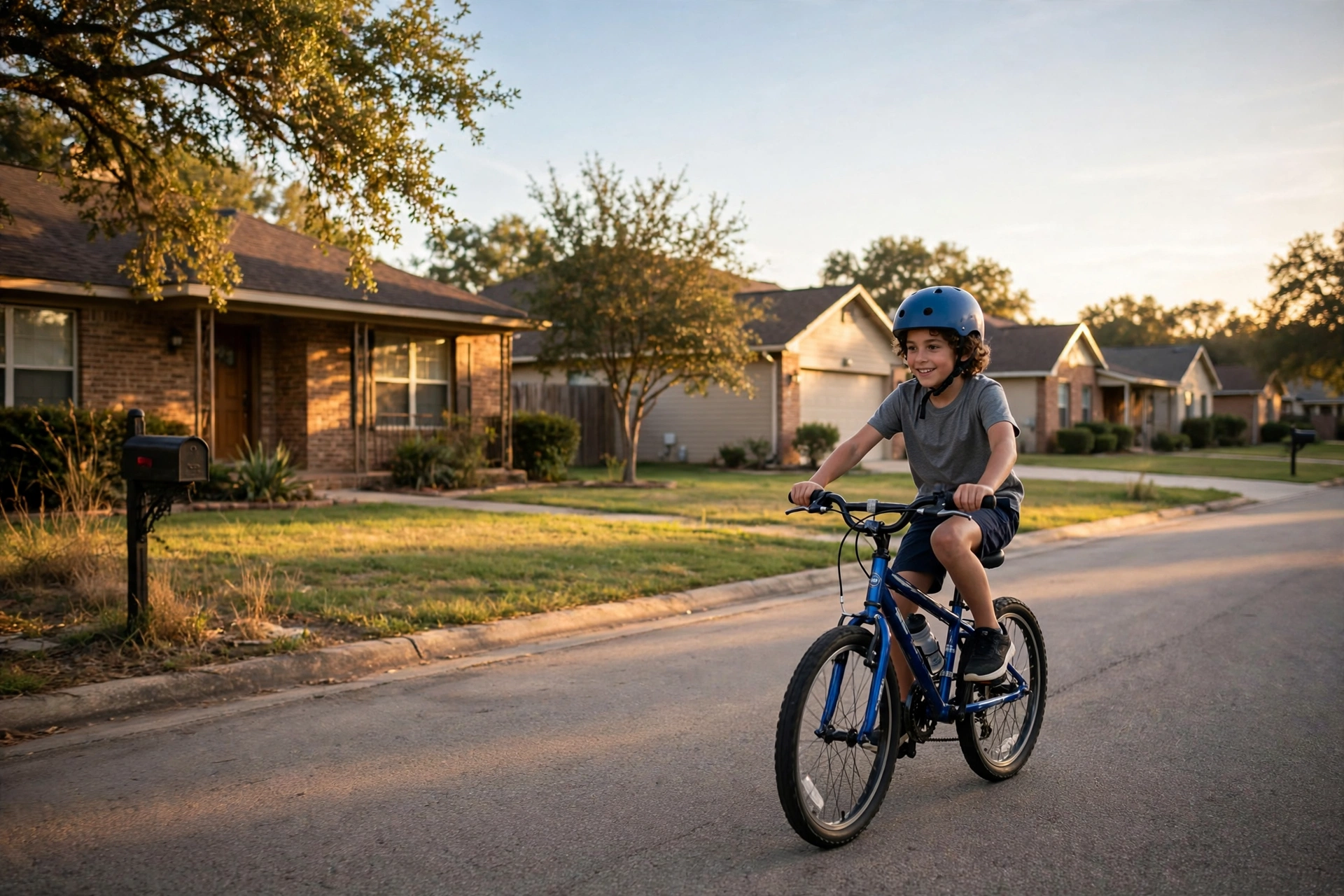
Why a Family Rule Simpler Than the Law Works Best
Trying to run a household policy that changes at every city limit is a losing game. Children ride to school in one town, to practice in another, and on trails in a third, and no parent can realistically re-check ordinances for every trip. The practical answer most Texas families land on is a single rule of their own: everyone under 18 wears a helmet on every ride. It matches the typical local pattern, it needs no research, and it never puts a child on the wrong side of an ordinance you did not know about.
There is a safety case behind that simplicity. Young riders are still developing balance, hazard awareness, and traffic judgment, and most children’s falls are low-speed, close-to-home events: a curb, a driveway apron, loose gravel, a sudden stop. A helmet is cheap insurance against the one part of that fall a parent actually worries about. Setting the rule in the driveway, before the first ride of the day, also avoids renegotiating it ride by ride.
Parents riding along should wear one too, even though no Texas rule asks it of them. It models the habit, it protects the adult, and it makes the under-18 rule feel like a family standard rather than a restriction aimed only at children.
Choosing a Helmet a Texas Kid Will Actually Wear
In Texas, the best helmet is often the one that is not miserable in the heat. A helmet left at home because it feels like an oven protects nobody, so fit and ventilation deserve as much attention as anything else:
- Check for the standard: choose a bicycle helmet that meets the federal CPSC standard, shown on a sticker inside. That applies to bike helmets sold in the US.
- Fit before features: measure around the head above the eyebrows, pick the matching size, and adjust so it sits level, about two finger-widths above the eyebrows, with straps in a V under the ears.
- Snug chin strap: fasten it so one or two fingers fit between strap and chin, and confirm the helmet does not rock or shift when your child shakes their head.
- Ventilation for the climate: look for generous vents and lighter colors for summer riding, and consider a visor for sun. Removable, washable pads help when a helmet is worn daily in hot weather.
- Replace after a crash: a helmet that has taken an impact should be replaced even if it looks fine, and so should one your child has outgrown.
Store the helmet indoors rather than in a hot car or garage, let sweaty pads dry between rides, and re-check fit at the start of each school year. Growing heads and worn straps undo a good fit faster than most parents expect.
Frequently Asked Questions
What age must a child wear a helmet in Austin or Houston?
Those cities have had local ordinances typically covering riders under 18, but ordinances can be amended. There is no Texas state age, so confirm your city’s current code before relying on a specific number.
Can a Texas child be stopped or fined for not wearing a helmet?
Not under state law, because Texas has no statewide bicycle helmet requirement. In a city with its own ordinance, local enforcement and penalties are possible under that city’s rules.
Do these rules cover e-bikes as well?
E-bikes have their own classes and rules in Texas, separate from ordinary bicycles. Do not assume the bicycle answer covers an e-bike; check the rules for the class your child rides and your city’s ordinance.

Olivia
Writer at Helmet Today, covering helmet reviews, fit and riding safety.


