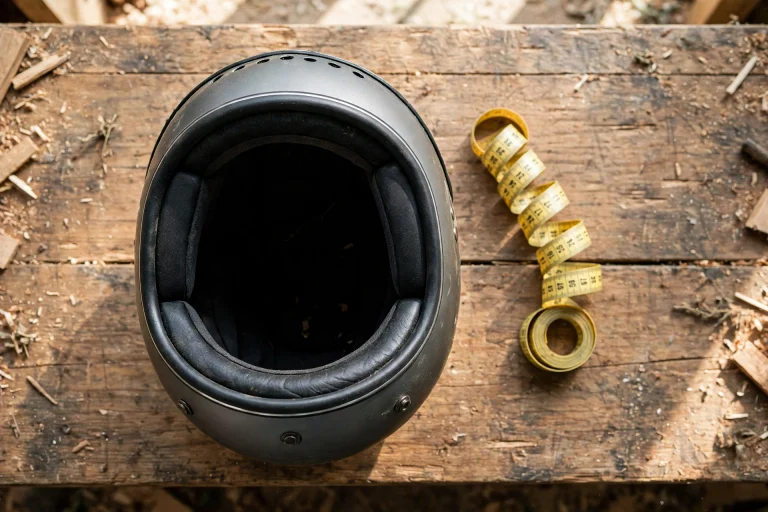
A motorcycle helmet’s label tells you its size letter, the head circumference range in centimeters (and often inches), the shell size it is built on, and its weight in grams. Reading all four together — rather than trusting the letter alone — is how you confirm a helmet matches both your head and your tolerance for neck fatigue on long rides.
Labels look like a wall of small print, and most riders only ever read the size letter. But the rest of the label explains why two helmets marked “Large” can feel completely different, and why one feels noticeably heavier by the end of a touring day. Here is how to decode each line.
Where is the size and weight label on a motorcycle helmet?
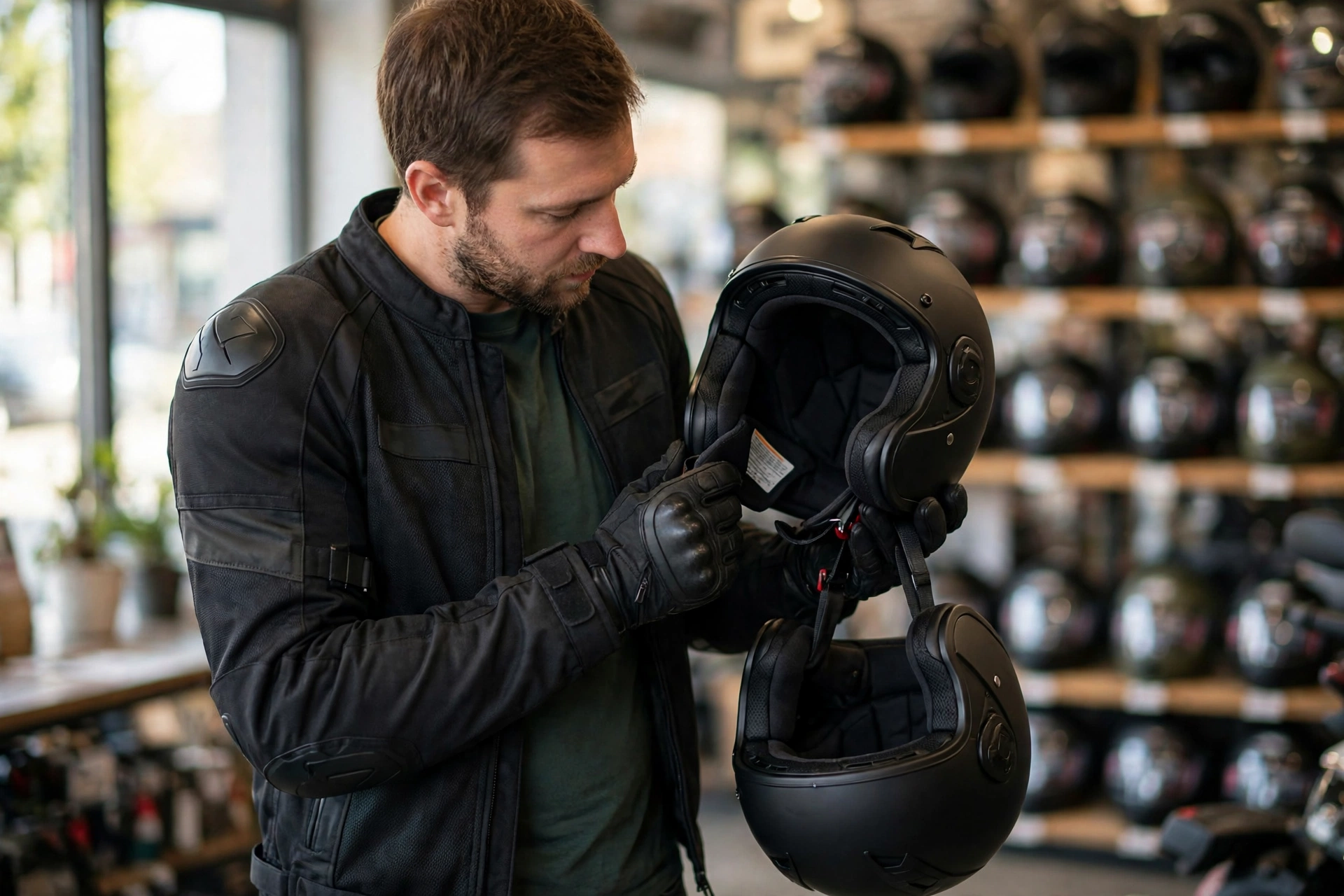
The main label is usually sewn or stuck inside the helmet, on or behind the comfort liner at the back or crown. Depending on the brand, you may need to lift or partially remove the liner to read it fully. A second, smaller sticker on the outside rear of the shell usually carries the certification mark.
Expect to find several pieces of information together: the size designation, a centimeter (and sometimes inch) range, a weight figure, the manufacture date, and the standard the helmet is certified to. Online listings reproduce most of this in the product specifications, but the physical label in the exact helmet you are buying is the authoritative version.
If a helmet has no legible label inside, treat that as a warning sign. Legitimate certified helmets always carry one, and its absence is a known marker of counterfeit or grey-market products.
What do the size letters and centimeter ranges mean?
The letter — XS, S, M, L, XL, and beyond — is only a shorthand. The numbers next to it are the real information: the range of head circumferences, measured around the head just above the eyebrows and ears, that the size is designed to fit.
The catch is that ranges are not standardized across the industry, in general terms. One brand’s Medium may cover roughly 57–58 cm while another’s covers 58–59 cm, and some brands run noticeably rounder or more oval than others. That is why the same rider can be a Medium in one helmet and a Large in another without either label being wrong.
Use the centimeter figure as your anchor. Measure your own head first, then compare your number against the printed range for each specific model — never order by letter alone, and be careful at the edges: if your measurement falls at the very top of one size’s range, most riders do better trying both that size and the next one up.
What does the weight figure actually tell you?
The weight on the label is the mass of the helmet in that size, usually printed in grams. It matters because your neck supports that weight for every minute of every ride. A heavier helmet is not automatically a safer one — all certified helmets meet the same impact standard for their market — but extra weight does translate into extra fatigue on long or windy rides.
Treat the figure as approximate and size-dependent. Larger sizes weigh more than smaller sizes of the same model, and published numbers may be measured on a mid size. Features drive most of the differences between models: drop-down sun visors, communication-system preparation, and flip-up mechanisms all add grams compared with a plain full-face shell.
When comparing two helmets, a difference of a few dozen grams is unlikely to be felt. Differences of a hundred grams or more, in general terms, are worth weighing against the features that cause them — especially if you tour, commute daily, or have any neck sensitivity. While you are reading the specification sheet, note any listed safety extras as well — some models include a rotational-impact liner of the kind described in our guide to what MIPS is and how it works, and small features like that help explain one model’s weight and price against another’s.
Why do shell sizes matter as much as the label size?
Many helmets are produced in a small number of outer shell sizes, with different thicknesses of internal padding used to create the full range of label sizes. The label or the product specification may state how many shells the model uses — and it quietly determines both bulk and weight.
If your size is made on the model’s smallest shell, you get a compact, lighter helmet. If your size is the largest fit squeezed onto that same small shell — or the smallest fit padded out in a big shell — the helmet can look and feel oversized, catch more wind, and weigh more than the label size suggests.
This is why two riders wearing “Medium” helmets from different brands can look so different, and why checking shell count is a pro move when buying. When a model you like uses more shell sizes across its range, in general terms, each label size tends to fit more proportionately.
How do you check the label against your own head?
Measure your head circumference with a soft tape, level, just above your eyebrows and ears, snug but not tight. Take the measurement two or three times and use the largest consistent reading — hair and tape position make small differences.
Match that number to the label’s centimeter range for the size you are considering, then try the helmet on. A correct new fit feels uniformly snug, like a firm handshake around your whole head, with no single hot spot. Cheek pads in a full-face helmet should press your cheeks noticeably without making it hard to talk.
Wear it for at least ten minutes in the shop. Pressure that is merely firm at minute one becomes a headache by minute forty if the shape is wrong for you. If the label says the size should fit but the helmet rocks side to side or lifts at the back, believe your head, not the label — and try a different model shape.
Frequently Asked Questions
Q: My head measurement falls between two sizes on the label. Which should I choose?
A: Start with the smaller size, in general terms, because comfort padding settles and compresses slightly with use while a loose helmet never becomes snug. If the smaller size creates a painful pressure point after ten minutes, try the larger one with thicker cheek pads if the brand offers them.
Q: Is a heavier motorcycle helmet safer than a lighter one?
A: Not by virtue of weight alone. Every helmet carrying the same certification has passed the same impact tests; weight differences mostly reflect shell material, size, and features. Choose the certified helmet that fits you best and that you can wear comfortably for your longest ride.
Q: Why does my helmet feel bigger than my friend’s in the same size?
A: Probably shell sizes. Your model may build your size on a larger outer shell with more padding, while theirs uses a shell closer to their head size. Head shape also plays a part — the label size only describes circumference, not shape.

Olivia
Writer at Helmet Today, covering helmet reviews, fit and riding safety.