No — in general terms, novelty helmets are neither legal where a motorcycle helmet law applies nor safe to wear in a crash. A novelty helmet is a thin decorative shell with little or no energy-absorbing foam inside, so it does not meet the federal DOT standard (FMVSS 218) that real motorcycle helmets are built to. It may look like a helmet, but in protective terms it behaves more like a hat.
Novelty helmets stay popular because they are light, cheap, low-profile, and comfortable on a hot day — riders who dislike the “mushroom head” look of a certified helmet are drawn to them. The problem is that the features that make a novelty helmet feel barely there are exactly the features that make it useless in an impact. This guide explains what a novelty helmet actually is, why it fails the legal test in helmet-law states, what that fake DOT sticker really means, and what to wear instead.
What Exactly Is a Novelty Helmet?
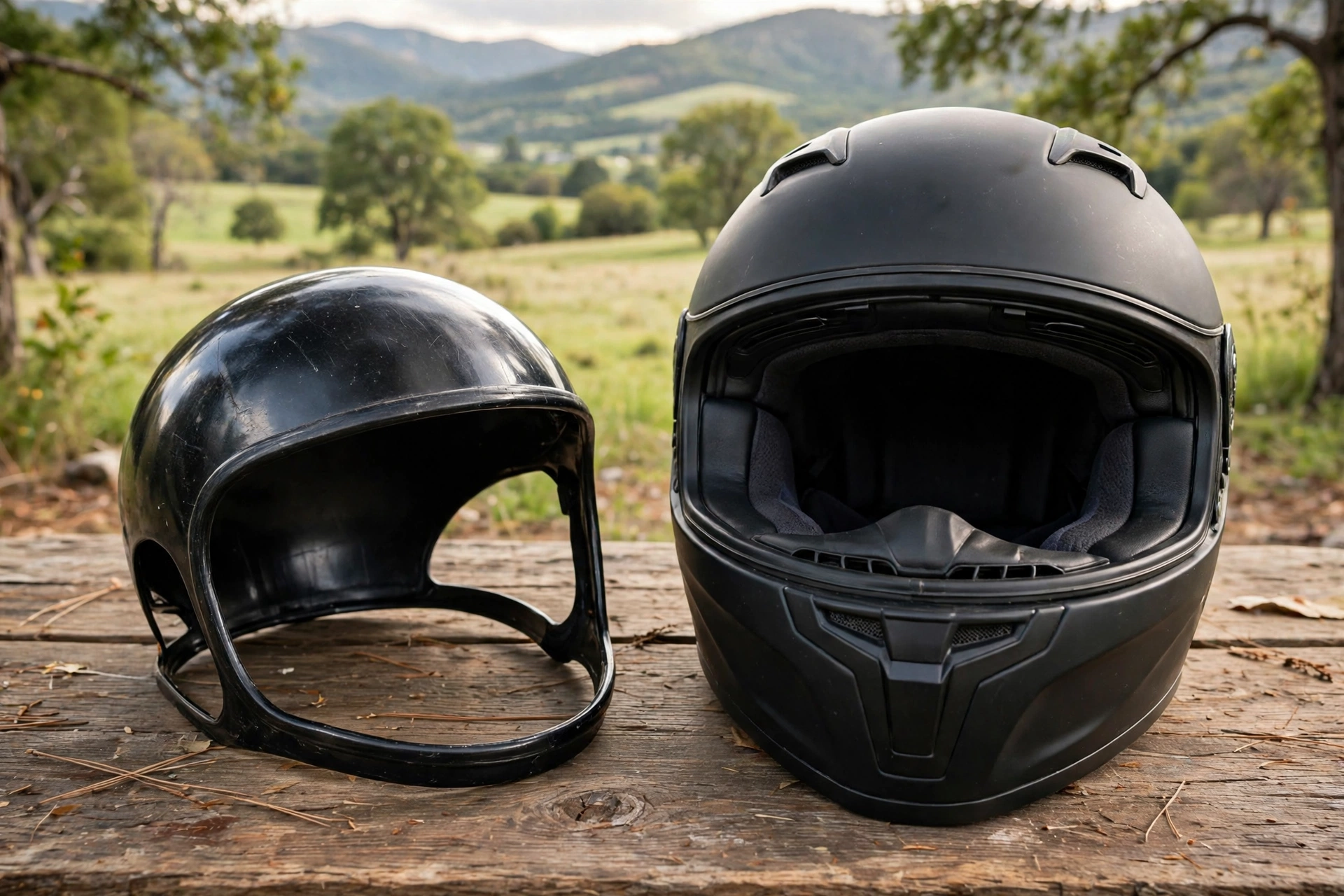
A novelty helmet is a lightweight shell — usually fiberglass or plastic — shaped like a half helmet or beanie-style motorcycle helmet, but built without the thick expanded polystyrene (EPS) foam liner that does the real work in a certified helmet. Some have little more than a thin comfort pad or fabric lining inside. Sellers typically market them with phrases like “novelty use only,” “not for highway use,” or “for costume purposes,” which is the manufacturer’s way of saying the helmet is not protective equipment.
That foam liner is not optional padding. In a crash, the EPS foam crushes in a controlled way to slow your head down over a fraction of a second longer, spreading the impact energy and reducing the force that reaches your skull and brain. A thin shell with no foam has almost nothing to crush, so your head absorbs nearly the full force of the impact. The shell might stop a scrape; it will not manage a real hit to the head.
Novelty helmets are weak in other ways too: flimsy straps, simple buckles, and little coverage at the sides and back of the head, with many designs sitting high on the head for that low-profile look.
Are Novelty Helmets Legal Where Helmet Laws Apply?
In general terms, no. States with motorcycle helmet laws require riders to wear a helmet that complies with the federal standard, FMVSS 218 — the DOT standard. Because novelty helmets do not meet that standard, wearing one in a state with a helmet law generally does not satisfy the law — and a rider stopped while wearing one can, in general terms, be cited for a helmet-law violation as if wearing no helmet at all.
The details vary by state. A handful of states have no helmet law for adult riders, and there wearing a novelty helmet is not a legal issue — though it remains a safety one. Other states have partial laws covering younger riders or certain license holders. Wherever a law does apply, the legal question is not “is something on your head?” but “is it a compliant helmet?” A novelty shell fails that test.
There is also a paperwork angle. If you are injured while wearing a non-compliant helmet in a helmet-law state, the choice can complicate insurance claims and legal proceedings, since the other side may argue you were not wearing legally required equipment. Consequences vary by state and case, but it is one more downside of saving a little weight.

Why Does the DOT Sticker on a Novelty Helmet Not Count?
Because anyone can buy the sticker. Genuine DOT certification is a self-certification system: the manufacturer tests its helmet design against FMVSS 218 and applies the DOT label to certify that the model complies. With a real helmet, that label means the maker is standing behind test results, and the model appears in official listings of certified helmets.
Novelty helmets are frequently sold with a DOT sticker already applied, or with a loose sticker included in the box for the buyer to stick on. That sticker is decoration, not certification — the helmet was never tested and could never pass, because it lacks the foam liner the standard’s impact tests depend on. Some sellers even ship the sticker separately as a wink to riders who want to look compliant at a glance.
A sticker fools nobody at the roadside for long. Officers are trained to look beyond the label: they check for the thick foam liner, the permanent manufacturer labels inside, and the overall construction. A thin, light, foam-free shell gives itself away quickly, sticker or not.
How Can You Tell a Novelty Helmet From a Real One?
Weight and thickness are the fastest tells. A certified half helmet has real heft and sits noticeably proud of the head, because there is roughly an inch of EPS foam between shell and skull. A novelty helmet feels suspiciously light and hugs the head closely — if it looks like a slightly padded cap, it almost certainly is one.
Look inside. A real helmet shows a firm foam liner — usually white, grey, or black EPS — that fills the inside of the shell, plus permanent manufacturer labels listing the maker, model, size, and date of manufacture. A novelty helmet typically shows a thin fabric liner or bare shell and little or no labeling. Sellers’ language is another clue: any listing that says “novelty,” “not DOT approved,” or “for show only” in the fine print is telling you the truth about the product. Price is only a supporting clue: certified helmets can be inexpensive, but one sold through costume channels rather than gear dealers deserves extra skepticism.
What Should You Wear Instead of a Novelty Helmet?
If you like the open feel of a half helmet, buy a certified one. DOT-compliant half helmets and low-profile “mushroom-free” designs have improved a lot, and the better ones keep the classic look while carrying a genuine foam liner. You give up very little in comfort and gain real protection.
If you want more protection, step up to a three-quarter or full-face helmet, which adds coverage for the face and jaw — areas a half helmet of any kind leaves exposed. Riders who want the science behind modern helmet design can read up on rotational-impact systems like the one explained in this guide to how MIPS helmet liners work, technology found only in genuinely engineered helmets.
Whatever style you pick, buy from a reputable motorcycle gear dealer, check that the helmet carries the proper certification label, and make sure it fits snugly. Those three habits will keep you both legal and protected.
Frequently Asked Questions
Q: Can I get a ticket for wearing a novelty helmet?
A: In a state with a helmet law, yes — in general terms, a novelty helmet does not satisfy the law because it does not meet the DOT standard, so an officer can treat it much like riding with no helmet. Rules and enforcement vary by state.
Q: My novelty helmet came with a DOT sticker. Does that make it certified?
A: No. Certification means the manufacturer tested that model and it passed FMVSS 218, which a foam-free novelty shell cannot do. A sticker sold with or stuck on a novelty helmet is decoration and offers no legal or safety protection.
Q: Is a novelty helmet better than no helmet at all?
A: Only marginally, for minor scrapes. It has little or no energy-absorbing foam, so in a real impact it offers far less protection than a certified helmet. If you ride regularly, a genuine DOT-compliant helmet is the sensible minimum.

Olivia
Writer at Helmet Today, covering helmet reviews, fit and riding safety.