Neither type is magic: a solar powered welding helmet charges its darkening circuit from the light of the arc (and usually from workshop light too), but in general terms almost all of them still rely on a backup battery, while a battery powered helmet runs entirely on replaceable cells you can swap in minutes. For most welders the most practical long-term choice is a solar-assisted helmet that also has a replaceable backup battery, because you get arc-powered convenience without a helmet that becomes scrap when an internal cell finally dies.
Power source rarely tops the list when people shop for a welding helmet — shade range, viewing area, and sensors get the attention. But the power design decides something fundamental: whether the helmet sitting in your locker is ready to darken on the very first arc strike today, and whether it will still be usable in five years.
How Does a Solar Powered Welding Helmet Actually Work?
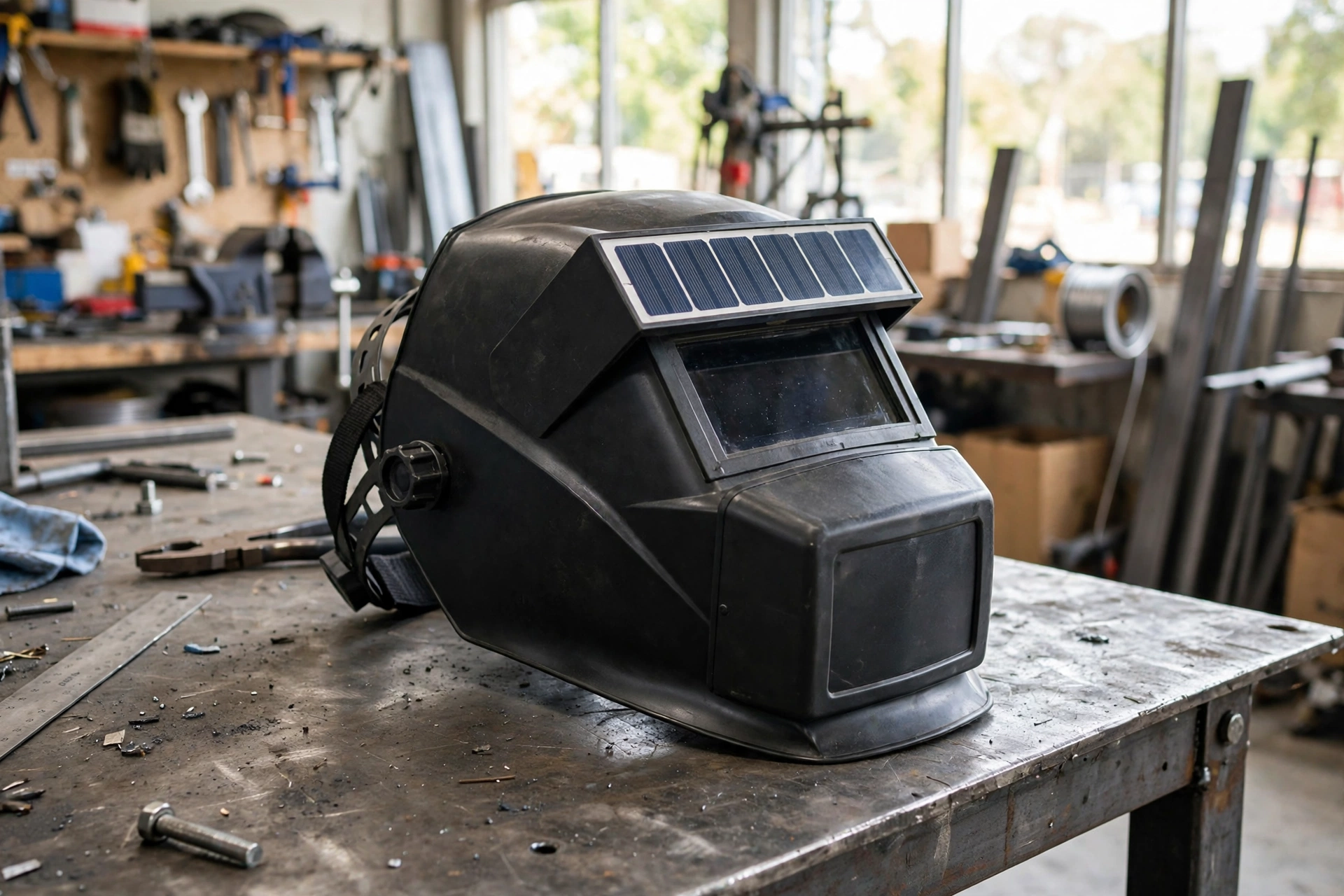
An auto-darkening filter needs electricity to switch the lens from light to dark in a fraction of a millisecond. In a solar design, a strip of solar cells across the front of the filter harvests light — primarily the intense light of the welding arc itself, and to a lesser degree bright ambient light — and feeds it to the circuit.
The clever part is that the helmet powers itself most when it is working hardest: the arc that demands instant darkening is also the strongest light source the cells ever see. In general terms, solar-assisted helmets also charge a small internal battery or capacitor from that harvested light, which carries the electronics through the moments before the first strike and between arcs.
That internal backup is the detail many buyers miss. A “solar” helmet is rarely solar-only. Most are solar-assisted, with a sealed lithium cell inside doing quiet support work. That distinction matters a lot when the helmet gets old, as we will see below.
How Do Battery Powered Welding Helmets Work?
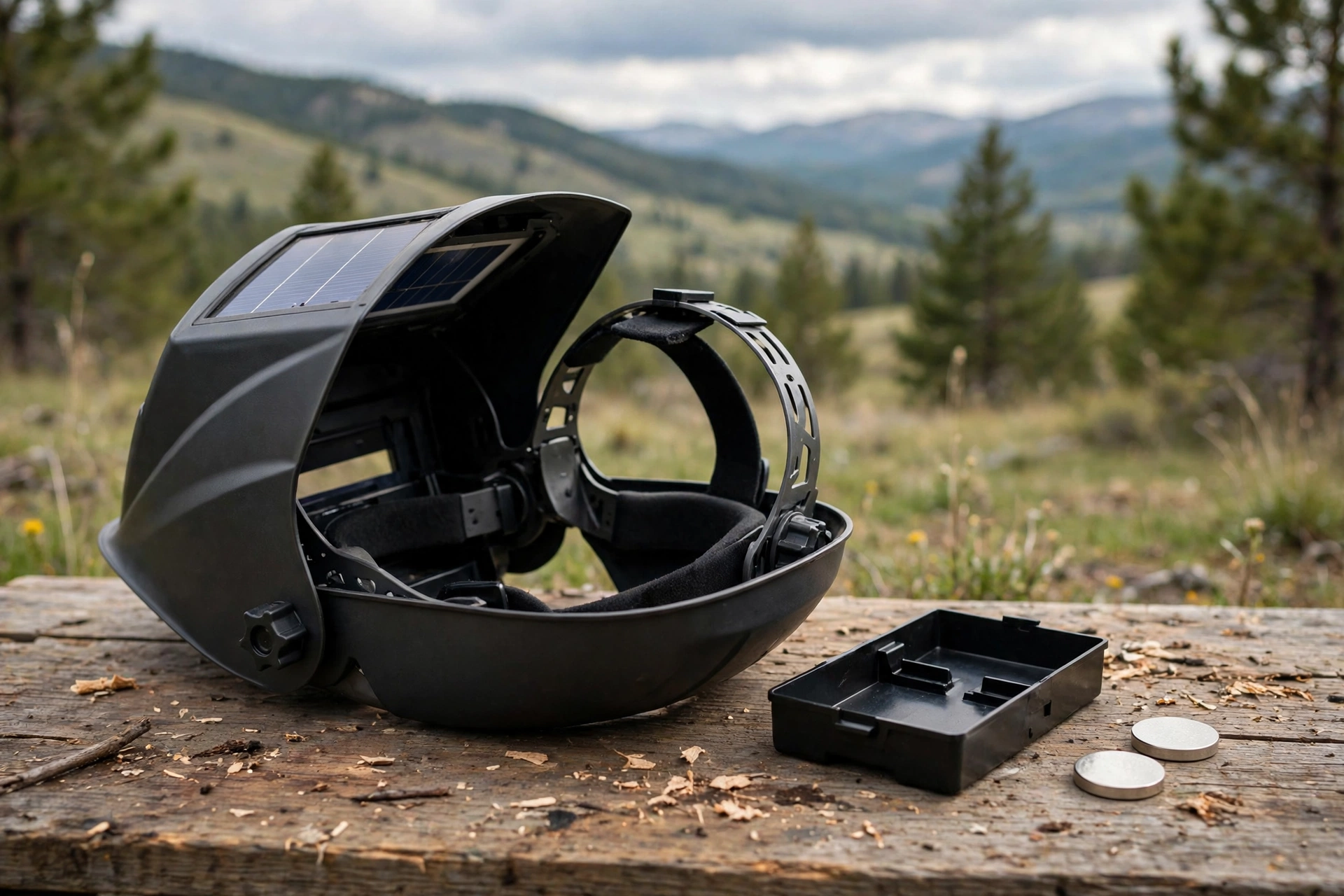
A battery powered helmet skips the harvesting and runs the filter directly from one or two replaceable cells — commonly coin cells or standard batteries in a slide-out tray. The electronics draw from the battery at all times, darkening the lens on sensor command and keeping the settings you dialed in.
The advantage is predictability and serviceability. When the low-battery indicator lights up or the lens starts switching sluggishly, you open the tray, fit fresh cells, and the helmet is fully restored. There is no sealed component whose slow decline ends the helmet’s life.
The trade-offs are small but real: you must keep spare cells on hand, a battery left in a hot truck ages faster, and a helmet stored for months with tired cells may greet you with a dead lens. Many modern helmets combine both approaches — solar cells assist a replaceable battery — which is why reading the exact specification matters more than the headline claim on the box.
Can a Solar Welding Helmet Die in Storage?
Yes, and this is the most common complaint about solar-only designs. The internal backup cell slowly self-discharges, and a helmet stored in a dark drawer, toolbox, or locker for months gets no light to replenish it. Pick it up for a quick job and the lens may darken weakly, flicker, or not switch at all on the first strikes.
The standard fix is simple: leave the helmet somewhere it catches light — on a bench near a window or under workshop lighting — for a while before use, so the cells can top up the backup. Many welders store solar helmets face-up on a shelf for exactly this reason. If a long-stored solar helmet still refuses to switch reliably after a good light soak, the internal cell may be permanently depleted rather than merely flat.
Battery powered helmets do not have this failure mode in the same way. A stored helmet with fresh cells wakes up ready, and a stored helmet with dead cells needs two minutes and a battery swap — not a hopeful afternoon in the sun.
Which Power Type Lasts Longer Over the Years?
It depends on what “lasts” means. The solar cells themselves are extremely durable and essentially never wear out. The weak point is the sealed backup battery inside a solar-only helmet: in general terms, like any rechargeable cell it loses capacity with age and charge cycles, and on many models it cannot be replaced without destroying the filter housing.
That is why replaceable-battery designs — whether battery-only or solar-assisted with a user-replaceable cell — are easier to keep alive for years. Every other wear part on the helmet, from cover lenses to headgear, can be renewed; a replaceable power source means the filter itself can be renewed too.
If you weld daily, a solar-assisted helmet gets constant topping-up and the sealed cell ages slowly in practice. If you weld a few times a year, the arithmetic flips: long dark storage is hard on sealed cells, and a helmet whose battery you can simply replace is the safer buy. Match the power design to your usage pattern, not just to the feature list.
How Do You Tell Which Power Type a Helmet Really Uses?
Read the specification, not the marketing headline. Look for phrases like “solar powered with replaceable battery backup” — that is the hybrid most worth having. If the spec lists a battery type (a coin cell designation or standard cells) and the manual shows a battery tray, the cells are user-replaceable.
Warning signs of a sealed solar-only design include “non-replaceable battery” in the fine print, or no mention of batteries at all on a solar helmet. Check the manual before you buy, not after the first failure. Also look for a low-battery indicator or a test button: both battery styles benefit, but they are especially valuable on sealed designs, where the indicator is your only warning before the lens starts misbehaving.
Whatever type you choose, test the filter before the first arc of every session: point it at a bright light or use the test button if fitted, and confirm it darkens cleanly.
One last thought: the same principle — know what your protective gear depends on, and check it before you rely on it — applies to every kind of helmet. Riders make the same checks on certified impact protection, which is why our explainer on what MIPS is and how helmet liners manage rotational forces is worth a read if you also spend time on two wheels.
Frequently Asked Questions
Q: Is a solar powered welding helmet safe if it has been in a dark toolbox for months?
A: Not until you have checked it. The backup cell may be flat, which can make the lens switch slowly or not at all. Give it a good soak in bright light, then test the darkening before striking an arc. If it still flickers or fails, do not weld with it.
Q: Can I replace the battery in a solar welding helmet?
A: On solar-assisted models with a listed battery type and a tray, yes. On sealed solar-only models, generally no — the cell is built into the filter. Check the manual: if it shows no battery replacement procedure, the battery is not user-replaceable.
Q: Which type should a hobby welder who welds a few times a year choose?
A: In general terms, a helmet with replaceable batteries — battery-only or solar-assisted hybrid — suits occasional use best. Long dark storage drains sealed cells, while a replaceable cell can be swapped in minutes whenever you pick the helmet up again.

Olivia
Writer at Helmet Today, covering helmet reviews, fit and riding safety.