Only if it is thin and approved for the purpose: in general terms, you should not wear a thick beanie, a baseball cap, or a hood under a hard hat, because extra layers change how the suspension sits, eat into the protective gap, and can let the hat slip off — but thin skull-cap-style liners and purpose-made winter liners that the hard hat maker approves are fine, and are the right way to stay warm.
Cold mornings are where this rule gets tested. This guide explains what the problem actually is, which under-layers are acceptable, and how to stay warm or cool without defeating your hat.
Can You Wear Anything at All Under a Hard Hat?
Something thin is already under almost every hard hat: the suspension’s own sweatband, and often a bandana or thin skull cap worn against sweat and sun. The question is never really “anything or nothing” — it is about thickness and design.
The hard hat is certified as a system with the headband sitting on your head in a particular position and the shell held a set distance above your crown. A thin layer that does not change that geometry in any meaningful way is a different matter from a thick, lumpy layer that re-shapes the whole fit.
Site and maker rules draw the line in slightly different places, so the maker’s guidance for your hat and your site’s policy are the final word. But the reasoning behind every version of the rule is the same, and it helps to understand it.
Why Do Thick Beanies and Caps Cause Problems?
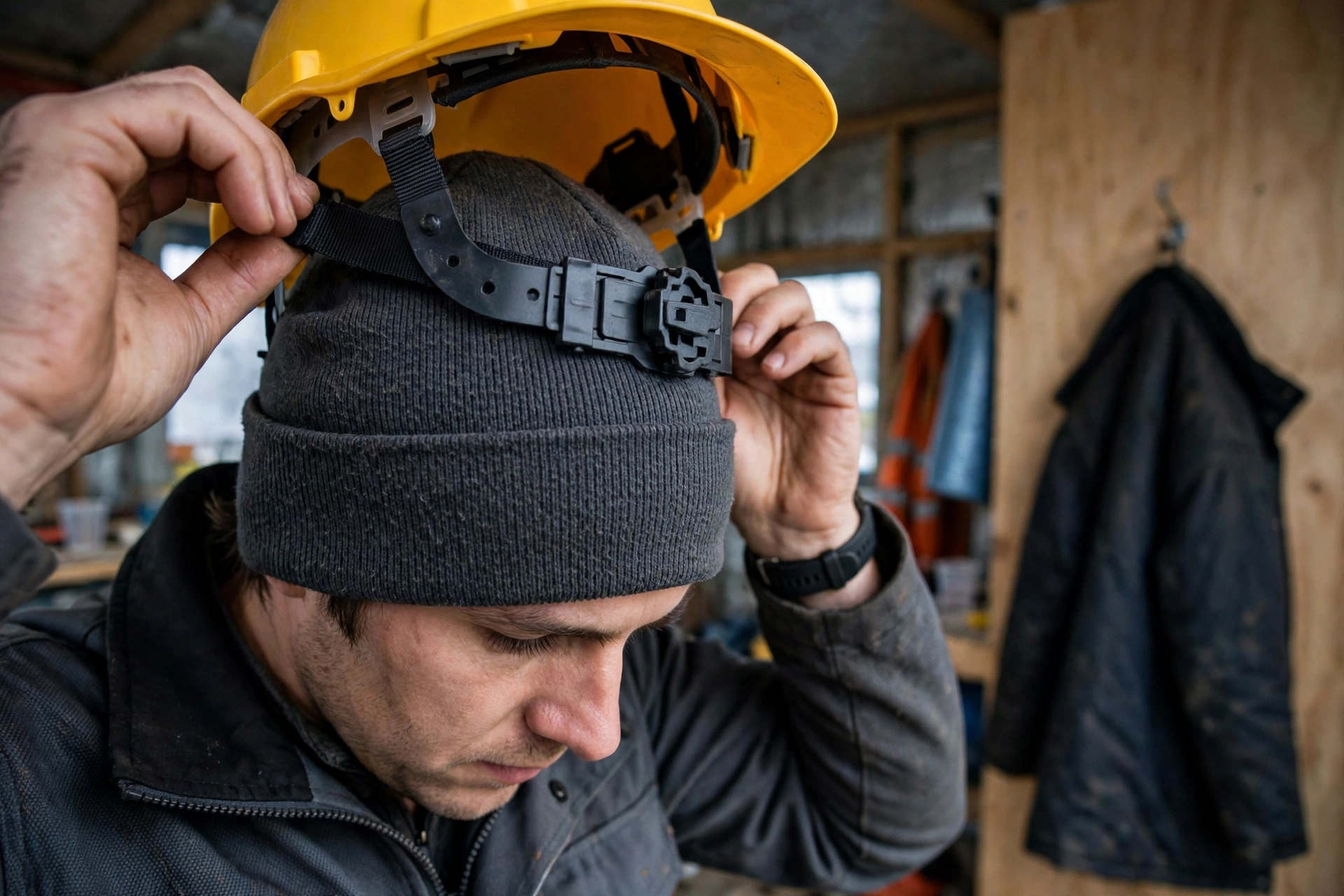
First, they lift and shift the hat. A thick beanie adds bulk the suspension was never sized for, so the headband rides higher, the hat sits less securely, and the shell’s protective gap over your crown shrinks. In a knock or a fall, a hat perched on padding can shift, tilt, or leave your head entirely.
Second, they introduce slippery, uneven layers. Knit fabrics slide against plastic headbands, hoods bunch on one side, and a baseball cap’s button and stiff brim press straight through the suspension — the brim can also stop the headband seating properly at the front. Pressure points plus movement equals a hat that migrates all shift.
Third, impacts are managed by spacing. A helmet protects by putting distance and a designed energy-absorbing system between the blow and your skull — in a hard hat, shell and suspension; in a sports helmet, shell, foam liner, and features like rotational-impact systems like MIPS. Stuffing that designed space with folded knitwear changes the system you were issued, in ways nobody tested.
What About Winter Liners and Skull Caps Made for Hard Hats?
These are the approved answer to cold weather. Purpose-made winter liners are thin where the headband sits, cover the ears and neck where the cold actually bites, and attach to the hat or suspension as the maker intends. Because they are designed and sold for use with hard hats, they keep the certified geometry intact while adding real warmth.
Thin skull caps and helmet liners for summer do the same job in reverse: they absorb sweat, keep the sweatband cleaner, and add sun protection at the neck, all in a few millimetres of fabric. Many workers find a thin liner makes the hat more comfortable, not less.
The test for any liner is simple: with it on, the headband should still sit in its normal position, the hat should still pass the shake test, and nothing should bunch, fold, or create a pressure ridge. If a liner fails that test, it is clothing, not an accessory.
Can You Wear a Baseball Cap or Hood Under a Hard Hat?
A baseball cap is the most common violation and one of the worst offenders. The stiff brim at the front and the button on top sit exactly where the suspension needs to seat and where the crown gap needs to be clear, and the smooth fabric lets the hat skate around. In general terms, most makers and sites say no outright.
Hoods — from hoodies and jackets — are nearly as troublesome: they bunch unpredictably, block hearing and peripheral vision, and change size every time you move. If your jacket has a hood, it goes over or outside the hat arrangement your site allows, never wadded underneath.
Hair deserves a mention too. Very thick hairstyles, high buns, and anything that lifts the headband share the same problem in miniature: if it changes where the hat sits, it needs managing — lower styles, or a liner arrangement that keeps the headband seated as designed.
How Do You Stay Warm or Cool Safely?
For cold: start with a maker-approved winter liner, add a neck warmer that sits below the hat line, and layer your clothing rather than your head. If your site works in serious cold, ask what liners it has approved — most cold-climate employers stock them, because the beanie problem arrives every winter.
For heat: a thin sweat-absorbing liner or bandana, a vented hat where the work allows one, and replacing sweatbands before they are saturated all help more than stuffing towelling under the shell. Shade attachments and light-colored shells are made for exactly this.
The principle in both seasons is identical: change what the makers designed to be changed — liners, sweatbands, approved accessories — and never improvise bulk inside a certified system. Comfort matters, because comfortable hats get worn; it just has to be the approved kind.
Frequently Asked Questions
Q: My employer lets us wear beanies. Does that make it fine?
A: Site policies vary, and some employers accept thin beanies after assessing the risk. The maker’s guidance still matters, though: if the beanie changes how the suspension seats, the hat is outside its tested configuration regardless of local habit. When in doubt, switch to an approved liner and you are covered both ways.
Q: What about a flat cap or bandana — are they thin enough?
A: A single flat layer like a bandana is generally treated like a skull cap: acceptable if the headband still seats normally and the hat passes a shake test. Anything with padding, folds, a brim, or a button is a different case.
Q: Can I wear my hard hat over a hood if the hood is thin?
A: It is still a poor idea. Hoods bunch, shift with your shoulders, and cover your ears, and they are not designed or tested as helmet liners. Use a purpose-made winter liner instead — it gives the same warmth without the fit problems.

Olivia
Writer at Helmet Today, covering helmet reviews, fit and riding safety.