To dry a hockey helmet after a game, take it out of your bag as soon as you get home, open the straps and loosen everything, and let it air-dry at room temperature in moving air — ideally on a rack or with a small fan — until the liner is dry right through, which in general terms takes overnight rather than an hour. Never use direct heat, and never leave it sealed in the bag: a helmet put away damp will smell, grow mildew, and age its foam and straps far faster than one dried properly.
This guide explains the full drying routine, the fastest safe methods, and the mistakes that quietly ruin helmets.
Why Does Drying a Helmet Properly Actually Matter?
A hockey helmet comes off your head soaked — sweat from the inside, rink moisture and spray from the outside. Left wet, that moisture sits in the comfort pads, works into the strap webbing, and stays against the foam liner for days inside a closed bag. The result is the infamous hockey smell, which is bacteria and mildew living in permanently damp foam.
The damage is not only to your nose. Constant damp softens and breaks down padding faster, corrodes buckles and cage mounts, rots stitching, and can loosen the adhesives that keep liners in place. A helmet that lives damp spends its life degrading, while the same helmet dried after every game can stay sound for its full certified life.
There is a comfort angle too. Putting on a still-damp helmet the next day is miserable, and pads that never fully dry lose their shape and cushioning, so the fit gets sloppier game by game. Drying is not housekeeping — it is part of keeping the helmet fitting and protecting as it should.
What Is the Best Way to Air-Dry a Hockey Helmet?
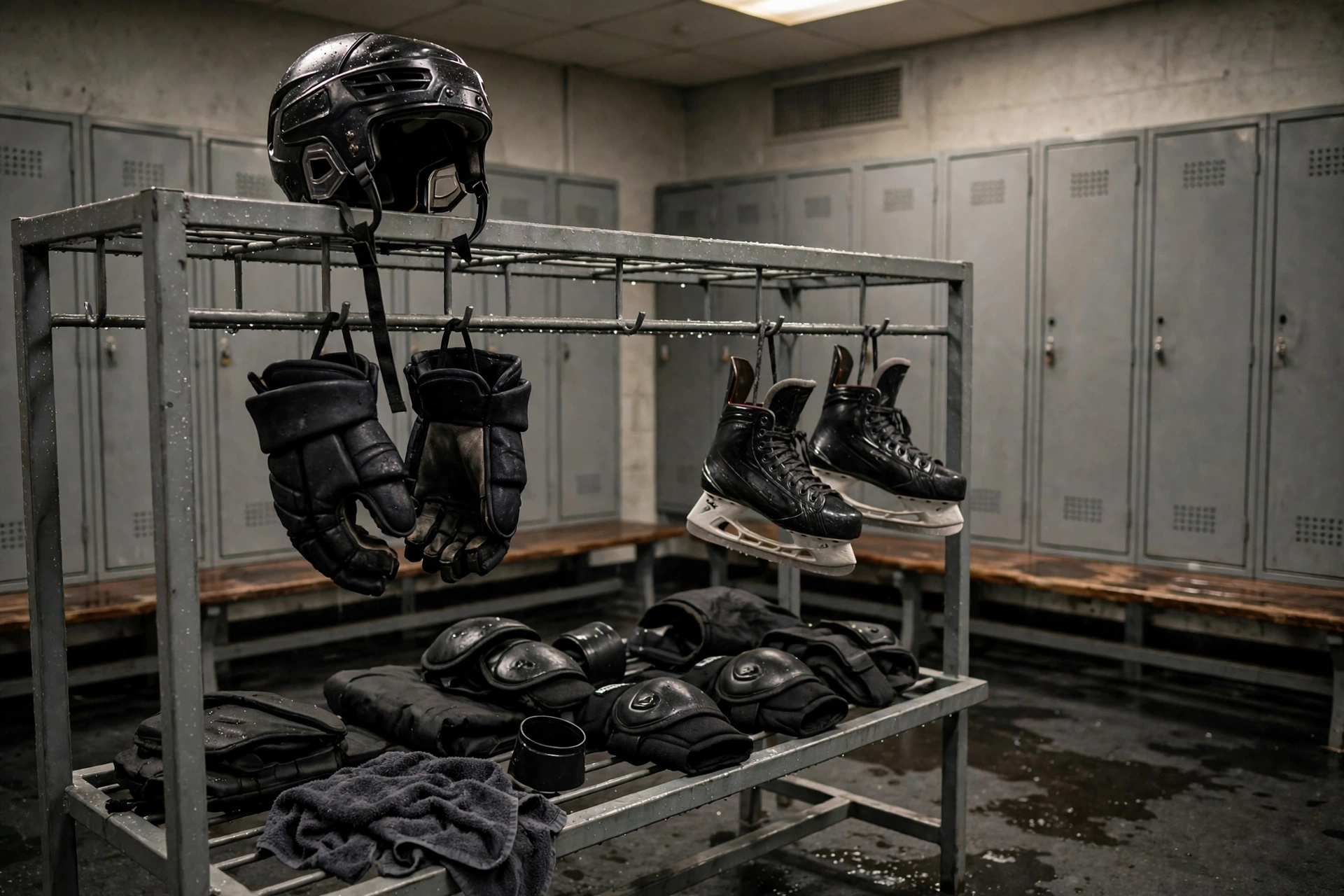
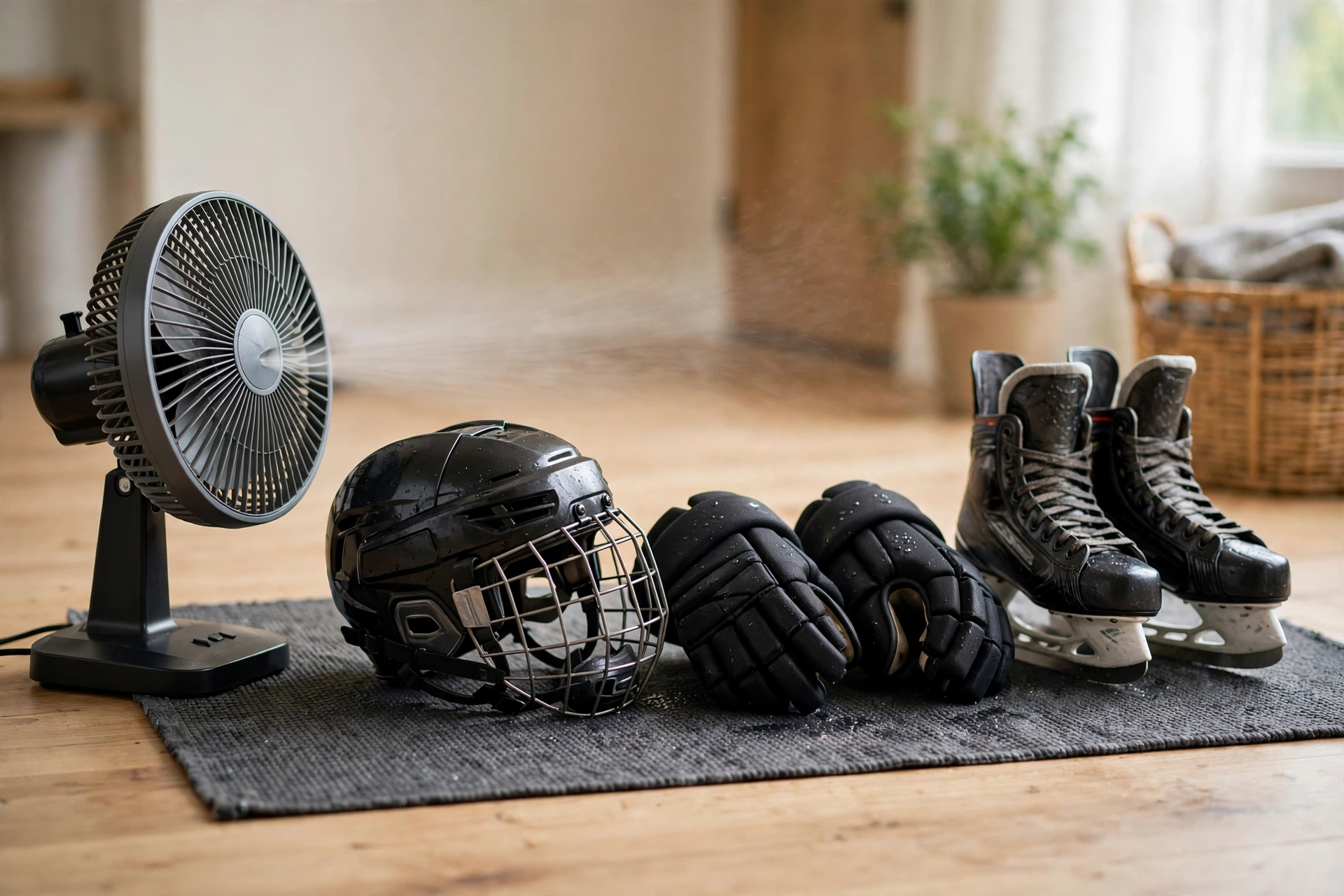
Start the moment you are home: out of the bag, every time, no exceptions for tired evenings. Undo the chin strap, loosen or remove the cage if it unclips easily, and open the helmet up so air can reach the liner. If the comfort pads are removable, take them out — separated pads dry in a fraction of the time and let the shell’s inside dry too.
Position matters. Rest the helmet open-side up or on its side on a rack, a towel bar, or a gear tree — anywhere air can circulate around and through it. A helmet left sitting crown-down on a flat floor traps its own moist air inside. A small fan pointed at your gear, or a purpose-made gear dryer that uses gentle moving air, speeds things up a lot on humid days.
- Out of the bag: immediately, every single game
- Open everything: straps undone, pads out if removable, cage off if it unclips
- Airflow: rack, fan, or ventilated room — not a closed cupboard or trunk
- Time: overnight as a minimum; thick pads in humid weather can need longer
Check before it goes back in the bag: pads should feel dry to the touch and smell neutral. If in doubt, give it more air — an extra day out harms nothing, while a day sealed in damp harms plenty.
What Should You Never Do When Drying a Helmet?
Heat is the big one. Radiators, space heaters, hair dryers on hot settings, hot cars, and tumble dryers all expose the helmet to temperatures that can warp the shell, soften liner adhesives, and age the impact foam. That foam is the heart of the protection — the layer that crushes in a hit and, in designs with low-friction layers, works with the systems explained in this guide to what MIPS is for helmets. Heat damage is invisible, so you cannot check your way out of it afterwards; just keep heat away.
Direct blazing sun for hours is a milder version of the same mistake: fine for a short airing, not a storage plan, because ultraviolet steadily ages plastics and foam. A shaded, breezy spot does the drying job without the ageing.
The other never is the closed bag. Leaving the helmet in a zipped equipment bag — worse, in the trunk of a car — is the single most common reason hockey helmets stink and rot early. If you genuinely cannot unpack at home, at least open the bag fully and stand the helmet out at the first opportunity.
How Do You Dry a Helmet Between Games on the Same Weekend?
Tournaments and double-headers compress the schedule, so help the process along with everything gentle you have. Remove the pads, open the straps, and put the helmet and pads in front of a fan as soon as you are back — moving air is the one accelerator that does no harm. In a hotel room, the bathroom fan and an open rack by the air conditioning vent are your friends.
A towel helps at the start: press the pads in a dry towel, or roll them in it, to pull out the first big share of moisture, then let air do the rest. Some players keep a second set of removable pads for exactly this situation, swapping to the dry set while the washed set dries at its own pace.
What not to reach for under time pressure is the hotel hair dryer on hot or the radiator — the same heat rules apply on the road. If the liner is still slightly damp at game time, that is uncomfortable but usable; a heat-damaged liner is a permanent problem you cannot see.
How Can You Tell a Helmet Is Fully Dry and Still Sound?
Use touch and smell, in that order. Press the thickest pad areas with the back of your hand: fully dry foam feels neutral and room-temperature, while damp foam feels cool and slightly heavy. Sniff the inside of the shell — a clean, dry helmet smells of almost nothing. A sour smell in a “dry” helmet means moisture is still deep in the pads.
Drying time is also your regular inspection time. While the helmet is apart, look for cracked foam, loose liner sections, frayed straps, rust on cage mounts, and buckles that no longer click firmly. Catching those on a Tuesday at home beats discovering them in the dressing room.
If a helmet never quite loses its smell despite proper washing and drying, the pads have usually absorbed more than cleaning can reverse. Replacement liner pads, where the maker sells them, restore both the hygiene and the snug fit — and the rest of the helmet carries on.
Frequently Asked Questions
Q: How long does a hockey helmet take to dry?
A: In general terms, overnight in moving air at room temperature is enough for most helmets, longer for thick removable pads or humid weather. A fan shortens it considerably. Judge by touch and smell, not the clock: the pads must feel dry and neutral right through before the helmet goes into a closed bag.
Q: Can I dry my helmet with a hair dryer?
A: Only on a cool or no-heat setting, held at a distance, and a plain fan does the same job more safely. Hot settings risk warping the shell and ageing the foam and adhesives, and that damage cannot be seen or undone. Gentle moving air is all a helmet needs.
Q: Is it okay to leave my helmet in my bag if I open the bag?
A: It is better than a sealed bag, but still poor: the helmet sits in its own damp air, surrounded by equally wet gear, and dries slowly if at all. Take it out and stand it in open air — it takes thirty seconds and is the difference between gear that lasts and gear that rots.

Olivia
Writer at Helmet Today, covering helmet reviews, fit and riding safety.