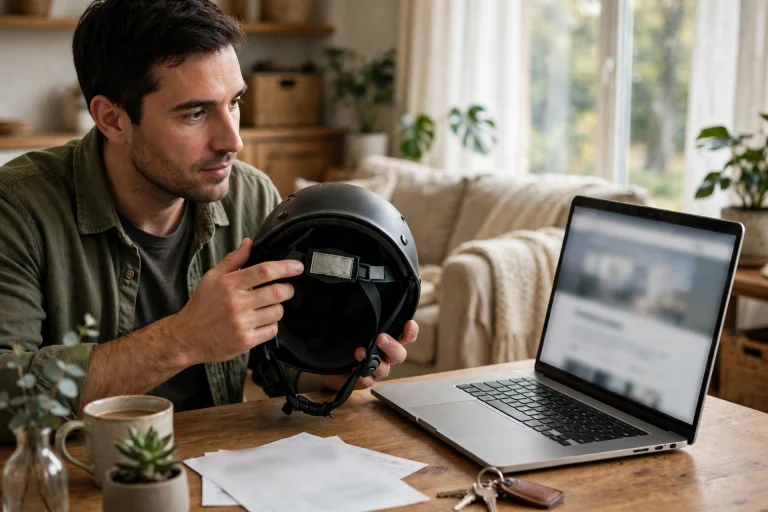
ASTM F1447 is the standard that sets out how bicycle helmets are tested and what they must do to protect a cyclist’s head in a fall. It is published by ASTM International, an organisation that writes technical standards used around the world, and it covers helmets made for recreational cycling. A helmet that meets ASTM F1447 has been tested for its ability to absorb impact energy, stay on the head, and cover the parts of the head that need protection.
If you ride a bike, the helmet you choose is the single most important piece of safety gear you own. Standards like ASTM F1447 exist so that you do not have to take a manufacturer’s word for it — an independent test has checked that the helmet performs to a set level.
What Does ASTM F1447 Cover?
ASTM F1447 covers helmets intended for recreational bicycle riding. That includes the helmets worn by commuters, weekend riders, and children on family rides. The standard sets out requirements for the helmet’s construction, the area of the head it must cover, and how it must perform when it is struck. It is a performance standard, which means it describes what the helmet must do rather than exactly how it must be made, so different makers can use different materials and designs as long as the helmet passes the tests.
The standard covers the full helmet, including the outer shell, the inner lining that absorbs impact, and the retention system that holds the helmet on your head. The lining is usually a foam that crushes on impact, spreading the force of a blow over a wider area and over a longer moment, which reduces the force that reaches the head. The shell holds the lining together and helps it slide over a surface rather than catching. The straps and buckle keep the helmet in place so that it is still there to protect you when it is needed.
How Are Bicycle Helmets Tested Under F1447?
In general terms, testing under ASTM F1447 involves dropping a helmet onto a hard surface from a set height and measuring how much force reaches the inside of the helmet. The helmet is fitted onto a head-shaped form, dropped onto a flat surface and onto a curved surface, and struck in several places, including the top, the sides, and the front and back. Sensors inside the form record the forces, and the helmet passes only if those forces stay below the limits the standard sets.
The helmet is also tested for how well it stays on the head. The straps are pulled and the helmet is checked for how far it moves, because a helmet that slips off or rolls back in a crash cannot protect you. The buckle and the strap adjusters are tested too, so that they hold firm under load but can still be opened by the wearer when needed. This part of the testing is easy to overlook, but it matters just as much as the impact test, since a loose helmet is a common problem in real crashes.

What Should You Check Before Buying?
The first thing to check is the label inside the helmet. A helmet that meets ASTM F1447 will say so on a label or sticker, usually inside the shell or on the lining. That label is your proof that the helmet has been tested to the standard. If there is no label, or the label only mentions a brand name with no standard at all, it is better to choose a different helmet. The label is a small detail, but it is the one that tells you the helmet has been independently checked.
Fit is the next thing to get right, and it matters as much as the standard. A helmet should sit level on your head, low on your forehead, with the straps forming a snug V under your ears and the chin strap tight enough that you can only fit one or two fingers between the strap and your chin. Shake your head gently: the helmet should move your skin a little rather than sliding around freely. If it wobbles, try a different size or a different model, because helmets are shaped differently and the right fit depends on your head.
Comfort matters too, because a helmet you hate wearing is a helmet you will leave at home. Look for enough ventilation to keep you cool, a weight that feels light on your head, and padding that sits comfortably without pressing in one spot. If you are learning about the extra technologies that can be built into a helmet, reading about what MIPS is for helmets can help you understand one of the features you may see on the helmets you compare.
How Does F1447 Compare with Other Bicycle Standards?
The most common bicycle helmet standards you will see are ASTM F1447, the CPSC standard in the United States, and the EN 1078 standard in Europe. All three set impact limits and test the helmet’s retention system, and in general terms a helmet that passes one of them is a properly tested helmet. The differences are in the details of how the tests are run, such as the height of the drop, the shape of the surface the helmet is dropped onto, and the limits placed on the forces measured.
For a buyer, the practical point is that you do not need to choose between these standards as if one were obviously better than the others. What matters is that the helmet meets at least one recognised standard and that it fits you well. A helmet that meets both ASTM F1447 and the CPSC standard, which is common on helmets sold in the United States, has been tested twice over and is a safe choice. In Europe, EN 1078 plays the same role, and many helmets sold there carry that marking instead.
Does an F1447 Helmet Need Replacing After a Crash?
Yes, in general terms a bicycle helmet that has been in a crash should be replaced, even if it looks fine from the outside. The foam lining inside the helmet is designed to crush on impact, and that crushing is what absorbs the energy of the blow. Once it has crushed, it cannot crush again in the same way, so the helmet may not protect you as well in a second crash. Damage to the foam is often invisible because it sits under the shell, so a helmet that looks undamaged can still be weakened inside.
You should also replace a helmet if you can see cracks in the shell, if the foam is dented or crumbling, or if the straps or buckle are frayed or broken. If you are unsure, it is better to replace the helmet than to keep riding in one you cannot trust.
Frequently Asked Questions
Q: What is the ASTM F1447 standard?
A: ASTM F1447 is a standard for recreational bicycle helmets that sets out how they must be tested for impact absorption, head coverage, and staying on the head. A helmet that meets it has passed independent testing to those requirements.
Q: Is ASTM F1447 the same as the CPSC standard?
A: No, they are separate standards, but they are similar in what they ask of a helmet. Many helmets sold in the United States meet both, and meeting either one is a good sign that the helmet has been properly tested.
Q: Should I replace my bicycle helmet after a crash?
A: Yes. The foam lining crushes on impact to absorb energy, and once it has crushed it may not protect as well again. Replace the helmet after any crash, even if it looks undamaged from the outside.

Olivia
Writer at Helmet Today, covering helmet reviews, fit and riding safety.