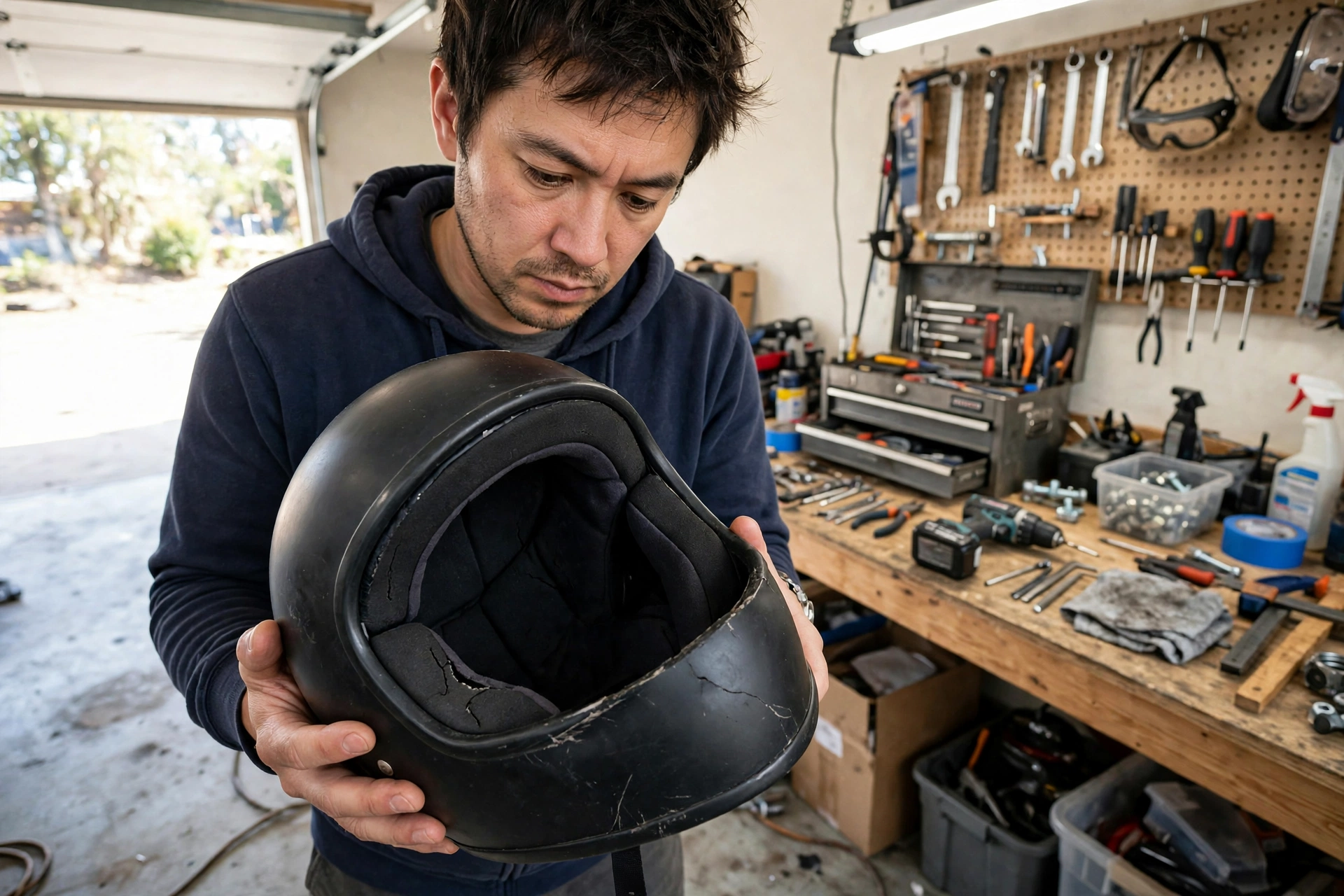
No, in general terms you do not need to replace a helmet after every drop, because a light drop onto a soft surface is unlikely to damage it, but you should replace it after a hard drop or any drop that leaves visible damage. Helmets are tougher than many people think, and a helmet that slips off a table onto a carpeted floor has probably suffered no harm at all. The confusion comes from the advice to replace a helmet after a crash, which is sound, being stretched into a rule about every small knock, which is not what manufacturers intend.
What Counts as a Drop That Matters?
Not all drops are equal, and the ones that matter are the hard ones. A helmet that falls from waist height onto concrete, or from a high shelf onto a hard floor, has taken a real impact, and the foam liner inside may have compressed even if the shell looks fine. A helmet that falls from a bike seat onto soft grass, or tips over on a table and lands on carpet, has taken a much gentler knock, and the liner is unlikely to have been affected.
The key factors are the height of the drop, the hardness of the surface, and whether the helmet was empty or had something heavy inside it. A helmet that falls with a heavy object inside, or that lands on a sharp edge, takes a harder blow than one that lands flat on a soft surface. A drop that makes you wince, or that leaves a mark on the shell, is worth taking seriously, while a gentle tip-over is usually nothing to worry about.
How Can You Tell If a Drop Has Damaged Your Helmet?
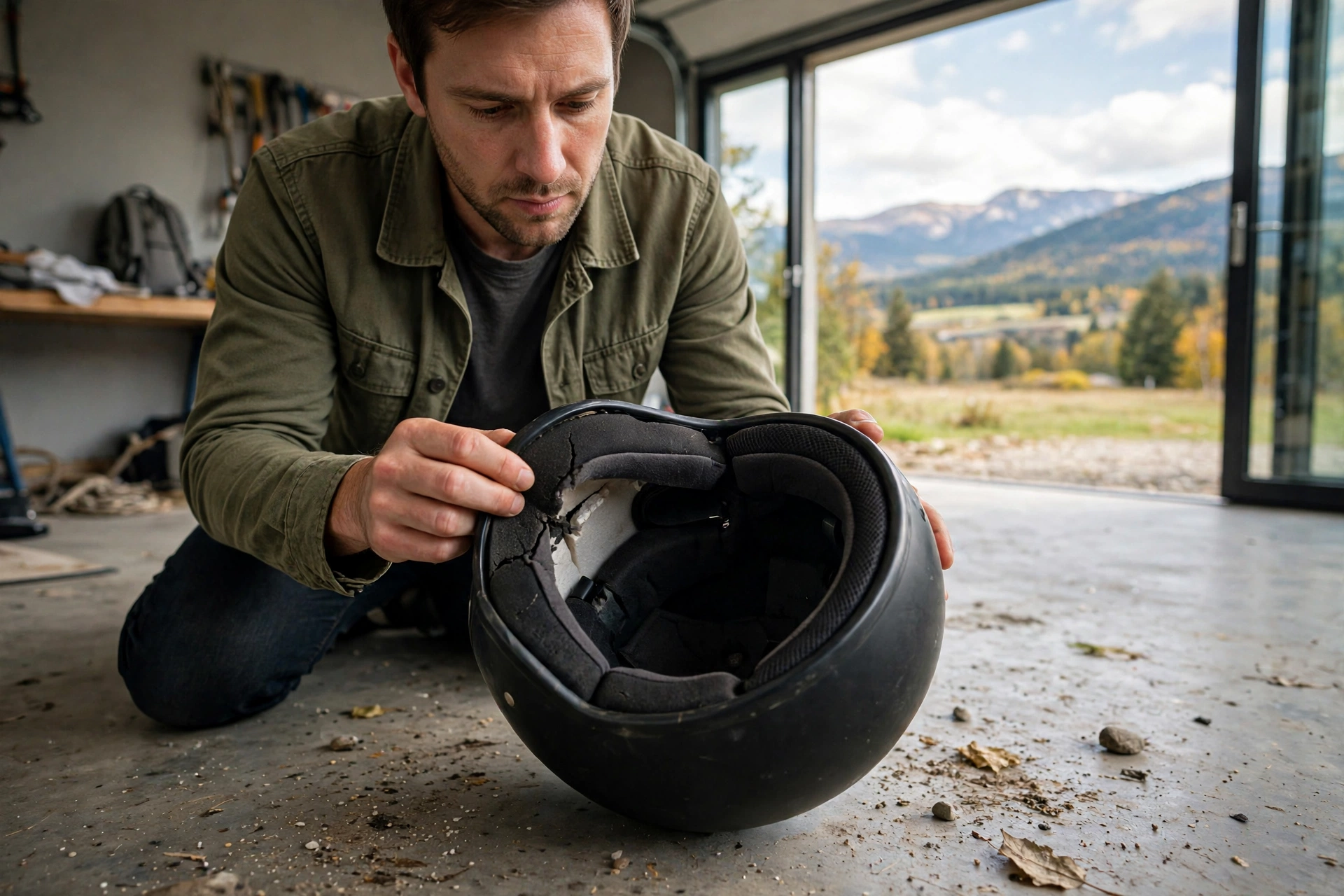
The best way to tell if a drop has damaged your helmet is to inspect it carefully, inside and out. Start with the shell: look for cracks, dents, or chips, especially around the point of impact, and run your fingers over the surface to feel for damage you cannot see. Then check the liner: press the foam gently and look for areas that feel compressed, cracked, or different from the foam around them.
Check the straps, buckles, and retention system too, because a hard drop can crack a buckle or stretch a strap, and a helmet that cannot be fastened securely is not safe to wear. If you find any cracks in the shell or liner, or if the helmet no longer fits the way it used to, it is time to replace it. If you want to understand a safety system that helps helmets manage impact forces, reading about what MIPS is for helmets is a useful starting point, and that system also needs checking after a hard drop.
Why Do Some People Say to Replace a Helmet After Any Drop?
The idea that a helmet must be replaced after any drop comes from a misunderstanding of good advice. Helmet makers do advise replacing a helmet after a crash or a hard impact, because the liner inside is designed to crush once and absorb energy, and after that it cannot do the same job again. Some people have taken that advice and applied it to every knock, including a helmet tipping off a chair, which is far beyond what was meant.
There is also a commercial angle: helmet makers have no reason to discourage replacement, and cautious advice protects them if something goes wrong. In general terms, the sensible approach is to follow the maker’s guidance for your specific helmet, which usually talks about crashes and significant impacts rather than every small drop, and to use your judgement and a careful inspection to decide. If you are ever in doubt after a hard drop, replacing the helmet is the safer choice.
Does the Type of Helmet Change the Answer?
Yes, the type of helmet matters, because different helmets are built differently. A hard hat on a construction site is designed to take repeated small knocks and has a suspension system that can absorb them, so a light drop is unlikely to harm it. A climbing helmet with a hard shell is also built to cope with repeated knocks against rock, and a small drop is part of its normal life.
A cycling or motorcycle helmet with a foam liner is more sensitive, because its liner is designed to crush in a single heavy impact rather than to take repeated knocks. Even so, a light drop onto a soft surface is unlikely to crush the liner, because the force involved is far below what the liner is designed to absorb. The lighter and softer the drop, the less it matters, whatever the helmet type, and the harder and higher the drop, the more seriously you should take it.
How Can You Avoid Dropping Your Helmet?
The simplest way to avoid dropping your helmet is to store it properly. Keep it on a shelf, in a helmet bag, or on a hook, rather than balanced on the edge of a table, on a bike seat, or on top of a car where it can slide off. When you take your helmet off, put it down somewhere stable, with the opening facing down so that it cannot roll away, and away from the edge of any surface.
When you carry your helmet, hold it by the strap or in a bag rather than by the shell with one hand, which makes it easy to drop. If you are travelling, pack it in the middle of your luggage, surrounded by soft clothes, so it is protected from knocks. In general terms, a helmet that is stored and carried with a little care will rarely be dropped at all, and the question of whether to replace it after a drop will hardly ever come up.
When Should You Definitely Replace a Helmet?
There are clear cases where a helmet should definitely be replaced. The first is after a crash or any impact while you were wearing it, because the liner may have absorbed energy even if the shell looks fine. The second is after a hard drop onto a hard surface from a real height, especially if the drop leaves a crack, a dent, or a mark on the shell or liner.
The third is when the helmet no longer fits properly, the straps are damaged, or the buckle no longer works, because a helmet that cannot be fastened securely cannot protect you. Age and wear matter too: a helmet that has been used hard for several years, exposed to sun and sweat, may have a liner and straps that have degraded, even without a single drop. When in doubt, replace it, because a helmet is cheap compared to a head injury, and a new helmet is the only way to be sure the protection is intact.
Do helmets need to be replaced after every drop?
No, in general terms a light drop onto a soft surface is unlikely to damage a helmet, so replacement after every small knock is not needed, but a hard drop onto a hard surface should be inspected carefully and the helmet replaced if there is any damage.
How can I tell if my helmet is damaged after a drop?
Inspect the shell for cracks or dents, press the foam liner to check for compression or cracking, and check the straps and buckle, and if anything looks wrong or the fit has changed, replace the helmet.
Should I replace my helmet after a crash?
Yes, in general terms a helmet that has absorbed a crash impact should be replaced, because the liner inside may be crushed even if the shell looks undamaged, and it may not protect as well a second time.

Olivia
Writer at Helmet Today, covering helmet reviews, fit and riding safety.