Yes, in general terms helmets need to be worn on short trips, because most accidents happen close to home, at low speed, and on familiar roads, which is exactly what a short trip looks like. It is tempting to skip the helmet for a quick ride to the shops or a short spin around the block, because the journey feels too brief for anything to go wrong. The evidence of everyday accidents says otherwise: a fall at low speed onto a hard road can still cause a serious head injury, and a short trip is not a safe trip just because it is short.
Why Do Short Trips Feel Safe Without a Helmet?
Short trips feel safe for a simple reason: familiarity. The road to the shops is a road you know well, the traffic is light, the speed is low, and nothing has ever gone wrong there before, so the brain files it under safe and stops worrying. That feeling is misleading, because familiarity does not change the physics of a fall: a head hitting the pavement from cycling height hits just as hard on a familiar road as on a strange one.
There is also a convenience factor. For a five-minute ride, putting on a helmet, fastening the strap, and then taking it off and carrying it around the shop can feel like more trouble than it is worth, especially on a hot day. In general terms, the decision to skip the helmet on a short trip is usually about comfort and habit rather than a real judgement of risk, and it is a habit worth changing, because the cost of wearing a helmet is small and the cost of a head injury is not.
What Can Go Wrong on a Short Trip?
A surprising amount can go wrong on a short trip. A car can pull out of a driveway without looking, a pedestrian can step into the road, a dog can run across your path, or a pothole can catch your front wheel and throw you over the handlebars. None of these need speed or distance: they happen at low speed, close to home, and often with no warning at all.
The road surface itself is a risk on short trips, because local streets are often in worse condition than main roads, with potholes, loose gravel, and uneven surfaces that are easy to miss. Wet leaves, oil on the road, and a drain cover in the wrong place can all cause a fall at low speed. In general terms, a short trip concentrates all the usual hazards of cycling into a small area, and the fact that the trip is short does not make any of them less likely.
Do Most Cycling Accidents Happen Close to Home?
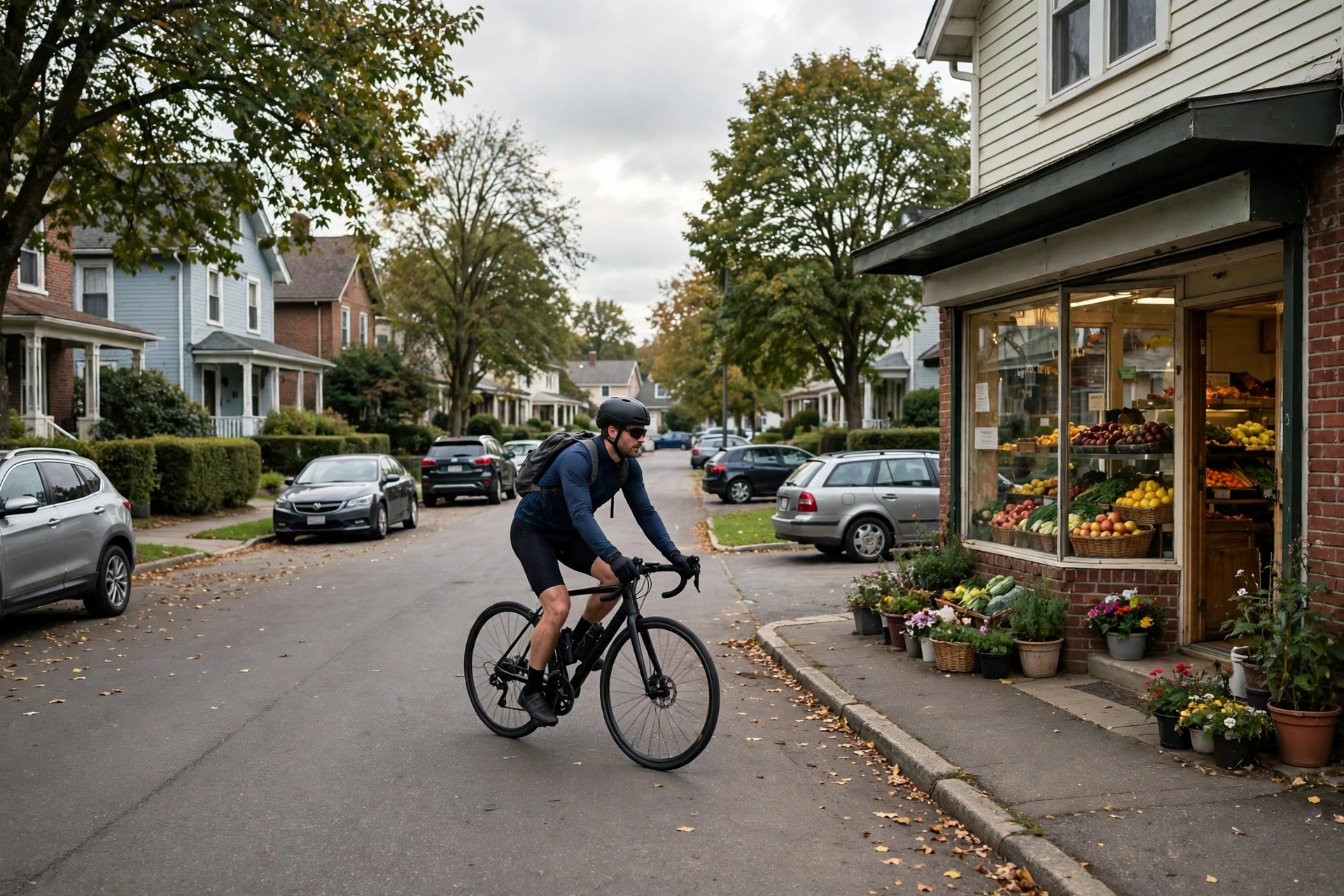
In general terms, yes, many cycling accidents happen close to home, and there are good reasons for that. Most cycling is local: the school run, the trip to the shops, the ride to work, and the evening spin all start and end near home, so most of the time a cyclist spends on the road is spent on nearby streets. It follows that most accidents will happen there too, simply because that is where most cycling happens.
There is also a behavioural reason. Close to home, riders relax: they ride more casually, they may not wear a helmet, they may not check the road as carefully, and they may assume that other road users know them and will look out for them. That relaxation makes a rider more vulnerable, not less. If you want to understand a safety system that helps helmets manage impact forces, reading about what MIPS is for helmets is a useful starting point, and it works just as well on a short trip as on a long one.
Is a Low-Speed Fall Still Dangerous?
Yes, a low-speed fall can still be dangerous, because the head does not need to be moving fast to be hurt. A cyclist sitting on a bike has their head about a metre and a half above the ground, and if they fall sideways, the head can strike the pavement with enough force to cause concussion or a more serious injury, even from a standstill. A fall at walking pace can still break a bone or cause a head injury if the head hits a kerb or a hard surface.
Children are a good example of this: a child falling off a bike at low speed in a driveway can still suffer a serious head injury, which is why children’s helmets are so important even for play. In general terms, speed adds to the danger, but it is not the only danger, and a helmet protects the head at any speed, including the low speeds of a short trip around the neighbourhood.
How Can You Make Wearing a Helmet on Short Trips Easier?
The easiest way to make wearing a helmet on short trips a habit is to remove the friction. Keep the helmet by the door, next to the bike, so that putting it on is part of picking up the bike rather than a separate decision. Choose a helmet that is comfortable and well ventilated, because a helmet that is hot or pinches will be left behind, while a comfortable one will be worn without thinking.
Some riders keep a second, cheaper helmet for short trips, so that they always have one to hand and do not have to fetch their best helmet from a cupboard. A helmet lock or a hook by the door can help too. In general terms, the goal is to make wearing a helmet the default, something you do without thinking, in the same way you put on a seatbelt in a car, even for a drive around the corner.
What About Short Trips on a Motorcycle or Scooter?
For motorcycles and scooters, the case for a helmet on short trips is even stronger, because the speeds are higher and the risks are greater, even on a short ride. A scooter trip to the shops still involves sharing the road with cars, and a fall or a collision at town speeds can cause a serious head injury. In many places, wearing a helmet on a motorcycle or scooter is also a legal requirement, whatever the length of the trip, and riding without one can lead to a fine as well as a risk of injury.
The convenience argument is weaker for motorcyclists too, because a motorcycle helmet is part of the riding kit, and most riders would not think of starting the engine without it. In general terms, the habit should be the same on two wheels whatever the vehicle: helmet on, strap fastened, every ride, however short. A short trip is still a trip, and the road does not know how far you are going.
Do helmets need to be worn on short trips?
Yes, in general terms helmets need to be worn on short trips, because most accidents happen close to home at low speed, and a fall onto a hard road can cause a serious head injury even on a five-minute ride.
Is a low-speed fall dangerous without a helmet?
Yes. A head striking the pavement from cycling height can cause concussion or a more serious injury even at low speed, because the head is high above the ground and the road surface is hard.
How can I make wearing a helmet on short trips a habit?
Keep the helmet by the door next to the bike, choose one that is comfortable and well ventilated, and treat putting it on as part of picking up the bike, so it becomes automatic rather than a decision each time.

Olivia
Writer at Helmet Today, covering helmet reviews, fit and riding safety.