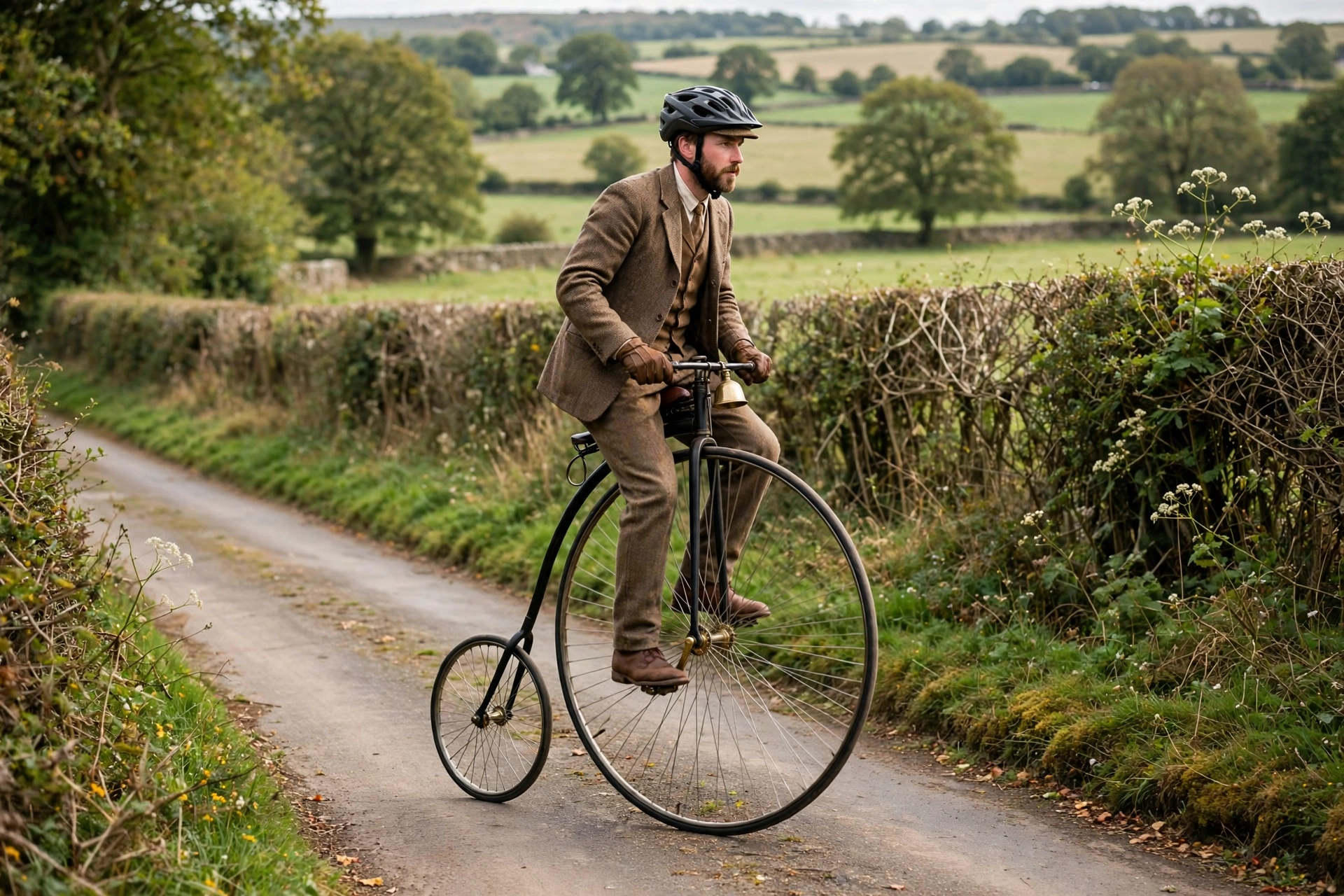
A helmet for riding a penny farthing is a well-fitting cycle helmet, and it is worth wearing because a fall from a penny farthing is a fall from a much greater height than a fall from an ordinary bicycle. A penny farthing, also called an ordinary bicycle or a high bicycle, has a huge front wheel and a tiny back wheel, so the rider sits high above the ground. There is no special penny farthing helmet on the market, but a standard cycle helmet gives useful head protection if you come off.
Penny farthings were the everyday bicycle of the late 1800s, and today they are ridden by enthusiasts, in vintage cycling events, and in parades and shows. Riding one takes balance and practice, because the rider pedals the big front wheel directly and sits above it. The most common fall is a “header”, where the rider tips forward over the handlebars, so the head is often the first thing to meet the ground.
Why is a penny farthing fall different from a normal bike fall?
The saddle of a penny farthing sits roughly at the height of the top of the front wheel, which can be more than a metre off the ground on a large machine. That means a rider who falls has further to drop, and more speed, than a rider falling from a modern bicycle. The head can strike the ground with considerable force, even at a slow speed.
A header happens quickly. If the front wheel hits a stone, a rut, or a patch of loose ground, the wheel can stop while the rider keeps moving forward. The rider then pitches over the bars, often with little chance to break the fall with their hands. A helmet cannot prevent the fall, but it can reduce the force of the impact on the head, which is why most penny farthing clubs expect riders to wear one.
What type of helmet works best on a penny farthing?
A standard cycle helmet that meets a recognised safety standard is the best choice. Look for a helmet certified to a standard such as EN 1078 in Europe or CPSC in the United States, and check the label inside the shell. A road cycling helmet is light and well ventilated, which suits the slow speeds and upright position of penny farthing riding.
Some riders prefer a helmet with more coverage at the back and sides, such as a skate-style or urban cycle helmet, because it protects a larger area of the head. That is a reasonable choice, especially if you ride in parades or on uneven ground. What matters most is that the helmet fits well and stays in place, because a helmet that slides around in a fall does not protect you properly.
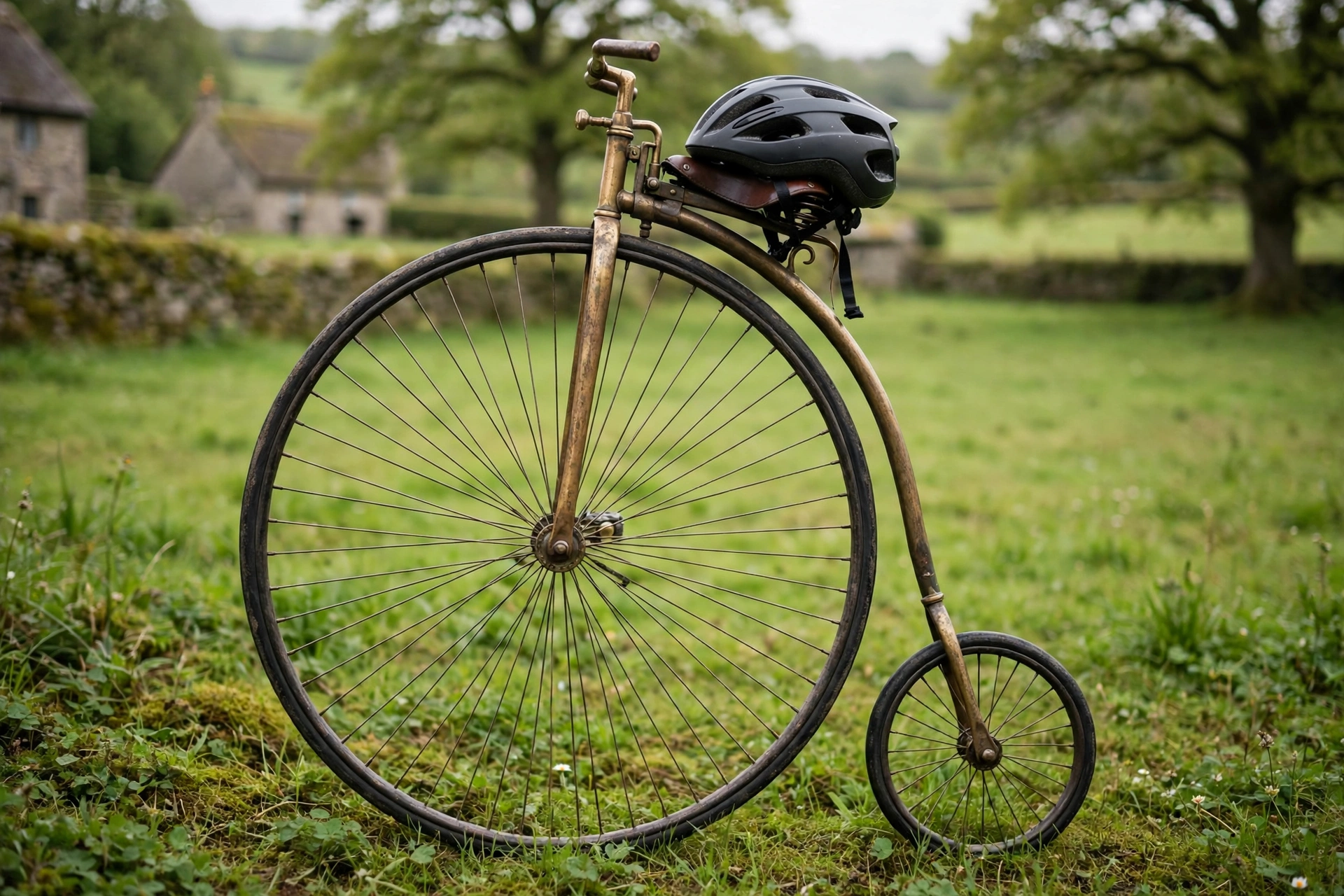
How should the helmet fit for penny farthing riding?
The helmet should sit level on your head, low on your forehead, with the front edge about two finger widths above your eyebrows. It should feel snug all the way around, without pressing hard in one spot. Use the adjustment dial at the back to fine-tune the fit, and fasten the chin strap so it is snug under your chin.
Because a penny farthing rider sits very upright, the helmet should not tip back when you look ahead. If it does, tighten the dial or try a different size or shape. Some riders wear a cap under the helmet for sun protection or for a vintage look, but a thick cap can change the fit, so use a thin cap or a cycling cap made to be worn under a helmet.
Do penny farthing clubs require a helmet?
Many penny farthing and vintage cycling clubs ask riders to wear a helmet at their events, and some make it a condition of taking part. The rules vary from club to club and from event to event, so check before you ride. Even where a helmet is not required, most experienced riders wear one, because they know how suddenly a header can happen.
If you are riding in a public event or a parade, the organiser may have insurance rules that require helmets for all riders. That is worth checking in advance, because you do not want to be turned away on the day. In general terms, wearing a helmet is simply good sense on a machine with no brakes in the modern sense and a saddle so high above the ground.
What else should a penny farthing rider wear?
Good footwear matters as much as a helmet. You need shoes with a firm grip on the pedals, because your feet drive the front wheel directly and there is no freewheel. Flat-soled shoes with a good tread work well, and laces should be tucked away so they cannot catch in the spokes or the pedal.
Gloves protect your hands if you fall, and they also help your grip on the handlebars, which are small and close to your body. Bright clothing helps other road users see you, which matters because a penny farthing is an unusual sight and drivers may not know how to judge your speed. A helmet with a bright colour or reflective details adds to that visibility, and some helmets use a slip layer such as MIPS to reduce rotational forces in an angled impact.
How do I learn to ride a penny farthing safely?
Start on flat, smooth ground with plenty of space and no traffic, and ask an experienced rider to help you. Mounting is the hardest part, because you step onto a small peg above the back wheel and then climb into the saddle while the machine is moving. Most beginners practise with a helper holding the machine steady until they can mount and dismount on their own.
Learn to dismount before you learn to ride far. The usual method is to sit back, put your feet on the mounting peg, and step down behind the machine. Practise stopping and dismounting at low speed until it feels natural. Always wear your helmet for practice as well as for events, because most falls happen while you are still learning.
Is a normal cycle helmet enough for a penny farthing?
Yes, in general terms, a standard cycle helmet that fits well and meets a recognised safety standard is the right choice. There is no special penny farthing helmet, and a good cycle helmet gives useful head protection in the most common type of fall.
Can I wear a vintage-style helmet instead?
A vintage-style leather hairnet or a cloth cap looks the part, but it offers almost no impact protection. If you want a period look, wear a modern helmet and add vintage clothing elsewhere, or choose a modern helmet in a plain colour that suits the style of the machine.
Do I need a helmet for a short parade ride?
Yes, it is wise to wear one even for a short ride. Most falls happen at low speed, on smooth ground, and often in front of a crowd. A helmet takes a moment to put on and can make a real difference if you come off.

Olivia
Writer at Helmet Today, covering helmet reviews, fit and riding safety.