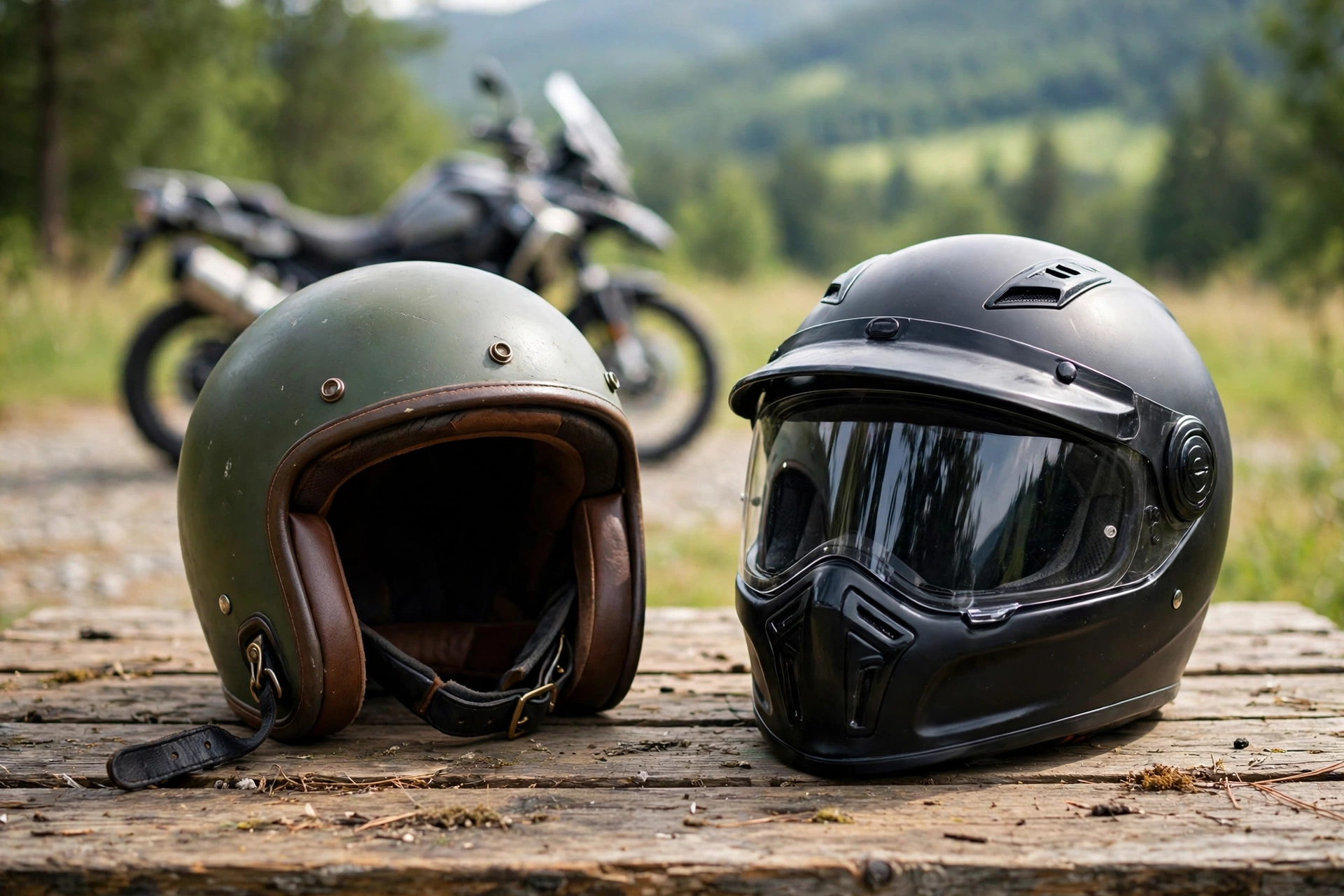
The difference between an open face and a full face motorcycle helmet is coverage: a full face helmet covers your whole head, including your chin and jaw, while an open face helmet leaves your face exposed. A full face helmet has a chin bar and a visor, so your face is protected from wind, rain, stones, insects, and the road itself in a crash. An open face helmet covers the top, back, and sides of your head, but your face is open to the air, and to anything the road throws at it.
Both types are proper motorcycle helmets, and both can meet the same safety standards. The choice is not about which one is “real” protection and which one is not. It is about how much of your face you want covered, how you ride, and what you are willing to trade for comfort and airflow. Most safety experts and riding instructors recommend a full face helmet, because the chin and jaw are involved in a large share of motorcycle crashes.
What does a full face helmet protect that an open face helmet does not?
A full face helmet protects your chin, jaw, teeth, and lower face. In a crash, the chin bar takes the impact instead of your face. Studies of motorcycle crashes have found that the chin area is struck in a large share of impacts, which is why the chin bar matters so much. Without it, a relatively minor slide can cause serious facial injuries.
A full face helmet also protects you from everyday riding hazards. At motorway speeds, a stone, a large insect, or a piece of debris can hit your face hard enough to cause real harm. Rain stings at speed, and cold wind dries out your eyes. The visor and chin bar of a full face helmet keep all of that away, so you can concentrate on the road instead of flinching.
When is an open face helmet a good choice?
An open face helmet suits slow, short rides in warm weather, especially around town or on a scooter. It gives you a wide field of view, lets you feel the air on your face, and makes it easy to talk at traffic lights or to hear what is going on around you. Many scooter riders and classic bike riders prefer the open, relaxed feeling it gives.
Open face helmets are also popular with riders who wear glasses, because there is no visor to fog up or to press against the frames. Some open face helmets have a small sun visor or a flip-down shield that gives a little extra protection without covering the whole face. In general terms, an open face helmet is better than no helmet at all, but it is a compromise on face protection.
Which helmet is safer in a crash?
In general terms, a full face helmet is safer, because it protects a larger area of your head. The chin bar adds structure to the helmet and spreads the force of an impact across the whole shell. In a crash where the rider slides face-first along the road, a full face helmet keeps the face away from the surface, while an open face helmet leaves it exposed.
That does not mean an open face helmet is unsafe. A good open face helmet that meets a recognised standard still protects the top, back, and sides of your head, which is where the brain sits. The difference is the face. If you ride mostly at low speeds in town, the extra risk may be small. If you ride at higher speeds or on long journeys, the full face helmet is the safer choice.
How do comfort and ventilation compare?
Open face helmets feel cooler and less enclosed, because air flows freely across your face. On a hot day in slow traffic, that can make a real difference to comfort. Full face helmets can feel warm, especially when you are stopped, although most modern full face helmets have vents at the chin and crown that move air through the helmet when you are moving.
Noise is another difference. A full face helmet is usually quieter, because the shell and visor block wind noise. An open face helmet lets in more wind noise, so many riders wear ear plugs on longer rides. Weight is similar between the two types, although a full face helmet is usually a little heavier because of the chin bar. Try both types on before you buy, and wear each one for several minutes in the shop.
What about visors, glasses, and face shields?
A full face helmet comes with a clear visor that you can flip up and down. The visor keeps wind, rain, and debris out of your eyes, and you can fit a tinted visor or an internal sun visor for bright days. Make sure the visor is scratch-free and closes properly, because a visor that lifts at speed is distracting and lets in wind.
An open face helmet has no built-in visor, so you need separate eye protection, such as goggles or safety glasses. Ordinary sunglasses are not enough, because they can shatter and they do not seal against the wind. Some open face helmets have a small flip-down visor that covers the eyes only. Whichever type you choose, systems such as MIPS are now available in some motorcycle helmets to reduce rotational forces in an angled impact.
Which helmet should a new rider choose?
Most riding instructors advise new riders to start with a full face helmet. When you are learning, you are more likely to fall or to make a mistake, and the extra protection is worth having. A full face helmet also teaches good habits, such as using the visor and checking it before every ride, and it keeps you comfortable in all weathers.
If you already ride a scooter or a small bike around town and you are sure an open face helmet suits your riding, that is a fair choice, as long as the helmet fits well and meets a recognised standard. Some riders own both types and switch between them. A modular helmet, which has a chin bar that flips up, is a popular middle ground, because it works as a full face helmet on the road and opens up when you stop.
Is an open face helmet legal for motorway riding?
In general terms, an open face helmet is legal where motorcycle helmets are required, as long as it meets the safety standard for your country. It is not against the law to wear one on a motorway, but a full face helmet is a safer choice at higher speeds.
Can I wear glasses with a full face helmet?
Yes, most full face helmets are designed with channels for glasses arms. Try the helmet on with your glasses before you buy, and check that the arms sit flat without pressing into your temples. A flip-up visor also helps, because you can lift it to put the helmet on.
Are modular helmets as safe as full face helmets?
A modular helmet is close to a full face helmet when the chin bar is locked down, but the hinge is a weak point, and some modular helmets are only certified as open face helmets when the chin bar is up. Always ride with the chin bar down and locked, and check the certification before you buy.

Olivia
Writer at Helmet Today, covering helmet reviews, fit and riding safety.