
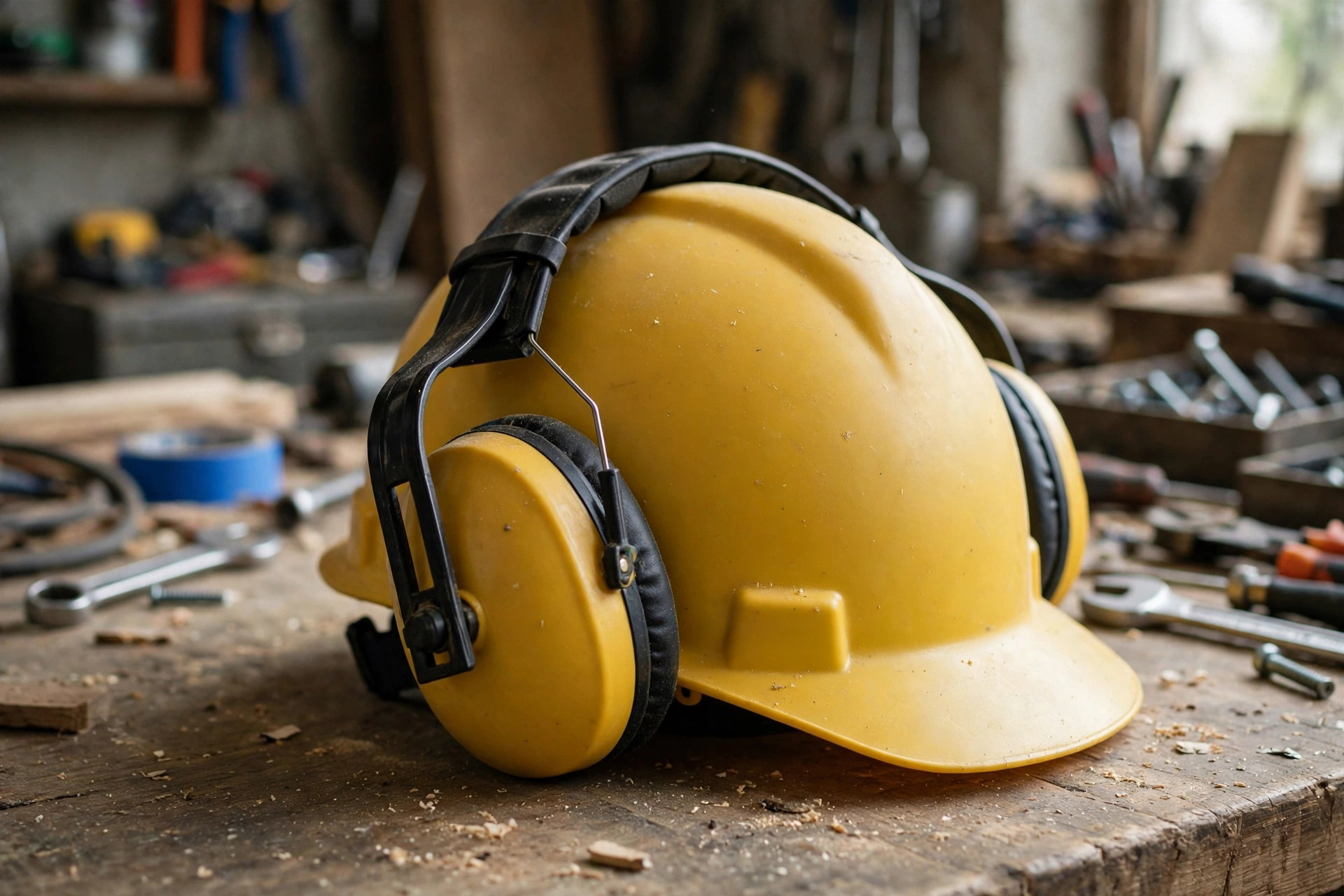
A helmet with built-in ear defenders is a work helmet with earmuffs attached to the shell, protecting the wearer’s hearing from loud noise on site. In general terms, the earmuffs fit over the ears and reduce the level of noise that reaches them, while the helmet protects the head from falling objects and knocks. It is a combined piece of safety kit used on construction sites, in factories, and anywhere loud machinery is running.
Why Would a Helmet Need Built-In Ear Defenders?
Many workplaces are loud enough to damage hearing over time. Saws, grinders, drills, compressors, and heavy machinery can all produce noise that is harmful when a worker is exposed to it for hours every day. Hearing damage builds up slowly, and by the time a worker notices it, the damage is often permanent. Ear protection is therefore a standard part of safety kit on noisy sites.
Combining the ear defenders with the helmet solves a practical problem. A worker who needs both a helmet and ear protection would otherwise have to wear two separate items, which can be uncomfortable and can get in each other’s way. Built-in ear defenders are attached to the helmet, so they are always there when the helmet is on, and they move with it. If you want to understand one of the safety technologies used in modern helmets, reading about MIPS is a good place to start, though industrial helmets use different systems from sports helmets in general terms.
How Do Built-In Ear Defenders Work?
Built-in ear defenders are earmuffs mounted on arms that clip into slots on the sides of the helmet. The muffs fit over the ears and seal against the head, and inside each muff is a layer of sound-absorbing material that reduces the noise reaching the ear. When they are not needed, many designs can be swung up and parked against the shell of the helmet, out of the way.
The level of protection depends on the muffs themselves, and the maker should state how much they reduce noise, in general terms. Some ear defenders are simple passive muffs that block sound, while others are electronic and let quiet sounds through while cutting out sudden loud noises. The right choice depends on the noise on the site and on whether the worker needs to hear speech or warning signals.
When Should a Worker Wear a Helmet With Ear Defenders?
A worker should wear a helmet with ear defenders whenever the site requires both head protection and hearing protection at the same time. This is common on construction sites where heavy machinery is running overhead or nearby, and in factories where loud machines run all day. Site rules and risk assessments usually say when both are needed, and workers should follow them.
There are also jobs where only one is needed. A quiet site may need a helmet but no ear defenders, while a noisy job with no overhead risk may need ear defenders but no helmet. The combined helmet is most useful where both risks are present together. In general terms, when in doubt, wearing the combined protection is better than wearing only one part of it.
What Should a Worker Look for When Choosing One?
Comfort comes first, because a helmet with ear defenders will be worn for hours. The helmet should sit level and feel snug without pressing, and the muffs should seal around the ears without squeezing painfully. A worker who wears glasses should check that the muffs fit over the arms of the glasses without breaking the seal, because a broken seal lets noise in.
Other things to check include:
- A helmet shell that is free of cracks and dents, with a label showing it meets a recognised industrial standard.
- Ear muffs that are clean, intact, and comfortable, with seals that are not worn or split.
- A fitting that lets the muffs swing up and park neatly when they are not in use.
- Compatibility with other kit, such as eye protection, a visor, or a dust mask.
- A noise reduction level that suits the noise on the site where it will be used.
It is also worth checking that spare parts, such as replacement seals and muffs, are available, because these wear out over time and need replacing.
How Should a Helmet With Ear Defenders Be Cared For?
A helmet with ear defenders needs regular checks to keep doing its job. Before each use, the worker should look over the shell for cracks or dents, check that the liner and straps are intact, and check that the muffs are clean and undamaged. The seals around the muffs are the part that wears out fastest, and a worn seal lets noise through, so it should be replaced when it looks cracked, flattened, or split.
The helmet and muffs should be wiped down regularly and stored away from direct sunlight and extreme heat, which can weaken the shell and harden the seals. A helmet that has taken a hard knock should be replaced, even if it looks fine, because the shell or liner may have absorbed damage that is not visible. In general terms, a helmet is a piece of safety kit with a working life, and replacing worn parts on time is part of looking after it properly.
Are Built-In Ear Defenders Better Than Separate Ones?
Built-in ear defenders are more convenient than separate ones, because they are always with the helmet and do not need to be carried separately. They also stay in the right place when the helmet is on, and they do not clash with the helmet’s straps or fit. For a worker who needs both a helmet and hearing protection every day, that convenience is a real advantage.
Separate ear defenders have their own advantages. They can be worn without a helmet, they can be replaced on their own, and some offer higher levels of noise reduction than the muffs that fit a helmet. In general terms, the best choice depends on the job: if the helmet is worn all day anyway, built-in defenders are the simpler option, while separate defenders suit work where the helmet comes on and off.
Do I need a helmet with built-in ear defenders?
If your site has both overhead hazards and loud noise, yes, in general terms a combined helmet is a practical choice. It protects the head and the hearing in one piece of kit.
Can I add ear defenders to any safety helmet?
Not always. The helmet needs slots or fittings that match the ear defenders, so check that the muffs are made for your helmet model before you buy.
How often should the ear muff seals be replaced?
When they look worn, cracked, flattened, or split, and in line with the maker’s guidance. A worn seal lets noise through, so replacing it on time matters.

Olivia
Writer at Helmet Today, covering helmet reviews, fit and riding safety.