
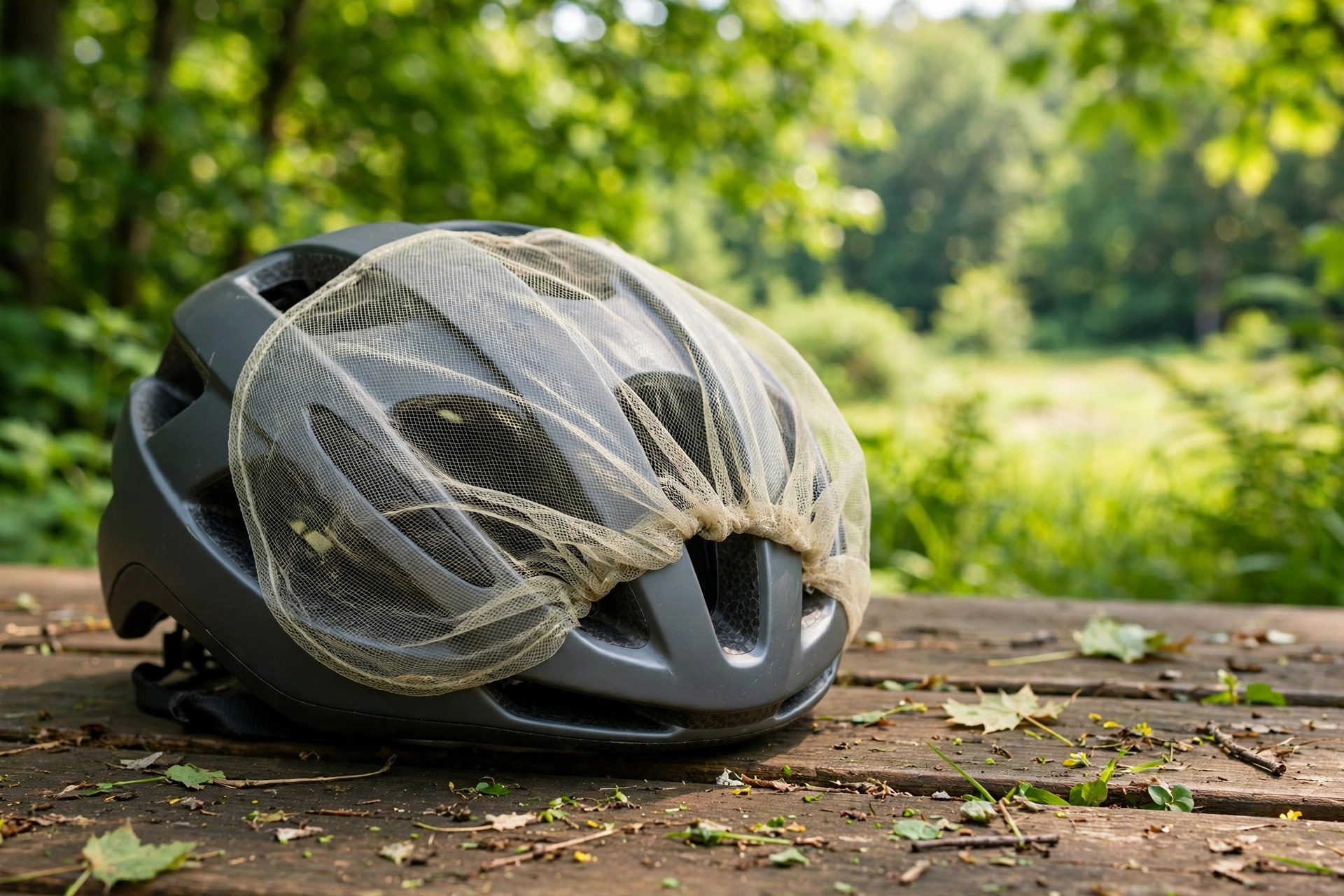
A helmet with a built-in insect net is a helmet that has a fine mesh net, usually fitted over the vents or across the face opening, designed to keep insects away from the head and face while riding. It lets air flow through the helmet while stopping flies, midges, and other small insects from getting inside. The net is part of the helmet itself, so there is nothing extra to carry or fit, and it is always in place when it is needed. Insect nets are most useful in warm weather, in wooded areas, and near water, where insects are most common.
How Does a Built-In Insect Net Work?
The net is a layer of fine mesh, similar to a very light fabric, that sits across the openings of the helmet. On many helmets the mesh covers the front vents, which are the openings that let air in as the rider moves. Air passes through the tiny holes in the mesh, but insects are too large to get through, so they are kept outside while the helmet still breathes.
On some helmets the net is a separate panel that can be pulled down over the face or neck, giving a wider area of protection when insects are thick in the air. In general terms, the finer the mesh, the smaller the insects it can stop, but very fine mesh can also slow the airflow a little. Helmet makers try to find a balance, using a mesh that is fine enough to stop the common biting insects while still letting enough air through to keep the rider cool.
Why Do Riders Need an Insect Net?
Riders need an insect net because insects are a real nuisance and a distraction on the road and trail. A fly in the eye, a midge in the ear, or a wasp inside a helmet can make a rider flinch, look away, or even lose control for a moment, which is dangerous at speed. Even when insects do not sting, they can be irritating enough to spoil a ride and make the rider want to stop.
Insects are worst in warm, still weather and in places where they gather, such as near rivers, lakes, and woods. Evening rides in summer can be the worst of all, because many biting insects are most active at dusk. A net takes this problem away without the rider having to do anything, and it works all the time, unlike sprays or lotions that wear off. For riders who spend long hours outdoors in summer, that constant protection is the main appeal.
Does an Insect Net Make the Helmet Hotter?
A mesh net can make a helmet feel slightly warmer, because it slows the air flowing through the vents. In general terms, the effect is small on most helmets, because the mesh is thin and full of tiny holes, and air still moves through it freely enough to cool the head. On a hot day, though, any reduction in airflow can be noticed, especially on a slow climb where there is little wind to push air through the helmet.
Some helmets deal with this by using the net only on the front vents, leaving the rear vents open so warm air can escape from the back. Others make the net removable, so the rider can take it out on the hottest days or in places where insects are not a problem. If the net feels too warm, it is worth checking whether the helmet has larger vents or a removable panel, because the best setup depends on the weather and the route.
What Is the Difference Between an Insect Net and a Visor?
An insect net and a visor do different jobs, though both can help keep insects away from the face. A visor is a solid shield, usually clear or tinted, that covers the eyes and part of the face and blocks wind, rain, and insects from reaching them. An insect net is a fine mesh that lets air through, so it protects a wider area, including the vents and the head, without blocking the view or the airflow.
A visor can stop insects hitting the eyes, but it does nothing about insects getting into the vents or around the sides of the helmet. A net can cover those openings and keep insects out of the helmet itself. In general terms, the two can work together, with the visor protecting the eyes and the net protecting the rest of the head. If you want to understand one of the safety technologies used in modern helmets, reading about what MIPS is for helmets is a good place to start, though an insect net itself is a comfort feature rather than a safety system.
Can an Insect Net Be Cleaned or Replaced?
Yes, in general terms an insect net can be cleaned, and on many helmets it can be replaced if it is damaged. The mesh can pick up dust, sweat, and dead insects over a season, which can block the tiny holes and reduce airflow. Rinsing the net gently with warm water and mild soap, then letting it dry fully, is usually enough to keep it working well.
A torn net is less useful, because even a small hole lets insects through, so it is worth checking the mesh when the helmet is cleaned. On helmets where the net is a separate panel, a replacement can often be fitted without tools. On helmets where the mesh is fixed into the shell, a repair may be harder, so it is worth asking about this when choosing a helmet. In either case, a damaged net should be fixed or replaced rather than left, since a net with holes gives a false sense of protection.
When Is a Built-In Insect Net Most Useful?
A built-in insect net is most useful in summer, in warm and humid conditions, and on routes that pass through woods, fields, or near water. These are the places and times when biting insects are most active, and a net makes a long ride much more comfortable. It is also useful on slow rides and climbs, where the rider is moving slowly and insects can keep up more easily than at high speed.
The net is less important in cold weather, when insects are scarce, or on fast road rides in open country, where the wind keeps most insects away. That is why some riders prefer a removable net, so they can use it only when it is needed. In general terms, a net is a small feature that makes a big difference in the right conditions, and it costs the rider nothing to have it there on a ride when it is not needed.
Does an insect net stop all insects?
Not quite all of them. A fine mesh stops most flies, midges, and other small insects, but very tiny insects may still get through, and insects can still reach exposed skin on the arms, legs, and neck. The net protects the head and the helmet vents, which is where it matters most.
Can I add an insect net to a helmet that does not have one?
In general terms, yes. Mesh vent covers and head nets are available as add-ons, and some can be fitted over the vents of an existing helmet. They may not fit as neatly as a built-in net, so it is worth checking that they stay in place before riding.
Will an insect net block my vision?
No, the mesh is fine and sits across the vents or over the face opening, not across the eyes. The rider looks through clear air, not through the net, so the view ahead is not affected in normal use.

Olivia
Writer at Helmet Today, covering helmet reviews, fit and riding safety.