Trampoline coaches do not normally wear a helmet: in general terms, a coach stands beside the trampoline in team clothing, with no head protection, and there is no rule requiring coaches to wear one. That can seem surprising, because trampoline coaches stand close to athletes who bounce high, twist, and somersault, and a gymnast who drifts off line can come down fast and hard. But a coach’s job is to watch, spot, and correct technique, and a helmet is not part of the standard kit for that role.
This guide explains what trampoline coaches actually wear on their heads, why a helmet is not normally part of the job, what head risks coaches do face beside the trampoline, and when wearing a helmet might be sensible. In general terms, the honest answer is that most coaches rely on spotting, positioning, and the gym’s mats and safety systems rather than on a helmet, and anyone considering extra protection should understand the trade-offs first.
Do trampoline coaches wear helmets?
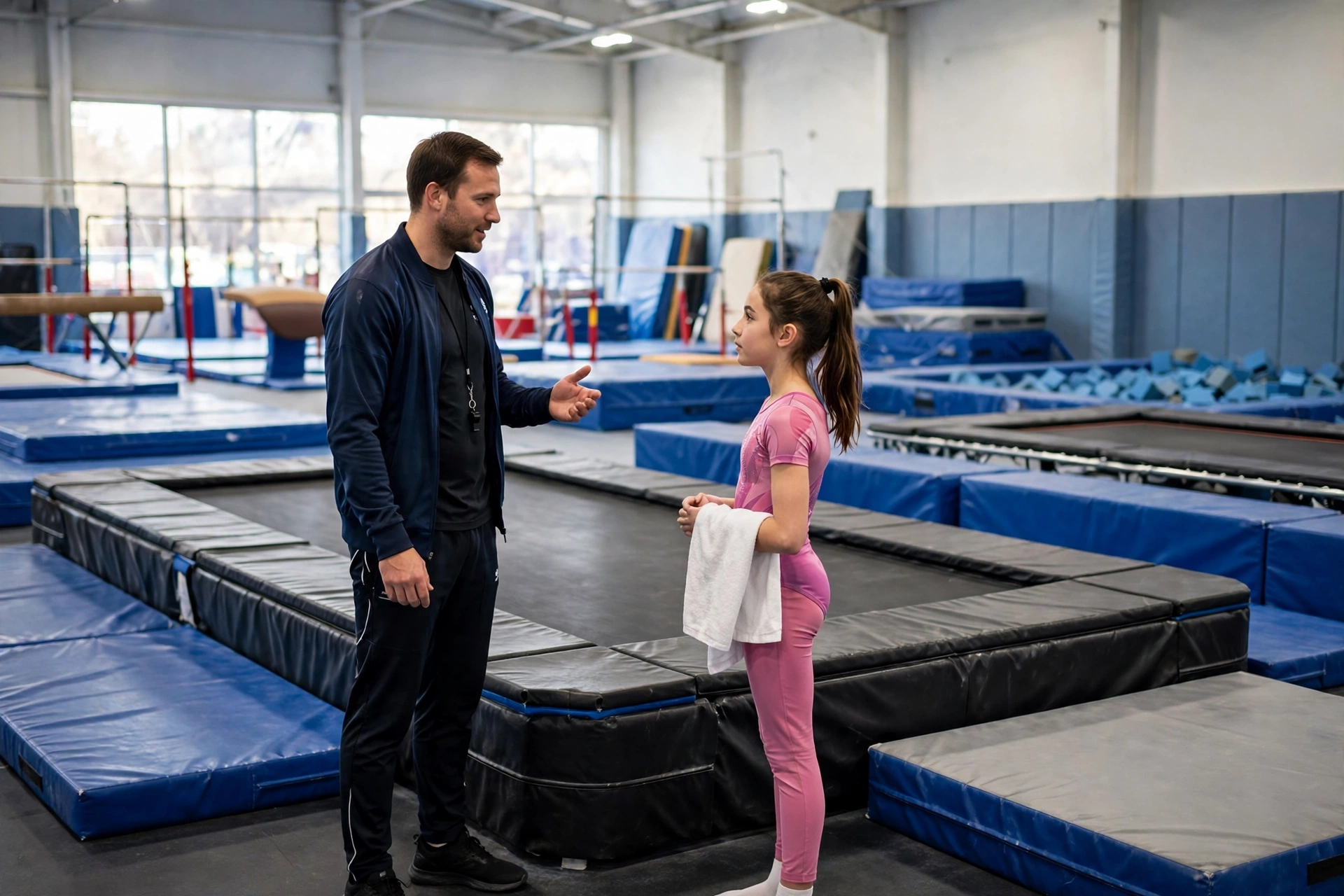
No, trampoline coaches do not wear helmets in normal training or competition. If you watch a session in any trampoline gym, the coach will be standing or kneeling beside the trampoline frame, with their head uncovered, watching the gymnast’s height, rotation, and landing, and ready to step in. The gymnasts wear no helmets either, so the coach is dressed like the rest of the team, in comfortable clothing and flat shoes.
The reason is that a coach needs to see, hear, and move freely. Spotting a trampolinist means watching their body position in the air, judging their drift across the bed, and catching them at the exact right moment if they lose control. A helmet would add weight, narrow the coach’s hearing, and could make it harder to move quickly around the frame or duck under a bouncing gymnast.
What head risks do trampoline coaches face?
Coaches face real but limited head risks, mostly from being close to skills that go wrong. A gymnast who drifts sideways, over-rotates a somersault, or loses control of a twisting skill can come off the bed and land on or near the coach. A swinging leg or foot can strike the coach’s head, and a coach who steps in to catch a falling gymnast can be knocked over and hit the floor or the trampoline frame.
Other risks come from the gym itself: tripping over mats or equipment, slipping on a dusty floor, or being struck by a gymnast practising on a neighbouring trampoline. Coaches who spot new skills, where athletes are still learning the timing, are more exposed than those watching a well-practised routine. In general terms, these are the same kinds of accidents that can happen to anyone working close to a fast, acrobatic sport, and the risk is highest when new skills are being taught.
Can a trampoline coach wear a helmet?
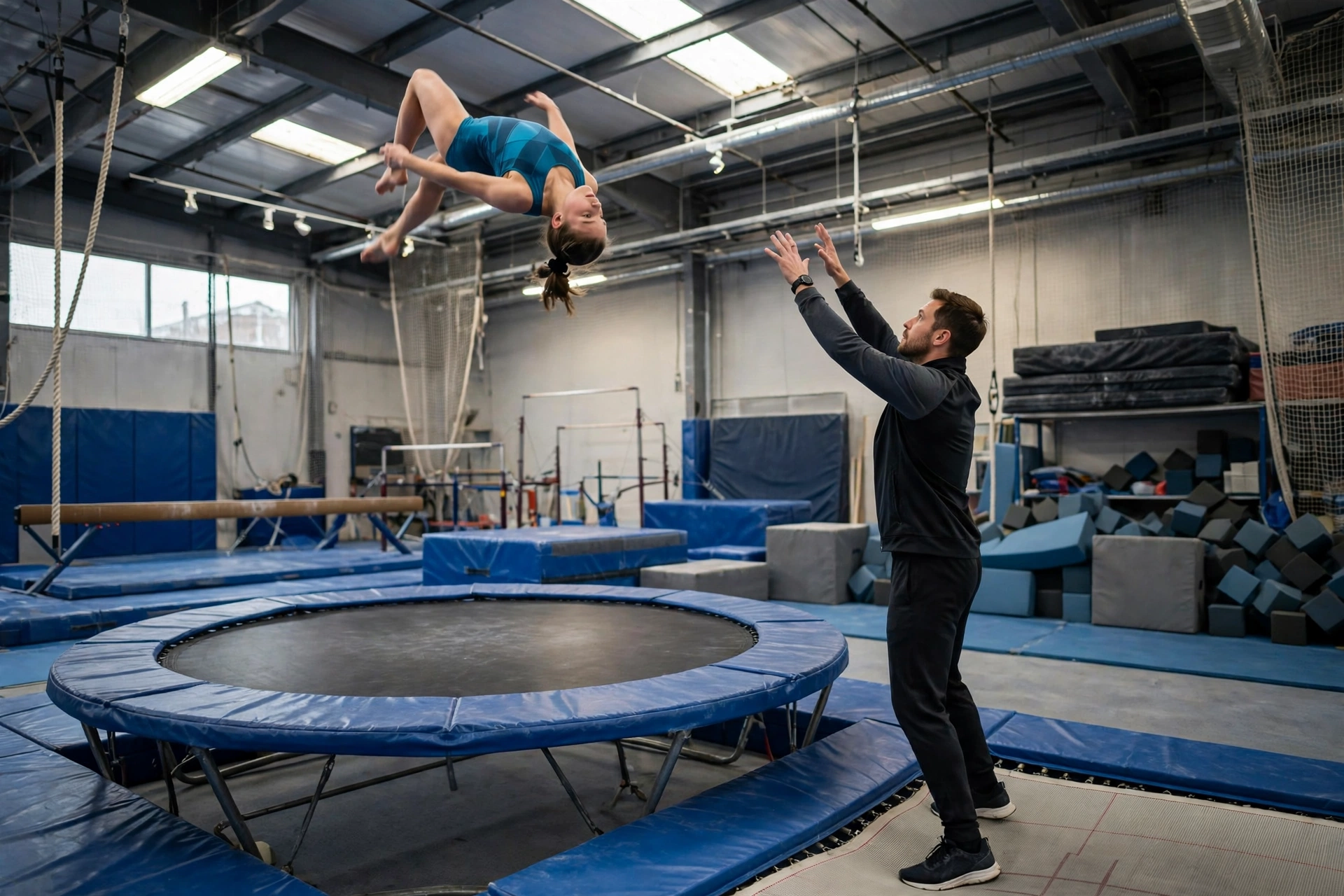
There is no rule that stops a coach from wearing a helmet if they want extra protection, and in practice some coaches do wear one in particular situations. The most common is spotting a new somersault or twisting skill, where the coach is standing close to the bed and the chance of a fall is higher. A light sports helmet can add a little protection there without getting in the way too much.
The trade-off is comfort and communication. A helmet is warm, muffles the voice, and can make it harder to hear a gymnast’s call or a fellow coach’s warning. Most coaches decide the benefits are not worth it for a normal session, when they can stand to the side and spot from a safer angle. But for a coach who has had a previous head injury, or who is teaching a difficult new skill, a light helmet is a reasonable, honest option to consider.
What do coaches wear instead of a helmet?
Instead of a helmet, coaches wear the kit that helps them do their job: team clothing, flat shoes with good grip on the gym floor, and sometimes a cap or headband to keep hair and sweat out of the way.
The most important protection a coach has is not something worn at all. It is spotting skill, which means knowing where to stand, when to step in, and how to guide a falling gymnast onto the bed or the mats, and it is the gym itself, with its thick mats, safety pads, and the trampoline’s own frame padding. A coach who spots well rarely ends up under a falling gymnast, while a coach who stands in the wrong place is at risk whatever they wear. In general terms, good spotting and good matting are the coach’s real head protection.
How do coaches stay safe without a helmet?
Coaches are trained to spot from the side of the trampoline, where they can see the gymnast’s height and drift without standing directly underneath. They learn to keep their knees bent, their hands ready, and their eyes on the gymnast at all times, and to call a warning the moment a skill starts to go wrong. This is taught in coaching courses and reinforced by practice, because safe spotting protects the athletes as well as the coach.
Coaches also rely on progression, which means teaching skills in small steps on a soft surface before moving to the full skill. If a coach is hurt, the session stops and the injury is treated like any other head injury in the gym. In general terms, the safety system for coaches is built on spotting, progression, and mats, and it works well enough that helmets have never become part of the kit.
When might a trampoline coach consider a helmet?
A coach might consider a helmet when teaching a new somersault or twisting skill, where the gymnast is learning to control rotation at full height and the chance of a fall is highest. In that setting, the coach is standing close to the bed and may need to catch a falling gymnast, so a light helmet can add a little protection. Some coaches also use one when spotting double trampoline, where the gymnast runs, bounces, and lands at speed, and a mistake can send them toward the spotter.
Another case is coaching young gymnasts, where skills can be unpredictable and the coach may need to step in quickly. A coach who feels exposed in that setting may choose a light helmet for peace of mind, and nobody will object. A cycling or skate helmet is not ideal, because it is designed for a different kind of impact, but a light, well-fitting sports helmet is the sensible choice if one is worn at all. Some modern helmets include a system designed to reduce rotational forces in a fall, such as MIPS, and a coach choosing a helmet should look for one that fits well and does not block hearing or vision, rather than the cheapest option.
Do trampoline coaches wear helmets?
No, in general terms trampoline coaches do not wear helmets during training or competition. There is no rule requiring one, and coaches rely on spotting, positioning, and mats to stay safe instead.
When might a coach wear a helmet?
A coach might wear a helmet when spotting a new somersault or twisting skill, where the chance of a fall is highest and the coach is standing close to the bed. That is the situation where extra protection is most sensible.
What should a coach do after a head knock while spotting?
Stop the session and get checked, just as a gymnast would. In general terms, any head knock should be treated seriously, and the coach should not carry on if there are symptoms such as dizziness, confusion, or headache.

Olivia
Writer at Helmet Today, covering helmet reviews, fit and riding safety.