
A helmet for deaf riders is a standard protective helmet chosen and fitted so that it works well for a rider who is deaf or hard of hearing, including with hearing aids or a cochlear implant. In general terms, there is no separate type of helmet for deaf riders; the difference is in how the helmet is chosen, fitted, and used.
Deaf riders cycle, ride motorcycles, ski, and take part in many other sports, just like hearing riders. A helmet’s job is the same for everyone: to protect the head in a fall. What changes for a deaf rider is the detail. A helmet must not press painfully on a hearing aid or an implant, and it must not block the vision that a deaf rider relies on more heavily.
What does a helmet for deaf riders mean?
For a deaf rider, the helmet is the same piece of safety gear that any rider wears, but the choice is made with a few extra things in mind. The first is comfort around the ears. A helmet that presses on the ears can be painful over a long ride, and for a rider who wears a hearing aid or an implant, that pressure can also push the device out of place or cause feedback. A helmet with room around the ears, or with ear pads that can be thinned or removed, is often the best starting point.
The second is vision. In general terms, deaf riders rely more on sight than hearing riders do, because they cannot hear a car coming up behind them, a bell, or a shout of warning. A helmet with a wide opening and a clear view to the sides helps a rider see what is around them, and a helmet that sits well with glasses, without pressing on the arms, is important for riders who also need vision correction.
How does a helmet work with hearing aids?
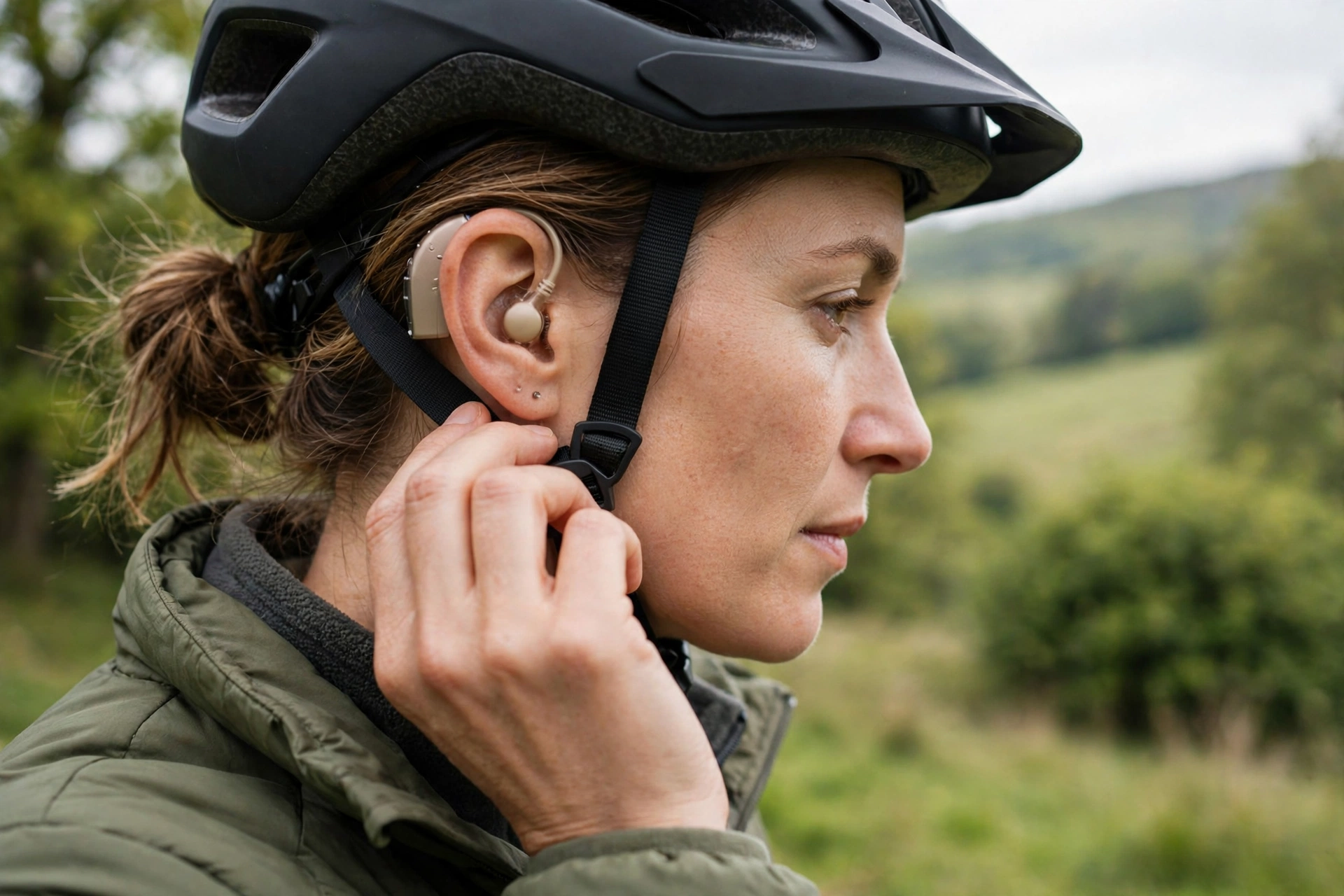
Hearing aids sit behind or inside the ear, and a helmet’s shell and straps pass close to that area, so the fit needs care. In general terms, the best approach is to try the helmet on with your hearing aids in place, exactly as you will wear them on a ride. If the helmet presses on the aid, pushes it off, or causes a whistling sound, try a different size or a different model, because heads and helmets vary and one maker’s shape may suit you better than another’s.
Some helmets have thinner padding around the ears, or padding that can be removed or swapped for a thinner set, and these can help. A helmet with straps that sit a little further forward or back can also make a difference, so take the time to adjust the straps while the aids are in place. If you wear glasses as well as hearing aids, check that the helmet, the glasses, and the aids all sit comfortably together.
What about cochlear implants and helmets?
A cochlear implant has two parts: an internal part under the skin behind the ear, and an external processor that sits on the head and is usually held in place by a magnet. A helmet can press on the external processor, push it out of place, or make it uncomfortable, so fitting needs even more care than with a hearing aid. In general terms, the same rule applies: try the helmet on with the processor in place, and choose a model that leaves room for it.
Some riders find that a helmet with a cut-out or a thinner pad over the implant site works well, while others prefer a helmet that sits a little higher at the back. A helmet with a dial adjuster at the back can help, because it lets you fine-tune the fit without tightening the whole helmet. If the processor has a retention clip or a cord, make sure the helmet does not pull on it when you put the helmet on or take it off. If you are unsure, talk to your audiologist or the implant team before you buy, since they will know your device. Never force a helmet over an implant, and if a helmet causes pain over the implant site, stop using it and try another.
How can deaf riders stay aware on the road or trail?
Deaf riders stay safe by making the most of their vision and by planning ahead. In general terms, checking over your shoulder before turning or changing lanes, using mirrors, and keeping a good lookout at junctions matter more when you cannot hear traffic coming. A helmet with a wide field of vision helps here, as does a mirror fitted to the handlebar or the helmet, which lets you see behind you without turning your head.
Bright clothing and lights help other road users see you, which is useful for any rider but matters more when you cannot hear a vehicle approaching. A light-coloured helmet, a high-visibility jacket, and lights on the bike make you easier to spot. Some helmets include a system designed to reduce rotational forces in a fall, such as MIPS, and that is a separate safety feature worth asking about, alongside the fit around your hearing device. If you ride in a group, agree on simple hand signals for turning, stopping, and hazards before you set off.
How should the helmet fit?
A helmet for a deaf rider should fit in the same way as any helmet: level on the head, low enough at the front to cover the forehead, and snug all round without pressing painfully. It should not tip forward over the eyes or slide back when you nod, and it should stay in place when you shake your head gently from side to side. The chin strap should be snug enough that you can fit only a finger or two between the strap and your chin.
The difference is that you should check this fit with your hearing aid or implant processor in place, and with any glasses you wear. Walk around in the helmet for a few minutes, and if you can, try it in the riding position you use, because your head and your devices sit differently when you lean forward. If the helmet presses on a device after a few minutes, it will only get worse on a long ride, so do not settle for a fit that is almost right. Check the helmet regularly for cracks, dents, or loose parts. In general terms, a helmet that has taken a hard knock in a fall should be replaced, even if it looks fine on the outside, because the inner lining may have been compressed.
Do deaf riders need a special helmet?
In general terms, no. Deaf riders use the same helmets as other riders, but the helmet must be chosen and fitted so it does not press on a hearing aid or cochlear implant, and so it gives a clear view to the sides.
Can I wear hearing aids with a helmet?
Yes, many deaf riders wear hearing aids under a helmet. Try the helmet on with your aids in place, look for a model with room around the ears, and check for pressure or feedback before you buy.
Can I wear a cochlear implant processor with a helmet?
Yes, but the fit needs care, since the helmet can press on the processor or push it out of place. Try the helmet on with the processor fitted, and ask your audiologist for advice if you are unsure.

Olivia
Writer at Helmet Today, covering helmet reviews, fit and riding safety.