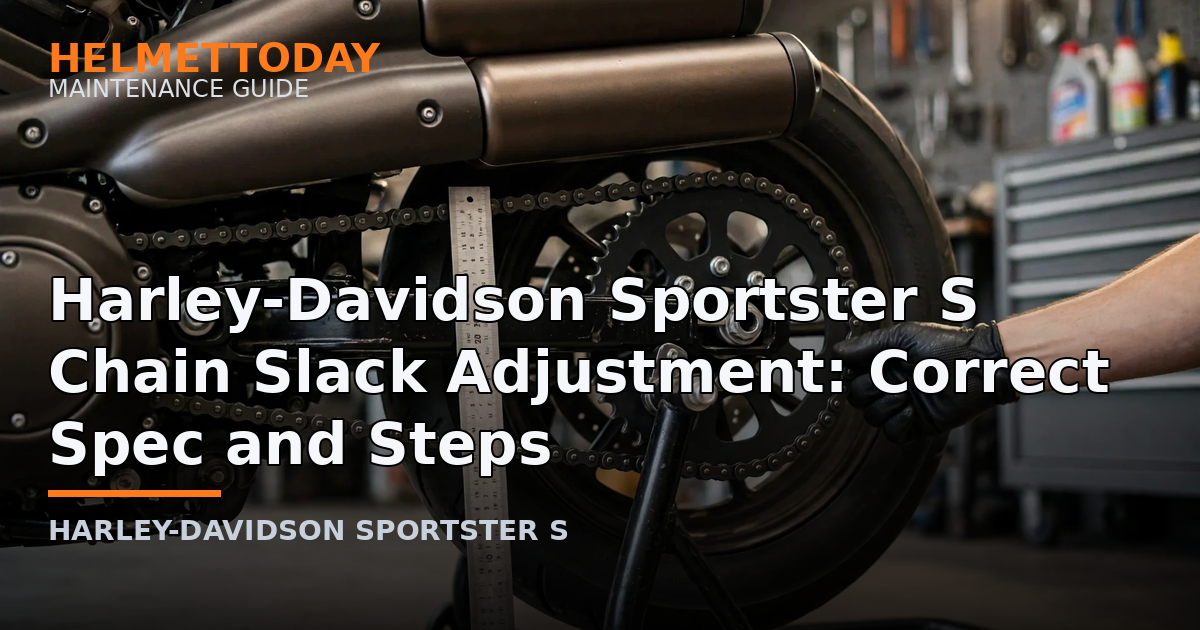
Correct chain slack on the Harley-Davidson Sportster S is the spec in your owner’s manual of vertical movement, measured midway between the sprockets. Too tight and you load the countershaft bearing and suspension; too loose and the chain can slap, jump, or wear the sprockets unevenly.
Check slack every 500-1,000 miles and after any rear-wheel work. You’ll need the bike upright (not on the side stand) for an accurate reading.
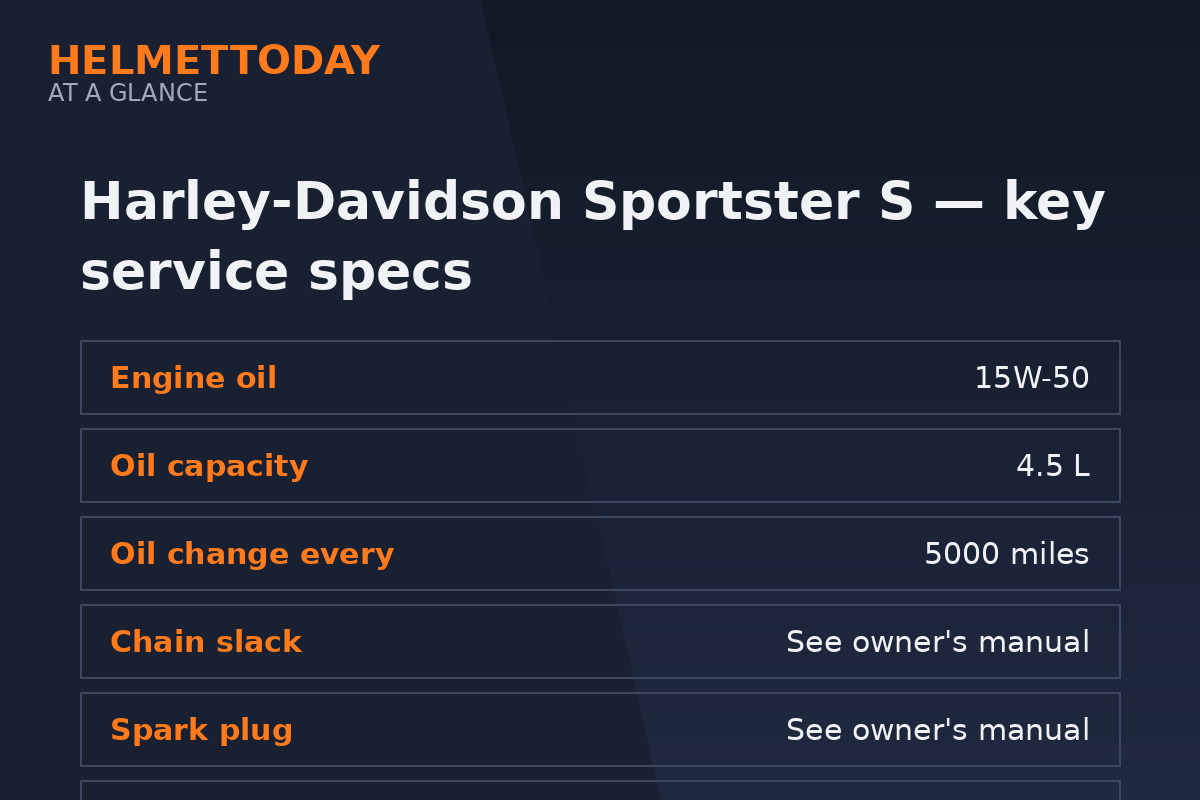
Harley-Davidson Sportster S quick service specs
| Item | Specification |
|---|---|
| Engine oil | 15W-50 |
| Oil capacity | 4.5 liters |
| Oil change interval | 5000 miles |
| Chain slack | See owner’s manual |
| Spark plug | your owner’s manual |
| Tire pressure (F/R) | 36 PSI front / 42 PSI rear |
| Battery | 12V 12Ah, 225 CCA |
How to adjust chain slack, step by step
- Place the bike upright on a paddock stand or have a helper hold it vertical.
- Find the midpoint between the front and rear sprockets on the lower chain run.
- Push the chain up and down with a finger and measure total vertical movement with a ruler or tape.
- Compare to the the spec in your owner’s manual spec. If it’s out of range, loosen the rear axle nut.
- Turn both chain adjuster bolts equally — count flats or use the alignment marks so the wheel stays straight.
- Re-check slack at several points by rotating the wheel; chains have tight spots. Set slack at the tightest point.
- Tighten the axle nut to the factory torque spec, re-check slack once more, and make sure the adjusters are locked.
Common mistakes to avoid
- Adjusting on the side stand — the reading will be wrong and you’ll set it too tight.
- Moving only one adjuster — a crooked rear wheel chews chains and handles badly.
- Setting slack at a loose spot — always measure at the chain’s tightest point.
FAQ
What happens if the chain is too tight?
It puts constant load on the output shaft bearing and fights the suspension, accelerating wear on the chain, sprockets, and bearings.
How do I know the chain needs replacing, not adjusting?
If you’re at the end of the adjuster range, if slack varies a lot around the chain, or if you can pull the chain off the rear sprocket noticeably — it’s done.
Do I need to lube after adjusting?
Yes — any chain work is a good moment to clean and lube while you’re there.
Related guides

Dan Heiman
Writer at Helmet Today, covering helmet reviews, fit and riding safety.