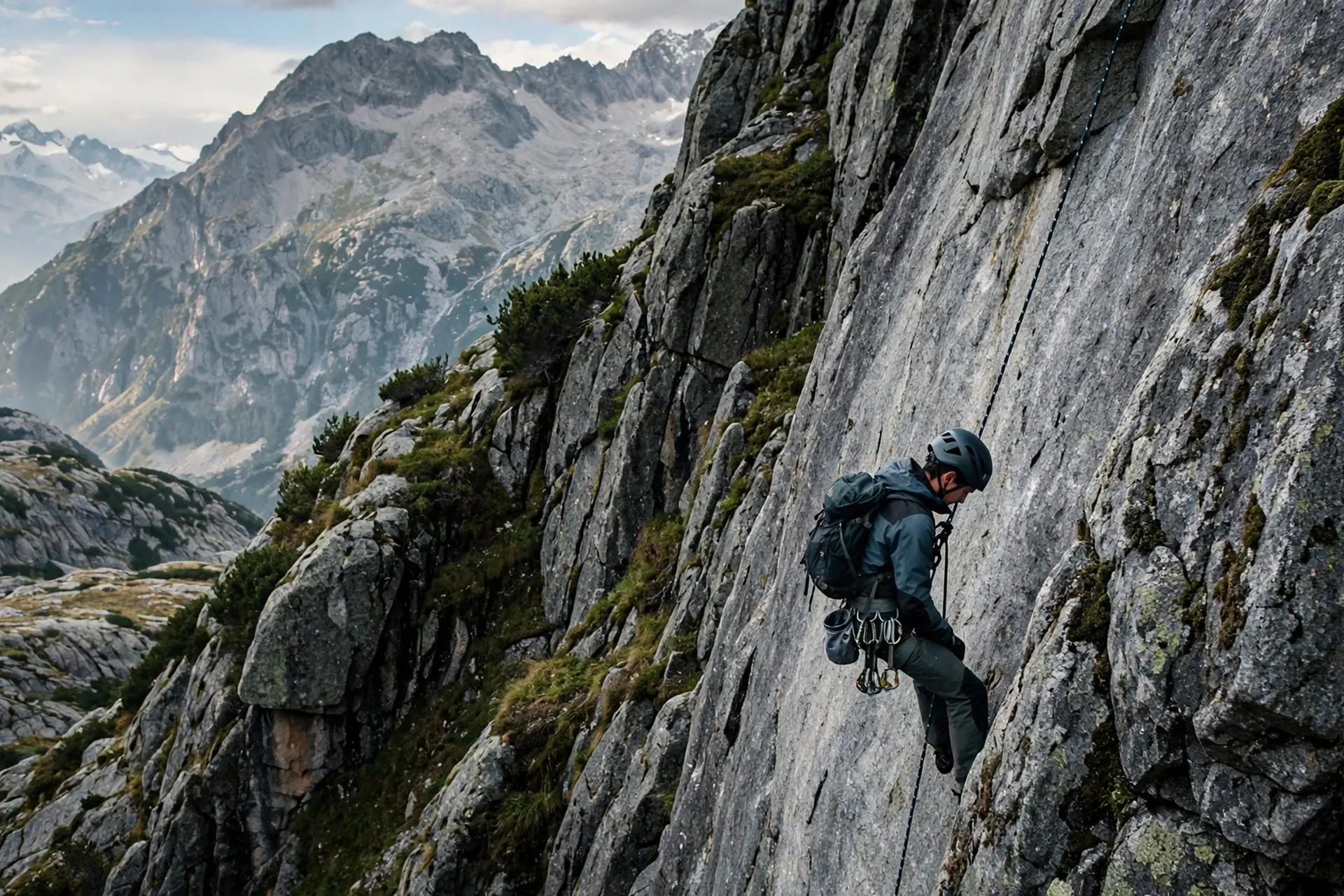
A helmet for abseiling is a climbing helmet worn to protect your head from falling rocks, knocks against the rock face, and bumps from equipment while you descend on a rope. Abseiling, also called rappelling, means lowering yourself down a cliff, a rock face, or a building on a rope, and a helmet is one of the most important pieces of safety kit for the job. Even a small stone knocked loose from above can cause a serious head injury, so the helmet is worn for the whole descent, not just at the start.
In general terms, the helmet used for abseiling is the same kind of lightweight climbing helmet used for rock climbing and mountaineering. It has a hard outer shell and a shock-absorbing inner layer, and it is held in place by a chin strap and an adjustable harness. Some abseilers use a helmet with a mount for a head torch, which is useful when abseiling into a cave or down a shaded face in low light.
Why do you need a helmet for abseiling?
You need a helmet for abseiling because your head is exposed to two main risks: objects falling from above and your own head striking the rock. Loose stones, bits of ice, and dropped equipment can all fall from the top of the descent, and they can pick up speed quickly. A helmet spreads the force of an impact and helps prevent a serious injury from something you never saw coming.
The second risk comes from the descent itself. As you lower yourself down, your body can swing, and your head can swing into the rock face, especially if the rope runs over a ledge or the wind catches you. A helmet also protects you from bumps when you start the descent, which is often the most awkward part, as you lean back over the edge and get your weight onto the rope.
What kind of helmet is used for abseiling?
The helmet used for abseiling is a climbing helmet, which is designed to be light, well ventilated, and comfortable to wear for a long time. Most modern climbing helmets have a hard plastic shell over a foam inner layer that absorbs impact, and a cradle or dial system at the back that lets you adjust the fit. They are much lighter than a hard hat, which matters when you are wearing one for hours.
Some climbing helmets are made mainly from expanded foam with a thin shell, while others have a thicker hard shell. The hard-shell type tends to be tougher and better suited to abseiling, where the helmet can be knocked against rock and scraped along the face. Whichever type you choose, it should sit level on your head and stay put when you shake your head gently.
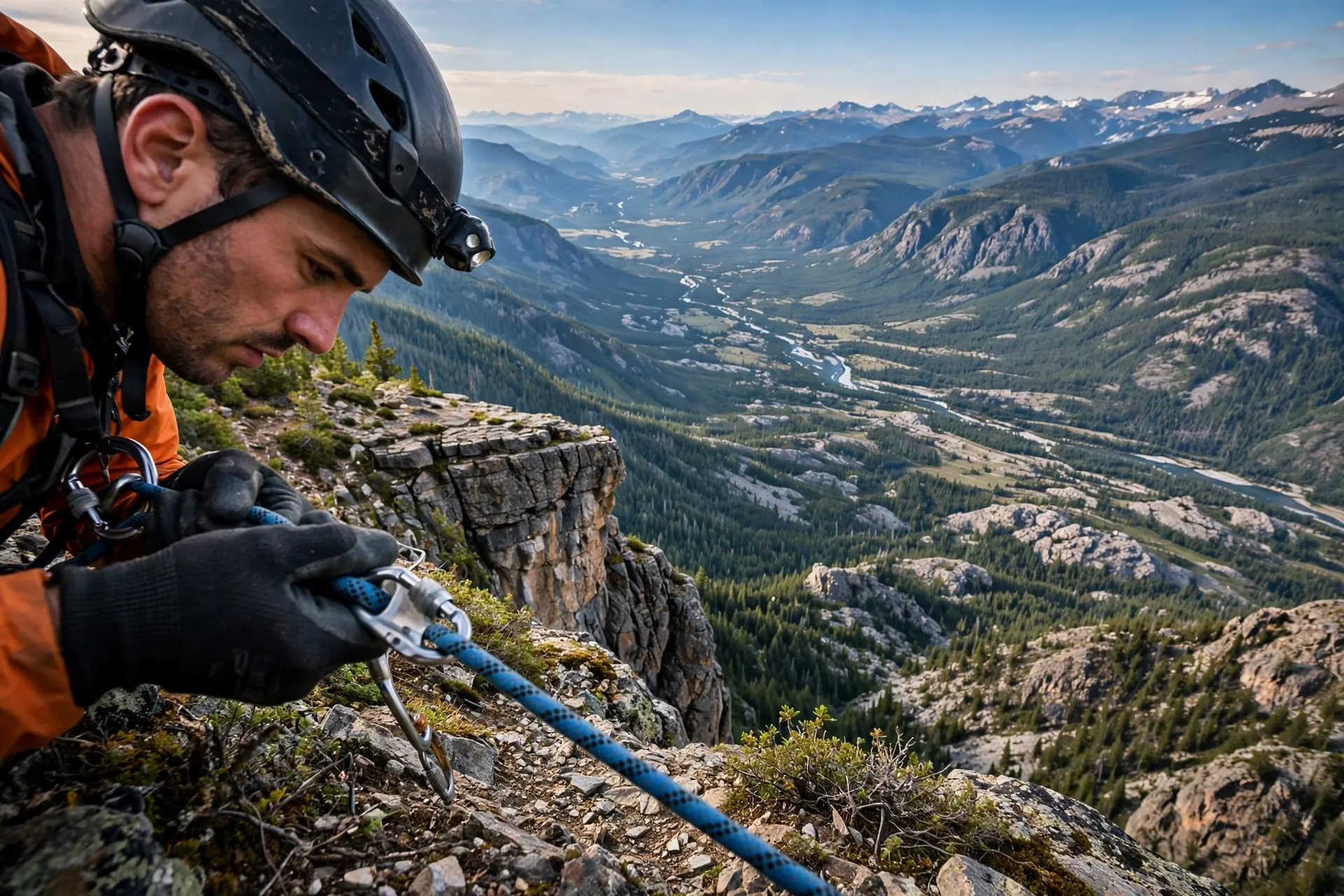
How should an abseiling helmet fit?
An abseiling helmet should fit snugly all round your head, without pressing painfully on your forehead or temples. It should sit low enough at the front to protect your forehead, and it should not tip forward over your eyes or slide back when you nod. The fit is best checked with the helmet on and the chin strap fastened, wearing the same hat or head covering you plan to use underneath, if any.
The chin strap should be snug enough that you can fit only a finger or two between the strap and your chin, and the rear adjustment should be tightened so the helmet does not rock when you move your head. A helmet that is too loose can shift in a fall or when you bump the rock, while one that is too tight will give you a headache before you reach the bottom. Take time to adjust it properly before you go over the edge.
Can you use a bike helmet or a hard hat for abseiling?
In general terms, a bike helmet is not a good choice for abseiling, because it is designed for a different kind of impact. Bike helmets are made to protect against a single impact from a fall onto a hard surface, and they often have large vents and a shape that leaves parts of the head exposed. A climbing helmet is designed with falling objects and knocks from above in mind, and it covers more of the head, including the sides and the back.
A builder’s hard hat is also not ideal for abseiling, although it is designed to protect against falling objects. Hard hats are heavier, less comfortable for long wear, and they are not made to stay on your head when you lean back or hang upside down. A proper climbing helmet, with its close fit and four-point chin strap, is the right tool for the job.
What features matter in an abseiling helmet?
Ventilation matters in an abseiling helmet, because you may be wearing it in warm sun on an exposed face. Look for a helmet with vents that let air flow through, and a lining that is comfortable against your skin. A head torch clip is a useful feature, especially for abseiling into caves, down shaded gullies, or in the early morning or evening.
Some climbing helmets also include a system designed to reduce rotational forces in a fall, such as MIPS, and it is worth asking about when you choose a helmet. Weight matters too, since a light helmet is easier to wear for a long day. Check that the helmet is in good condition before every use, with no cracks, dents, or damage to the shell or straps, and that all the buckles and adjusters work smoothly.
How do you look after an abseiling helmet?
After abseiling, check your helmet for cracks, dents, and scratches, and look at the straps and buckles for wear. Brush off dust and mud, and wash the helmet with lukewarm water and mild soap if it is dirty, letting it dry naturally away from direct heat or strong sunlight. Do not leave it in a hot car, as heat can damage the foam inside over time.
In general terms, a climbing helmet that has taken a hard impact from a falling rock or a heavy knock should be replaced, even if it looks fine on the outside, because the inner layer may have been compressed. Store your helmet in a dry place, away from chemicals and sharp objects, and keep it in a bag or case when you carry it, so it is not scratched or crushed by other gear.
Do you always need a helmet for abseiling?
Yes, in general terms a helmet should be worn for every abseil, even a short or easy one. Falling rocks and knocks against the face can happen on any descent, and a helmet is the simplest protection against them.
Can children wear the same abseiling helmet as adults?
No, children need a helmet that fits their smaller head properly. A loose adult helmet can shift and protect less well, so use a junior or small-sized climbing helmet that sits level and stays put.
When should an abseiling helmet be replaced?
Replace it after a hard impact, if the shell or straps are damaged, or if the fit no longer stays secure. In general terms, a helmet that has protected you in a serious knock has done its job and should not be relied on again.

Olivia
Writer at Helmet Today, covering helmet reviews, fit and riding safety.