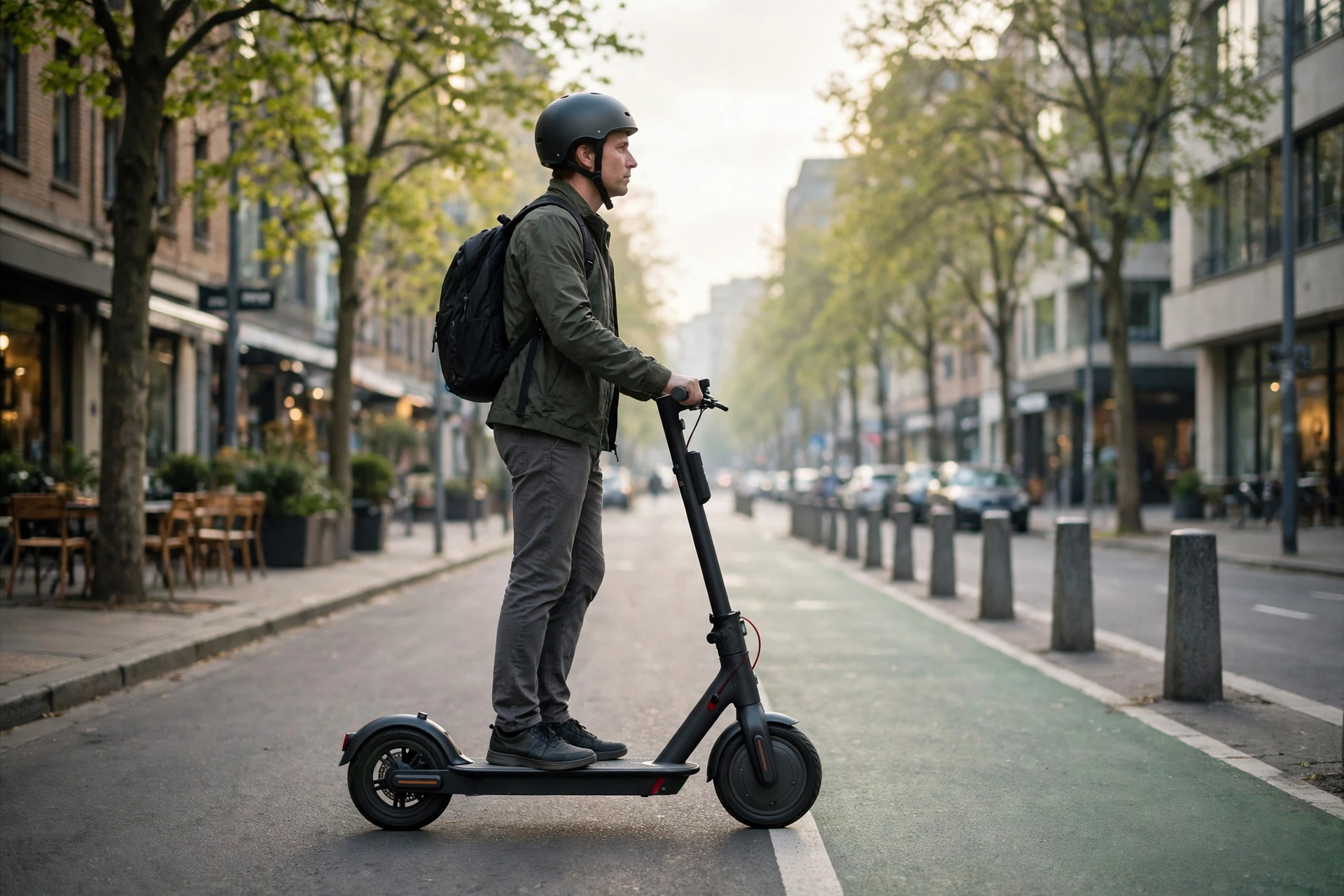
For most city e-scooter riding, the right choice is a certified bicycle-style helmet with extended coverage at the back and sides. If your scooter regularly cruises above roughly 20 mph, step up to a helmet rated for higher-speed impacts, such as an NTA 8776-certified e-bike helmet or a lightweight motorcycle-style helmet, because crash energy rises quickly with speed.
Standing scooters put you upright, exposed, and close to traffic, with small wheels that react sharply to potholes and wet drain covers. That combination makes head protection more important, not less, than on a bicycle. This guide walks through speed, certification, coverage, fit, and comfort so you can pick a helmet that matches how and where you actually ride.
What speed does your scooter actually reach?
Start with the scooter, not the helmet shelf. Many city e-scooters are limited to around 15–20 mph, while faster commuter models cruise at 25 mph or more, in general terms. The helmet that is perfectly sensible for a shared scooter on a protected lane may be under-matched for a dual-motor scooter mixing with car traffic on a main road.
Check your scooter’s realistic cruising speed, not just its advertised top speed. If you spend most of your ride at the upper end of that range, treat helmet choice the way faster e-bike riders do: more coverage, and a standard written for higher-energy impacts. If you ride slowly on separated paths, a standard certified bicycle helmet is the usual baseline.
Also think about how you fall. Scooter falls often pitch the rider forward or sideways over the front wheel, which is one reason coverage at the temples and the back of the head matters more here than a featherweight, barely-there road cycling shell.
Which certification should an e-scooter helmet have?
Look inside the helmet for a certification label before you look at colors or features. In the US, bicycle helmets are certified to the CPSC standard; in Europe, the equivalent mark is EN 1078. Either label means the helmet has passed impact tests for cycling-speed crashes, and either is a reasonable minimum for lower-speed city scootering, in general terms.
For faster scooters, the Dutch NTA 8776 standard — developed for speed e-bikes — tests helmets at higher impact energies and requires more coverage. A growing number of urban helmets carry it, and it is a sensible step up if your commute involves sustained speeds above about 20 mph or heavy traffic.
Avoid novelty helmets and uncertified fashion shells entirely. They may look like helmets, but without a certification label there is no tested energy-absorbing performance behind the styling. The label is the product; everything else is comfort and convenience.
How much coverage do you need for city riding?
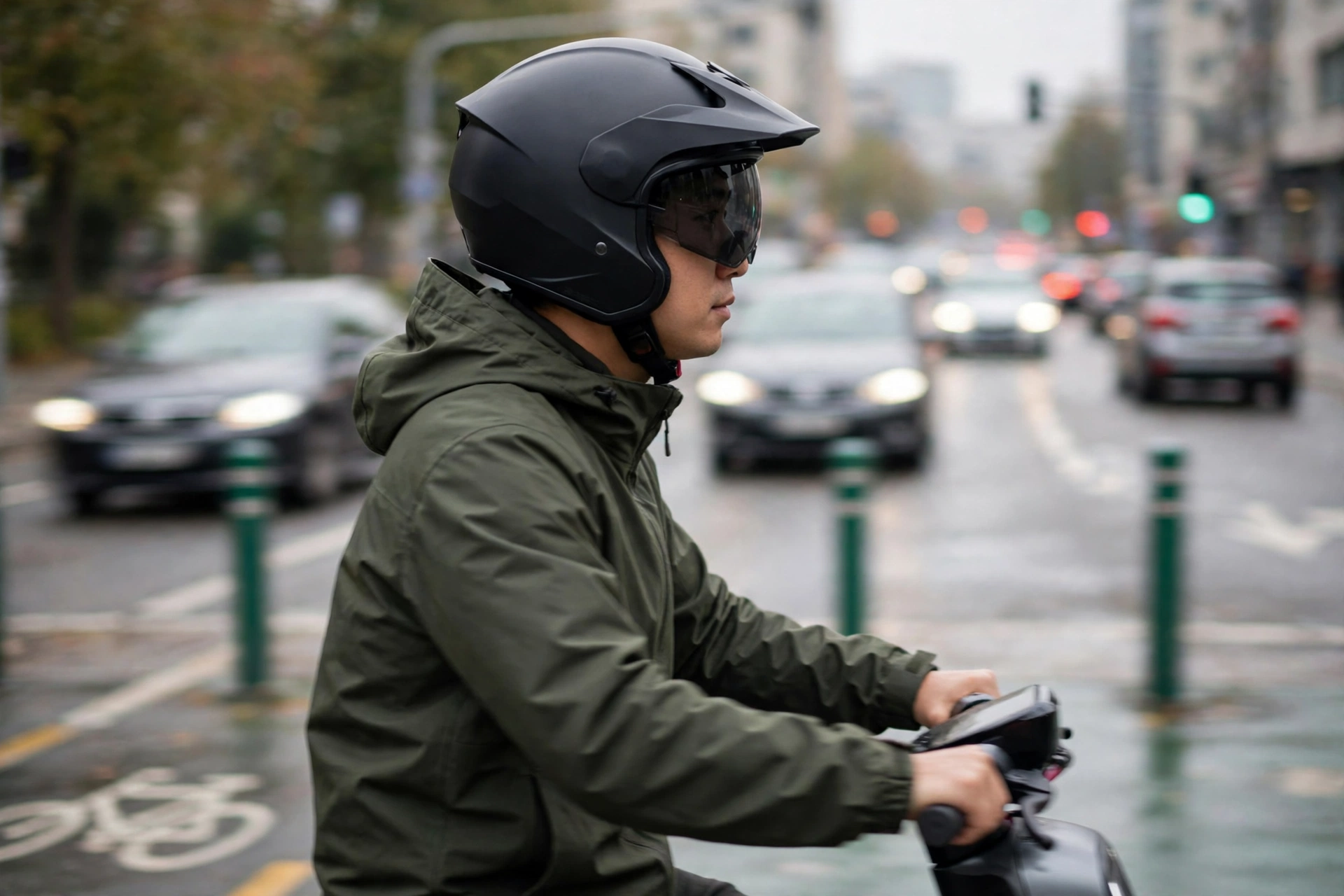
Coverage describes how much of your head the shell wraps. Urban and commuter helmets typically extend lower at the back and sides than minimalist road bike helmets, protecting the occipital area and temples — zones that are vulnerable in the sideways and backward falls common on scooters.
Some riders also consider rotational-impact technology. In angled impacts, systems designed to reduce rotational forces, such as the one explained in our guide to what MIPS is and how it works, add a low-friction layer inside the helmet. It is not a substitute for certification or fit, but it is a reasonable feature to look for when comparing helmets in the same price range.
Full-face helmets sit at the far end of the coverage scale. On a fast scooter they protect the chin and face as well, but they are heavier, warmer, and harder to carry around a city day. For most city riders, a deep-coverage half shell is the practical balance; reserve full-face designs for genuinely fast machines.
How should an e-scooter helmet fit?
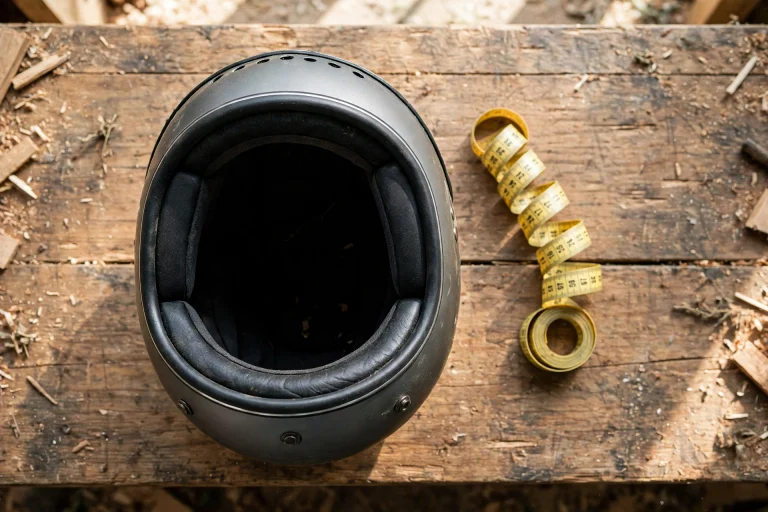
A helmet protects only when it stays in position, so fit comes before features. Measure your head circumference just above the eyebrows and ears with a soft tape, and match the number to the manufacturer’s chart for the exact model — sizes are not perfectly consistent between brands.
On your head, the helmet should sit level, low on the forehead, snug all around without a single painful pressure point. Shake your head gently: the helmet should move with your scalp rather than sliding independently. The chin strap should be snug enough that the helmet cannot be rolled off forward, while still letting you talk and swallow comfortably.
Try the helmet on with anything you will wear under it — a thin winter liner changes fit, and thick hats should never be worn under a helmet at all. If you are between sizes, choose the smaller one and use the fit dial and pads to fine-tune, rather than accepting a loose larger shell.
What comfort features matter for a daily commute?
City riders take helmets on and off many times a day, so small conveniences add up. A rear adjustment dial makes one-handed fitting easy. A magnetic buckle can be worked with gloves. Removable, washable pads keep a daily helmet fresh, because sweat buildup is the fastest route to a helmet you stop wanting to wear.
Visibility features earn their place in city traffic. Bright colors, reflective details, and an integrated or clip-on rear light help drivers spot you at junctions — where you are upright, narrow, and easy to miss between parked cars. A small visor or peak keeps low sun and light rain off your eyes without the bulk of a full face shield.
Finally, consider how you will carry and store it. A helmet that locks through its straps to the scooter, or fits in your bag, is a helmet that actually comes with you. The safest helmet is the one you are wearing when something goes wrong, and convenience is what makes that happen day after day.
Frequently Asked Questions
Q: Can I just use my bicycle helmet on an e-scooter?
A: For lower-speed city riding, a certified bicycle helmet is a reasonable baseline in general terms, especially one with deeper coverage. If your scooter cruises above roughly 20 mph, consider stepping up to an NTA 8776-rated e-bike helmet or a lightweight motorcycle-style helmet.
Q: Do I legally need a helmet to ride an e-scooter in the city?
A: Rules vary widely by country, state, and city, and some rental schemes set their own requirements. Check your local rules, but wear one regardless — the law is a minimum, not a guide to what protects you.
Q: When should I replace my scooter helmet?
A: Replace it after any crash or significant impact, even if the shell looks fine, because the foam may be compressed invisibly. Also replace it when straps fray, the fit loosens beyond adjustment, or the manufacturer’s recommended service life has passed.

Olivia
Writer at Helmet Today, covering helmet reviews, fit and riding safety.