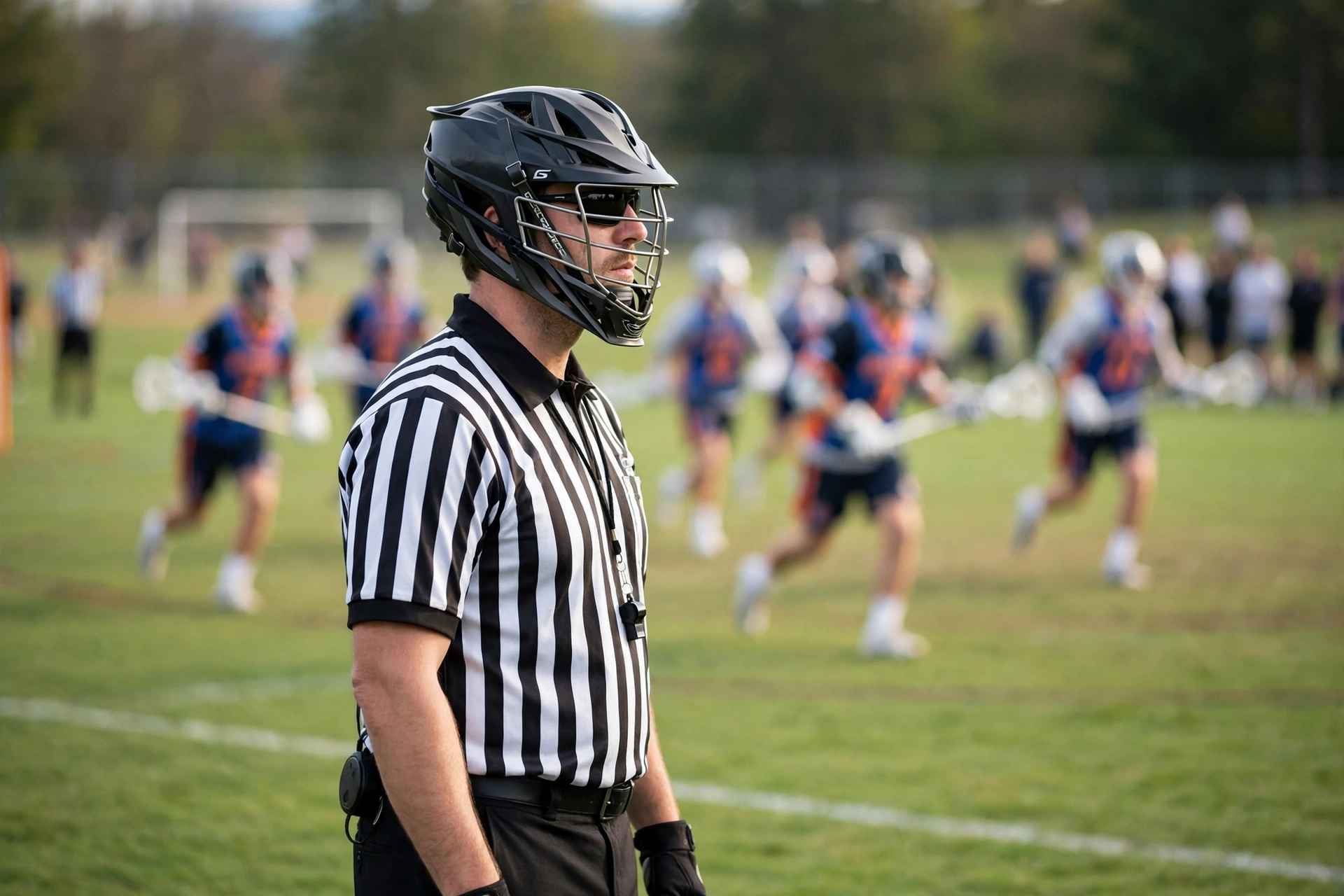
A helmet for lacrosse referees is a protective helmet worn by the officials who run a lacrosse game, and in general terms it is usually a light helmet that guards against stray balls and accidental contact with sticks. Referees spend the whole game moving around the field close to fast play, so head protection is a sensible precaution even though they are not taking part in the game itself.
Lacrosse is a fast game with a hard ball and long sticks, and the ball can travel quickly in any direction, including towards the officials. A referee may also be caught by a follow-through swing or a collision when players chase a loose ball. A helmet will not stop those things from happening, but it can reduce the force of a knock to the head if one does happen.
Do lacrosse referees wear helmets?
Whether lacrosse referees wear helmets depends on the level of the game and the rules of the league or association running it. At some levels, referees are expected or encouraged to wear a helmet, while at others it is left to the individual official to decide. In general terms, helmets are more common among referees at higher levels of the game, where the ball moves faster and the play is more physical.
Even where a helmet is not required, many referees choose to wear one for their own peace of mind. A referee who has been hit by a stray ball once is often keen not to repeat the experience, and a light helmet is a small price to pay for that protection. If you are starting out as a referee, it is worth asking your local association what its policy is before your first game.
What kind of helmet do lacrosse referees wear?
In general terms, lacrosse referees wear a light helmet that gives good vision and hearing, because they need to see the whole field and hear players and fellow officials. Some referees wear a lacrosse player helmet, which offers strong protection but can feel heavy and warm over a full game. Others wear a lighter helmet, such as a soft-shell or padded headguard, which protects against glancing blows while staying comfortable and cool.
At youth and school level, referees sometimes wear a standard lacrosse helmet simply because it is easy to get hold of and clearly meets the safety standards used in the game. At adult level, some officials prefer a helmet designed for referees or for other field sports, with a lower profile and better ventilation. Whatever style is chosen, the helmet should fit well, stay in place while running, and not block the referee’s view of play.

Why do lacrosse referees need a helmet?
Lacrosse referees need a helmet because they work inside the playing area, often only a few steps from the ball. A shot that misses the goal, a pass that goes astray, or a ball that bounces off a stick can reach an official with little warning. The ball is hard and relatively small, so even a glancing hit can hurt, and a direct hit to the head can cause a serious injury.
Referees also move into tight spaces to judge play, such as near the goal during a close contest or in the middle of a scramble for a loose ball. In those moments, sticks can swing close to their head and players can collide with them. A helmet gives a layer of protection in exactly those situations, and it also gives the referee confidence to get into the right position to make the call, rather than hanging back to stay safe.
What should a lacrosse referee look for in a helmet?
Fit comes first. A referee helmet should sit level on the head, cover the forehead, and stay put while running, turning and blowing the whistle. If it slides around or tips forward over the eyes, it will distract the referee at the worst moments. The chin strap should be snug enough to hold the helmet in place without being uncomfortable over a long game.
Vision and hearing matter almost as much as protection. A referee needs a wide view of the field and the ability to hear calls from other officials and players, so a helmet with a bulky face mask or thick ear coverage may not be the best choice. Ventilation matters too, since referees run for the full length of a game and can get very warm. Some helmets include a system designed to reduce rotational forces in a fall, such as MIPS, and it is worth asking about when you choose. Light weight is also worth considering: a helmet that feels comfortable is one the referee will actually keep wearing.
Can a lacrosse referee wear a player helmet?
Yes, a lacrosse referee can wear a player helmet, and many do. A player helmet meets the safety standards of the game, it is widely available, and it offers strong protection for the head and face. For a referee who is new to the game or who officiates at a level where the ball moves fast, a player helmet is a straightforward and safe choice.
There are trade-offs, though. A player helmet is heavier than a light referee helmet, and its face mask can narrow the field of vision a little and make it harder to hear. Some referees also find that a full player helmet gets hot over a long game, especially in warm weather. If those things bother you, a lighter helmet designed for officials may suit you better, as long as it still offers the protection you need. Check with your association first, since some leagues set out which helmets referees may wear.
How should a referee helmet fit?
A referee helmet should fit snugly all round without pressing painfully on the temples or the forehead. It should sit low enough at the front to cover the forehead, and it should not tip forward over the eyes or slide back when you nod. Try it on with any cap or headband you plan to wear underneath, and make sure nothing pushes the helmet out of position.
Check the fit while moving, not just standing still. Jog a few steps, turn your head quickly from side to side, and blow a whistle if you have one handy, since that is what you will be doing during a game. The helmet should stay in place through all of that. If it moves, try adjusting the straps or the fit system, and if it still moves, try a different size or a different model. A helmet that fits well protects better and distracts less.
Do lacrosse referees have to wear a helmet?
It depends on the league or association. Some require or encourage helmets for referees, while others leave it to the official, so check the rules for your level of the game.
What is the best helmet for a lacrosse referee?
In general terms, the best choice is a light, well-ventilated helmet that fits snugly and gives a clear view of the field, with enough protection for stray balls and accidental contact.
Can a referee wear a helmet with a face mask?
Yes, many referees wear a player helmet with a face mask for extra protection, though the mask can narrow vision a little and make hearing harder, so try it on before a game.

Olivia
Writer at Helmet Today, covering helmet reviews, fit and riding safety.