Yes, in general terms, a helmet can protect your head against hail, but it is not designed for that job and it has real limits. A motorcycle or cycling helmet is built to absorb the force of a fall or a crash, and its hard outer shell can also deflect hailstones that strike it. That means wearing a helmet in a hailstorm is much better than having no head protection at all, especially when the hail is small. However, hail can still hurt the rest of your body, damage your visor, and make the road dangerously slippery, so a helmet alone does not make riding through hail safe.
Hailstorms can arrive with very little warning, and riders are often caught out in the open when the first stones start to fall. If you are on a motorcycle or a bicycle, your head and face are exposed, and even small hailstones can sting badly at speed. This guide looks at what hail can do to a helmet, how much protection a helmet really offers in a hailstorm, and what you should do if you are caught in one.
What Does Hail Actually Do to a Helmet?
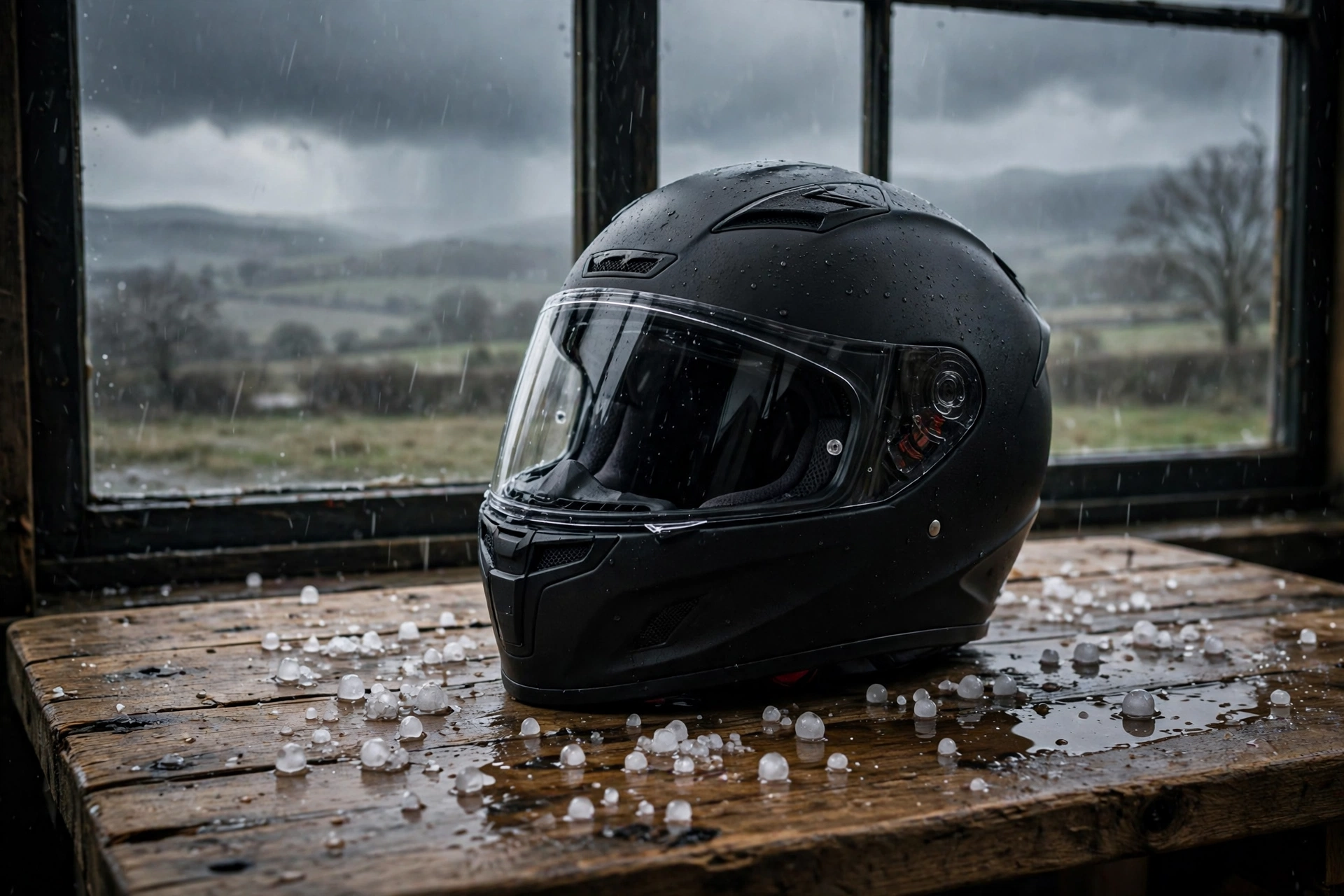
Hail is simply frozen rain, but the stones can range in size from tiny pellets to lumps as large as golf balls. When hail hits a helmet, the hard outer shell takes the impact first. In general terms, a good helmet shell is made to spread the force of a blow across a wider area, and that is exactly what happens when a hailstone strikes it. The shell may pick up small dents or scuffs from larger stones, but for most hail it should hold up well.
The visor is the part of the helmet most likely to suffer in a hailstorm. A clear visor can be scratched or chipped by hailstones, especially if you are moving fast and the stones are hitting it head-on. Scratches on a visor may seem minor, but they can scatter light and make it harder to see, particularly at night or in low sun. If your visor is badly chipped, it is worth replacing it rather than riding with reduced vision.
Can a Helmet Protect Your Head in a Hailstorm?
In general terms, yes. A helmet covers the top, sides, and back of your head, and that coverage is exactly where hail would otherwise strike. Small and medium hailstones that would bruise or cut bare skin will mostly bounce off a hard helmet shell. For a cyclist or motorcyclist caught in a sudden shower of small hail, putting the helmet on and keeping it on is one of the best things you can do.
That said, a helmet does not cover everything. Your face, neck, hands, and arms are still exposed, and hailstones can sting or bruise them badly. A full-face helmet with the visor down offers more protection than an open-face helmet or a cycling helmet, because it shields your face and jaw as well. Even with a full-face helmet, though, hail can still hit your neck and shoulders, and at speed those impacts can be painful enough to distract you.
It also helps to slow down. At higher speeds, hailstones hit with much more force, because your speed adds to the speed of the falling stones. Slowing right down reduces the impact of each stone and gives you more time to react if the road surface changes. If you are learning how helmets handle different kinds of impact, reading about what MIPS is for helmets can help you understand one of the technologies used in modern helmet design.
What Are the Limits of Helmet Protection in Hail?
The biggest limit is the size of the hailstones. Small hail, roughly the size of peas, is unlikely to damage a helmet or hurt a helmeted rider much. Larger hailstones, on the other hand, carry far more energy, and a stone the size of a golf ball falling from a storm cloud can hit with serious force. In general terms, no ordinary helmet is rated or tested for direct hits from very large hailstones, so it would be wrong to assume that a helmet makes you safe in a severe hailstorm.
There is also the road to think about. Hail does not just fall on you; it also falls on the road, where it can build up into a slippery layer very quickly. A road covered in hail behaves a little like a road covered in loose gravel or ice, and braking distances grow sharply. A helmet cannot help with that at all, which is why the safest response to heavy hail is usually to stop rather than to keep riding and rely on your helmet.
What Should You Do If You Are Caught in Hail?
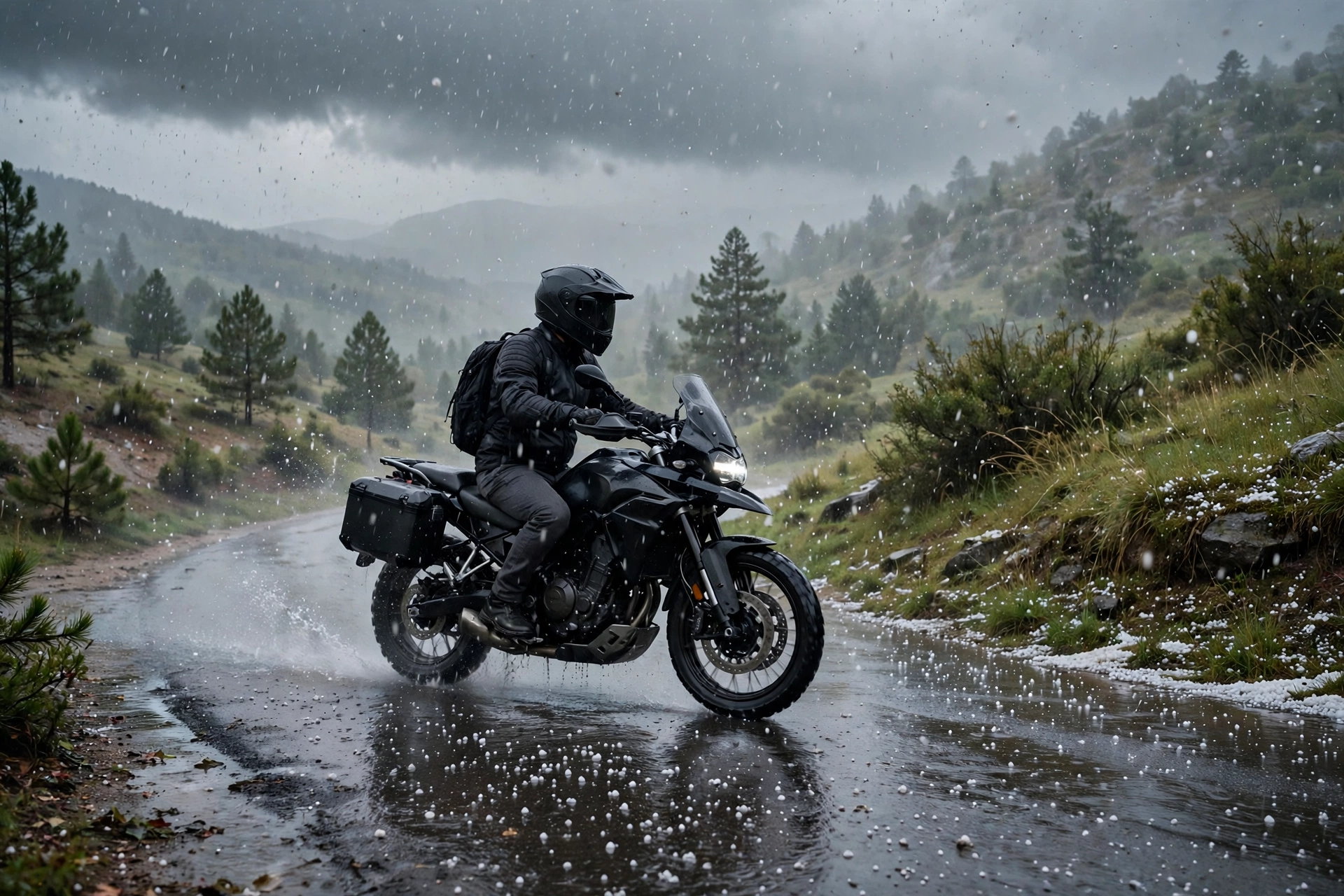
The first thing to do is slow down smoothly. Do not brake hard, because the road may already be slippery with hail and water, and sudden braking can cause a skid. Ease off the throttle, keep the bike upright, and look for a safe place to pull over. A petrol station canopy, a bridge, a car park, or any solid overhead cover is ideal.
If you cannot find cover straight away, keep your visor down and your head tucked slightly to reduce the area hail can hit. If you are wearing a cycling helmet, pull any jacket or extra layer you have over your neck and shoulders. Keep both hands on the handlebars and avoid sudden steering movements, because a hail-covered road can be unpredictable.
Does Hail Damage a Helmet Enough to Replace It?
In most cases, no. A hailstorm that leaves your helmet with a few scuffs or light scratches has not destroyed it, and the helmet should still protect you in a crash. The shell is built to take impacts far harder than a typical hailstone, and cosmetic marks on the outside do not mean the protective foam inside has been damaged. A quick visual check is usually enough after a light hailstorm.
There are exceptions, though. If the hail was very large and your helmet has deep dents, cracks, or a visor that is badly chipped, you should take the damage seriously. A crack in the shell can weaken the helmet, and a badly damaged visor can reduce your vision. In that case, it is sensible to have the helmet checked by a dealer or to replace the damaged parts, and to consider replacing the helmet if the shell itself is cracked.
Frequently Asked Questions
Q: Will a helmet protect me from large hailstones?
A: In general terms, a helmet helps against small and medium hail, but no ordinary helmet is designed to stop very large hailstones. In a severe hailstorm, the safest choice is to find solid cover and wait it out rather than relying on the helmet alone.
Q: Can hail crack a motorcycle helmet visor?
A: Yes, large or fast-moving hailstones can chip or crack a visor, especially if you are riding at speed. Check the visor after a hailstorm and replace it if the damage affects your vision.
Q: Should I replace my helmet after a hailstorm?
A: Usually not. Light scuffs from small hail do not mean the helmet is ruined. Replace it only if the shell is cracked or deeply dented, or if the visor is too damaged to see through clearly.

Olivia
Writer at Helmet Today, covering helmet reviews, fit and riding safety.