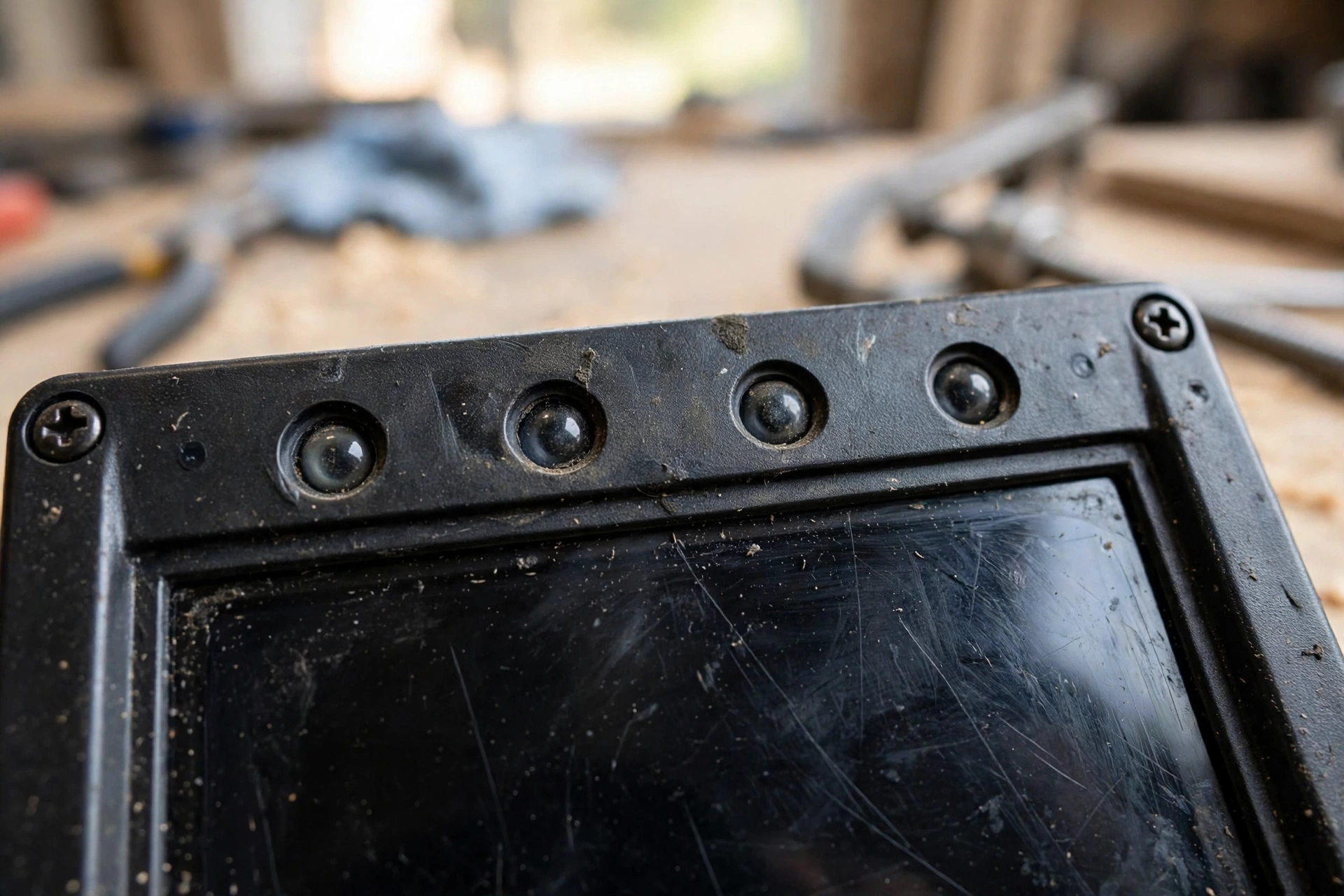
For most welders, four arc sensors is the safer choice; two sensors are enough only for simple bench work where the arc is always in clear view of the helmet. The sensors are the small windows on the front of an auto-darkening filter that “see” the arc flash and trigger the lens to darken. What matters is not the number by itself, but how hard it is for something — a pipe wall, a car panel, your own hand — to block every sensor at the same moment you strike the arc.
Sensor counts are one of the first specs buyers compare, and one of the least explained. This guide covers what the sensors do, why placement matters as much as count, and which kind of welding genuinely needs four.
What Do Arc Sensors Actually Do?
An auto-darkening helmet has to react in a fraction of a blink. The sensors are photodiodes that detect the sudden burst of light and UV from an arc and send the signal that switches the filter from its light state to its dark shade. In general terms, this happens almost instantly on any decent helmet — the switching speed is rarely the weak point.
The weak point is line of sight. A sensor can only trigger on an arc it can actually see. If the arc is hidden from the sensor — behind the workpiece, behind a clamp, behind your glove — the sensor sends nothing, and the lens can stay light or flicker for the moment the arc starts. That brief flash is exactly what the helmet exists to prevent.
This is why every sensor on the filter works independently: the lens only needs one sensor to catch the arc. More sensors simply mean more independent chances that at least one has a clear view.
Why Does Sensor Placement Matter as Much as the Count?
Four sensors clustered together in the middle of the filter behave almost like one sensor. What gives a four-sensor helmet its advantage is spread: sensors positioned toward the corners of the viewing area look at the arc from different angles, so a single obstruction rarely blocks them all.
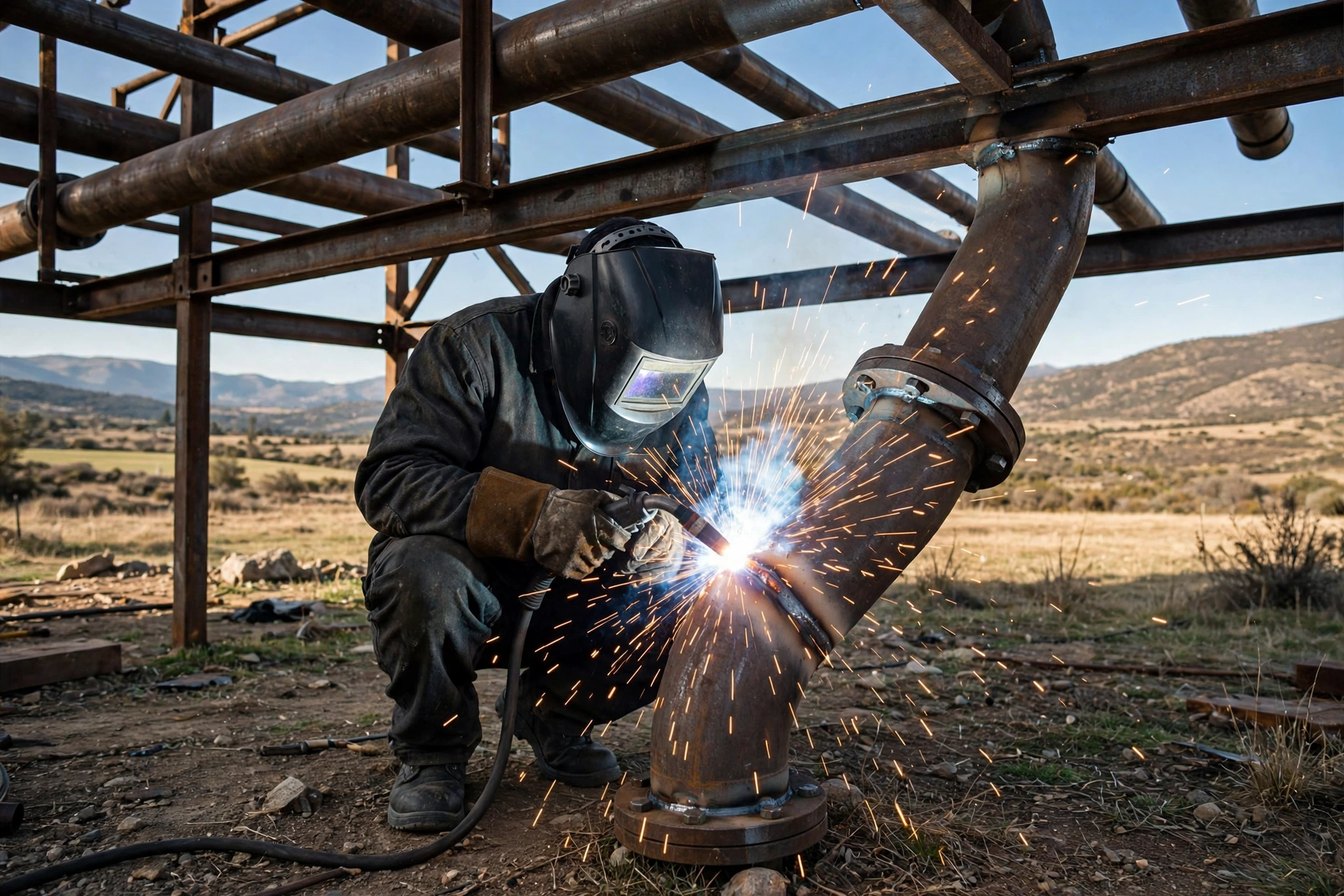
Think about welding a pipe joint. The curve of the pipe, the ground clamp and the torch itself all sit between the arc and parts of your filter. A sensor on the far corner can still see the arc start even when the near ones are shadowed. The same logic applies when you are lying under a car, reaching around a frame rail, or welding inside a cabinet or machine housing.
Placement also interacts with your own body position. Welders shift, lean and reposition constantly, and each shift changes which parts of the filter face the arc directly. A wider spread of sensors keeps the triggering reliable across all those small movements.
When Are Two Sensors Enough?
Two sensors are perfectly serviceable for the classic workshop setup: flat or gently curved work on a bench, with you standing or sitting squarely in front of it and nothing between your helmet and the weld. Fabrication benches, practice coupons, gate and frame projects in a home garage — in these conditions the arc is almost always in open view of both sensors.
Many good helmets ship with two sensors, and plenty of professionals used them for years on bench work. The count alone does not make a helmet good or bad; a well-made two-sensor helmet with clean sensors and sensible settings will out-trigger a neglected four-sensor one.
The honest test is your work, not the spec sheet. If your welding is nearly all open bench work, two sensors are a reasonable place to save money. If you regularly weld in awkward positions, the calculation changes.
When Do Four Sensors Earn Their Keep?
Four sensors earn their keep whenever the arc can be partially hidden: pipe and tube work, automotive welding under or inside a vehicle, welding around brackets and gussets, and any out-of-position work overhead or vertical where your arms and the workpiece crowd the filter’s view.
Low-amperage TIG is the other case worth knowing. A small, stable TIG arc is a weaker signal than a crackling stick arc, and sensors near the edge of their view may miss it in general terms. Extra sensors, combined with a sensitivity setting tuned for TIG, make triggering noticeably more consistent.
If you are upgrading from a two-sensor helmet and wondering whether you will feel the difference, the answer is that you mostly will not — when things go right. The difference shows up in the flashes that do not happen: the starts that darken cleanly even though your torch hand was in the way.
What Else Affects Reliable Triggering?
Clean sensors, first of all. Spatter dust and shop grime film over the sensor windows just as they cloud a cover lens, and a dirty sensor is a half-blind one. Wipe the filter face and sensor windows whenever you clean or change the cover lens.
Sensitivity settings come second. Sensitivity controls how much light a sensor needs before it triggers. Set it too low and a faint arc may not trip it; set it too high and bright shop lights or a colleague’s arc across the room can trip it when you do not want it dark. Dial it in for the process you are running, especially for low-amp TIG.
Finally, remember the sensors need a moment of honest testing. Before the first arc of a session, trigger the lens with a bright light or the helmet’s test routine if it has one, and confirm it darkens evenly. A sensor count on a spec sheet means nothing if one of the sensors has failed silently.
Sensor layouts are a good reminder that protective gear only works in the position you actually use it — the same principle riders rely on with features like MIPS rotational protection in bike and motorcycle helmets, where coverage and fit decide how much of the technology’s benefit you really get. In the welding shop, that means matching the sensor spread to the angles you actually weld at.
Frequently Asked Questions
Q: Can I add more sensors to my existing helmet?
A: No. The sensors are built into the auto-darkening filter, and the filter is a sealed unit. If you need wider sensor coverage, the upgrade is a different filter or a different helmet, not an add-on part.
Q: Do four sensors make the lens darken faster?
A: In general terms, no — switching speed is a property of the filter electronics and is fast on any quality helmet. Extra sensors improve the chance that at least one sensor sees the arc at all, which is a reliability gain, not a speed gain.
Q: How do I know if one of my sensors has failed?
A: Test the helmet before use and watch for uneven darkening or missed triggers from certain angles. Cover each sensor in turn with a fingertip while triggering the lens with a bright light — if the lens stops triggering when one particular sensor is the only one exposed, that sensor may be dead and the filter should be replaced.

Olivia
Writer at Helmet Today, covering helmet reviews, fit and riding safety.