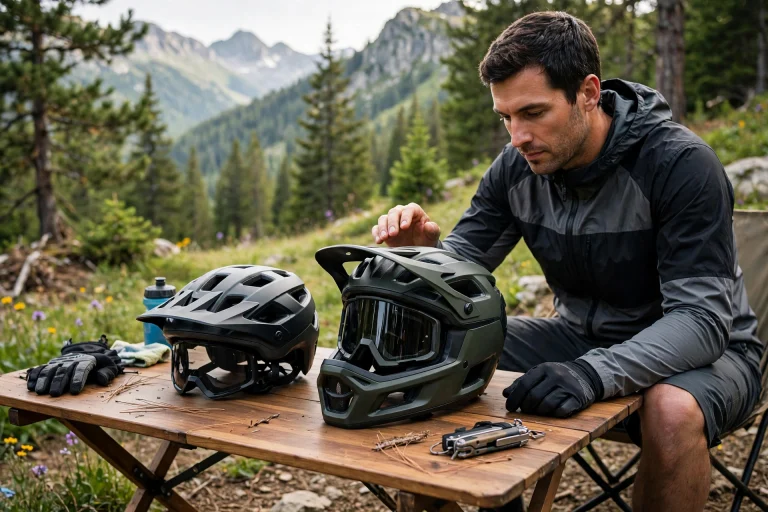
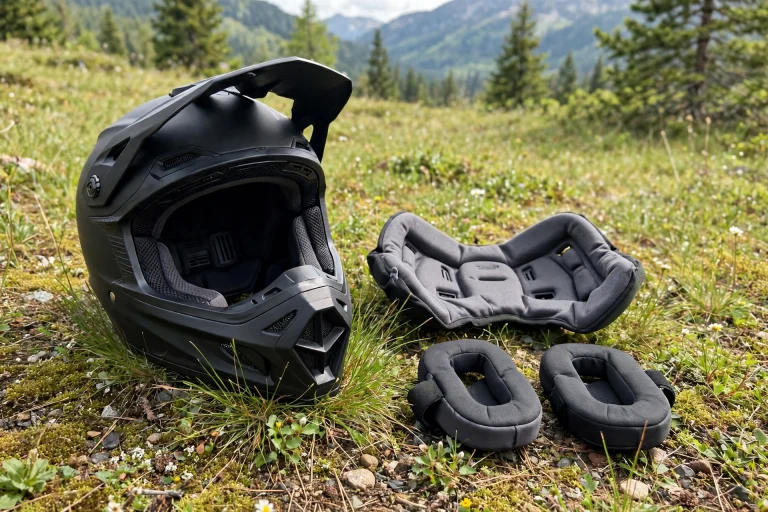
Adjust bike helmet straps so the side straps form an even V under each ear with the slider sitting just below your earlobe, and the chin strap is centered and snug enough to fit only one or two fingers underneath. That geometry — even Vs, centered buckle, firm tension — is what keeps the helmet level and in place during a fall. If the helmet can slide forward, backward, or sideways when you push it, the straps need work.
Strap adjustment confuses riders because the pieces interact: change the chin strap length and the sliders move; move a slider and the tension balance shifts. Work in the order below — side straps first, chin strap second, final check last — and the whole job takes a few minutes.
How Do You Set the Side Straps Into a V Under Each Ear?
Put the helmet on level, low on your forehead, and look at the side straps. On each side, one strap runs from the front of the helmet and one from the back, and they meet at a plastic slider (sometimes called a divider or lock). Together they should frame your ear in a V or Y shape, with the meeting point just below your earlobe and your ear inside the opening, untouched by webbing.
To adjust, open or loosen the slider — most slide along the straps with firm finger pressure, and some flip open — then feed strap through until the junction sits in the right place. Aim for symmetry: if the left V is tall and the right V is squashed, the helmet will sit and pull crooked. Ears should never be folded, pinched, or crossed by a strap, because discomfort guarantees the rider will loosen things later.

How Tight Should the Chin Strap Be?
Buckle the chin strap and pull the tail through the buckle until the strap sits flat and centered under your chin. The tension test: you should be able to slip one or two fingers between strap and chin, no more. Then open your mouth wide — the strap should pull the helmet noticeably down onto your head. If you can fit a whole hand’s width or the helmet barely moves, it is too loose.
Too loose is the dangerous direction. A slack chin strap lets the helmet rotate back off the forehead or come off entirely in a crash. Too tight is self-correcting, since nobody keeps riding with a strap that chokes — but check that the buckle sits in the center, not dragged to one side, because an off-center buckle usually means the two sides are unevenly tensioned. A small pad or strap cover, if your helmet has one, should sit under the buckle for comfort.
How Do You Even Out Tension and Manage Excess Strap?
With the helmet buckled, feel both sides. The left and right straps should feel equally taut when you tug them, and the helmet should sit straight without a tilt. If one side is slack, adjust at the slider or where the strap anchors, a little at a time, re-checking in a mirror. Feed excess chin strap tail through the rubber keeper ring or loop most helmets provide, so the tail does not flap, tickle, or work the buckle loose.
Do not cut a long strap tail unless your helmet’s manual explicitly describes it — a too-short strap cannot be un-cut, and frayed cut ends can slip through keepers. If a strap is genuinely far too long even at proper tension, that can be a sign the helmet is the wrong size or the straps were mis-threaded after washing; re-check the routing against the manual before reaching for scissors.
When Should You Re-Check Bike Helmet Strap Adjustment?
Any time something changes. After washing the pads and straps, because webbing stretches slightly when wet and sliders migrate while you handle them. After the helmet has been borrowed, dropped in a gear bag, or adjusted by someone else. And for children, on a regular schedule — growing heads change the geometry, and a V that framed a seven-year-old’s ear perfectly can ride up over it within a season. Kids’ straps should be checked every few weeks and always at the start of a riding season.
Also re-check whenever the fit feels different mid-ride-week: straps that keep needing tightening may be slipping through a worn slider, and inner systems such as MIPS for helmets rely on the straps holding the shell in its designed position to do their job. A quick tug test before each ride — buckle up, push the helmet in four directions, confirm it grips — takes ten seconds and catches most problems early.
When Do Worn or Damaged Straps Mean Replacing the Helmet?
Straps and buckles are not usually replaceable parts on bike helmets, so serious strap damage ends the helmet’s life. Replace the helmet if the webbing is frayed, cut, sun-rotted, or stretched so it will not hold adjustment; if the buckle cracks, fails to click positively, or releases under a firm tug; or if a slider is broken or will not grip the strap. These are structural components, and a helmet that cannot stay on cannot protect.
The same applies if the strap anchors — where webbing attaches inside the shell — are pulling loose or the surrounding foam is damaged. Do not attempt repairs with stitching, glue, or replacement webbing from another product; none of it restores tested performance. Strap failure is uncommon on a well-kept helmet within its 3-to-5-year service life, which is one more reason to treat visible strap wear as the helmet’s final warning.
Frequently Asked Questions
Where exactly should the strap slider sit?
Just below your earlobe, with your ear sitting inside the V formed by the front and back straps. If the slider is up beside your ear or down on your jawline, the geometry is off and the helmet will not sit level.
How do I stop my helmet straps from twisting?
Lay the straps flat each time you put the helmet on, and run your fingers along the webbing from the shell to the buckle to smooth twists out before fastening. Persistent twisting usually means a strap was re-threaded incorrectly after cleaning — check the routing in the manual.
My child’s helmet straps keep loosening. What should I do?
First, confirm the slider is locked or fully closed — many kids’ helmets have locking dividers. If it still slips, the slider may be worn. Do not knot the straps; if the hardware cannot hold adjustment, replace the helmet.

Olivia
Writer at Helmet Today, covering helmet reviews, fit and riding safety.