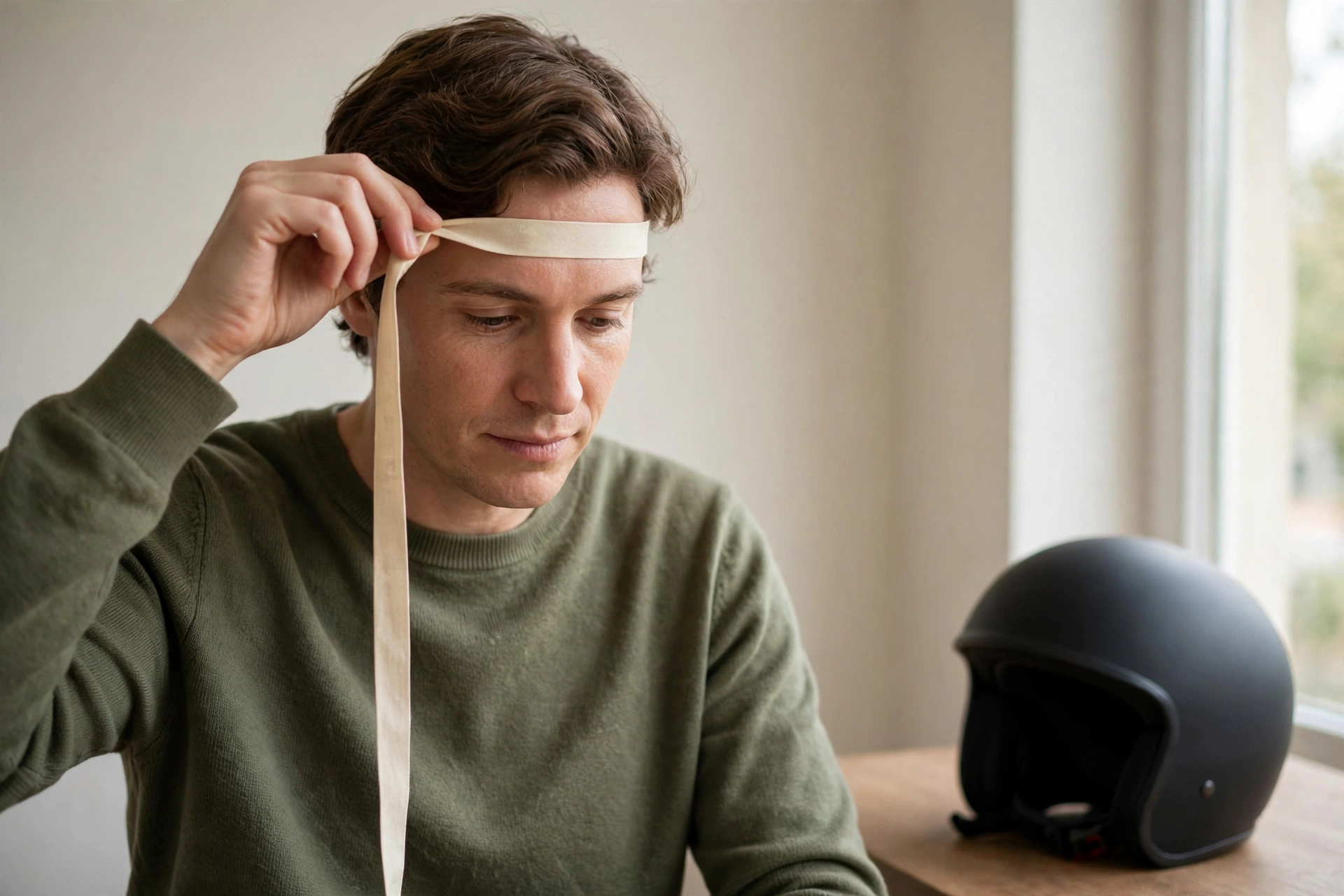
To measure for a scooter helmet, wrap a soft measuring tape around the largest part of your head — roughly an inch (about 2.5 cm) above your eyebrows and just above your ears — keep it level and snug, and read the circumference. Then match that number to the size chart of the exact helmet model you want to buy. Ordering by measurement, not by the size label you wore in another brand, is what gets the fit right.
Scooter helmets come in open face, jet and full face styles, and every brand cuts its shells a little differently. A “medium” in one make can feel a size away from a medium in another. Your head circumference is the one number that translates across all of them, so it is worth taking the two minutes to measure properly.
Where Exactly Should the Tape Sit?
The tape should circle the part of your head with the greatest circumference, because that is the part the helmet has to pass over and grip. Position it across your forehead about an inch above your eyebrows, pass it just above the tops of your ears, and bring it around the back of your head at the widest point. Keep it level all the way around — a tape that rides up at the back will read small.
Pull it snug, so it sits against your hair without slack, but not so tight that it dents the skin. If you have thick or long hair, measure with your hair roughly as you will wear it under the helmet. Take the measurement two or three times and use the largest consistent reading; small differences change which size you should order.
No flexible tape? Wrap a piece of string, a ribbon or a phone charging cable around your head in the same position, mark where it meets, then lay it flat against a ruler. It is the same measurement — just avoid anything stretchy, which will read long.
What Does Your Measurement Mean on a Size Chart?
Helmet sizes are sold against circumference ranges, usually printed in centimeters, inches, or both. In general terms, adult sizes run from extra small at the low end through to extra large and beyond, with each size covering a band of a few centimeters. Your job is simply to find the band your measurement falls into on that model’s chart.
A few chart-reading habits help:
- Use the chart for the exact model, not the brand’s generic chart — ranges differ between models.
- If you fall near the middle of a band, that size is usually the straightforward choice.
- If you fall at the very top of a band, expect a snug fit and pay attention to the between-sizes advice below.
- Remember that scooter helmets are often listed in motorcycle helmet sizing, which is the same circumference system used for full face helmets.
Measuring in centimeters usually gives the cleanest match, because most charts are built in centimeters first and converted to inches second. If your tape only shows inches, convert carefully (multiply inches by 2.54) rather than rounding casually.

How Should a New Scooter Helmet Feel When You Try It On?
A correctly sized helmet feels snug all the way around, with firm, even pressure and no single painful hotspot. The cheek pads on a full face or jet helmet should press your cheeks noticeably — new pads are supposed to feel firm, and they relax slightly with use. The helmet should not rotate freely when you shake your head, and it should not slide down over your eyes when you nod.
Wear it for at least ten to fifteen minutes indoors if you can. A helmet that feels fine for thirty seconds can develop a forehead pressure point by minute ten, and that point will not improve on the road. Check that the helmet sits level, with the front edge low on your forehead rather than tipped back like a cap.
Fit is also what makes the helmet’s safety features work as intended. The energy-absorbing liner only manages an impact properly if the helmet stays in position, and modern features such as MIPS rotational protection are designed around a helmet that grips the head evenly rather than wobbling. Snug and stable is the goal; painful is too far.
Why Do Sizes Run Differently Between Brands and Styles?
Two reasons. First, head shape. Helmets are built on different internal shapes — some rounder, some longer front-to-back — and brands design for the head shapes most common in their home markets. Two helmets with the same circumference range can press in completely different places on your head.
Second, shell and style differences. An open face scooter helmet, a jet helmet with a long visor, and a full face helmet from the same brand can each use different shells and pad thicknesses, so the effective fit shifts even within one maker’s range. Some models also come in several shell sizes across the range, while others use one shell with different pads, which changes how each size feels.
The practical lesson is that your measured circumference gets you to the right neighborhood, but trying the helmet on — or ordering from somewhere with easy returns — settles it. If a helmet in your measured size pinches your forehead but feels loose at the sides, that is a shape mismatch, not a sizing error, and another brand will likely suit you better.
What If Your Measurement Falls Between Two Sizes?
Between sizes is common, and the usual advice is to start with the smaller size if it is comfortable, because comfort pads compress a little over the first weeks of use and a helmet that starts slightly loose only gets looser. A helmet should never be bought with growing room the way shoes sometimes are.
That said, “smaller” only works if there is no sharp pressure point and no headache developing during a longer try-on. If the smaller size hurts, go up and use the thicker cheek pads or liner options many makers offer to fine-tune the fit. Some brands sell alternative pad thicknesses precisely for this situation.
Never solve a between-sizes problem by wearing a hat or extra layers under the helmet, which changes how it sits and can let it shift in a fall. And if neither size in one model works, switch models rather than forcing it — head shape matching matters as much as the number on the chart.
Frequently Asked Questions
Q: Can I just order the same size as my bicycle helmet?
A: Use it as a starting guess only. Scooter and motorcycle helmets are shaped and padded differently from bicycle helmets, and sizes vary between brands. Measure your head and compare against the specific model’s chart before ordering.
Q: Should a new helmet feel tight?
A: Snug, yes; painful, no. Expect firm, even pressure and noticeably firm cheek pads, which ease slightly with use. Sharp pressure on the forehead, a developing headache, or numb spots mean the size or shape is wrong.
Q: How often should I re-measure?
A: Measure every time you buy, rather than trusting memory — and re-check fit if you change hairstyle significantly, gain or lose a lot of weight, or notice your current helmet moving around. Pads also compress over the years, so an old helmet can feel looser than it did when new.

Olivia
Writer at Helmet Today, covering helmet reviews, fit and riding safety.